All species › Passerines › Tapaculos › Trilling Tapaculo
Trilling Tapaculo | Scytalopus parvirostris
Zwartgrijze tapaculo | Churrín trinador | Macuquinho-trinador
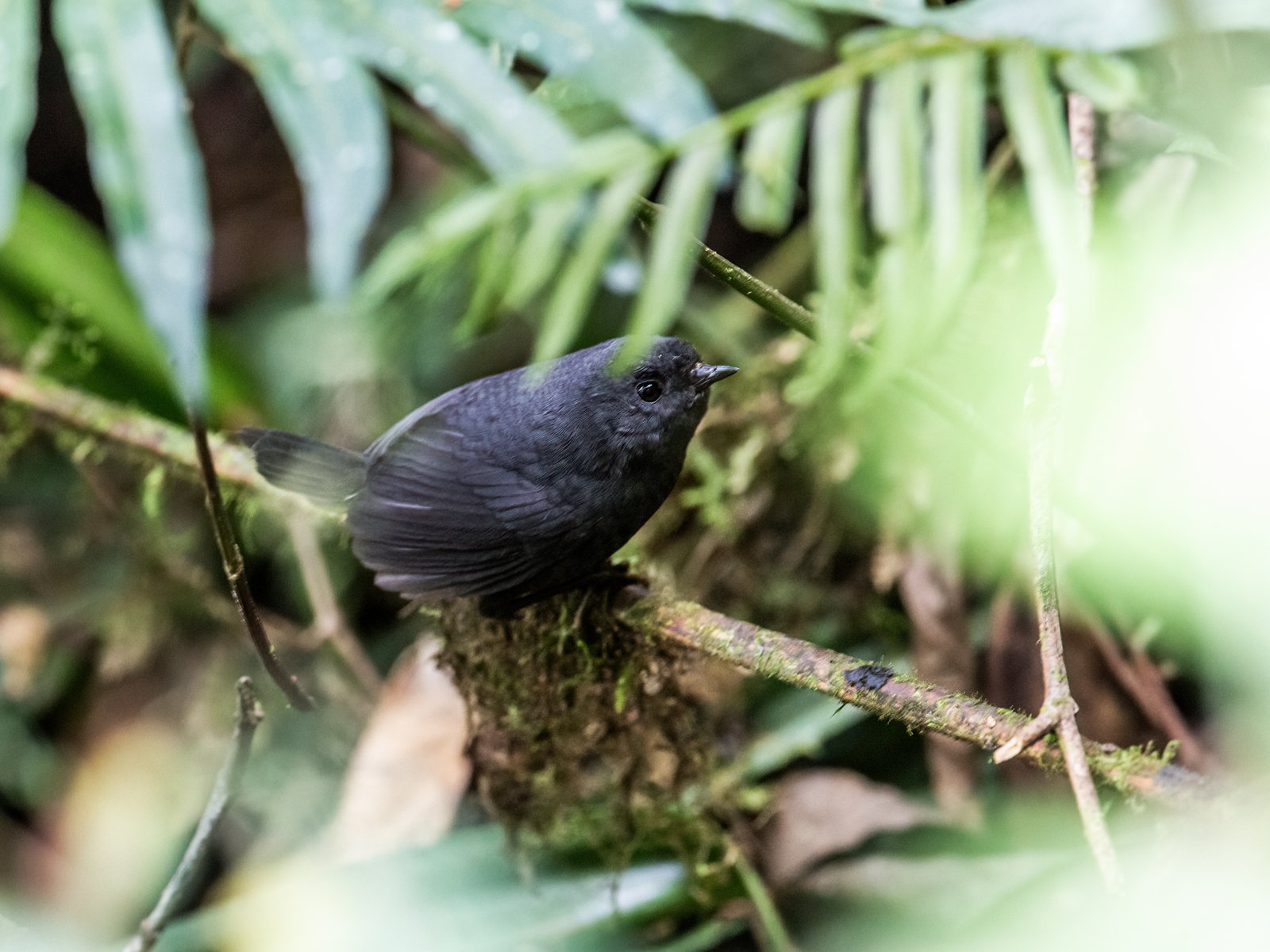
The Trilling Tapaculo is a small, dark grey tapaculo of the undergrowth of humid montane forest on the eastern slope of the Andes in Peru and Bolivia. The English and Spanish names refer to its long, fast trill, which is its main field character. It was formerly treated as a subspecies of Unicolored Tapaculo and was recognised as a separate species mainly on the basis of its song.
Voice
The song is a long, fast, dry trill; its speed varies regionally, from about 14 notes per second in southern Peru to more than 20 in central Peru and Bolivia. There is also a shorter, scolding version of the trill and a single-note call.
Recording: Jerome Fischer — CC BY-NC-SA 4.0 · xeno-canto
Identification
10–11 cm, with a thin, small bill (parvirostris means 'small-billed'). The male is dark grey above and paler grey below, sometimes entirely dark grey; the flanks and undertail coverts are dark rufous-brown with dusky bars. The female resembles the male but is paler, with a dark brown wash. Juveniles resemble the female but look scaly because of yellowish feather edges.
Confusion species
Bolivian Tapaculo Scytalopus bolivianus usually lives lower, up to about 2300 m, and the male often has white on the crown. Puna Tapaculo Scytalopus simonsi and Diademed Tapaculo Scytalopus schulenbergi live higher, at the treeline; Diademed Tapaculo has a silvery-white forecrown and eyebrow. White-crowned Tapaculo Scytalopus atratus in central Peru is larger, with a white crown patch, and lives lower.
Habitat
Undergrowth of humid montane forest and cloud forest, also at forest edges with dense vegetation; in Peru at roughly 1800 to 2500 m, in Bolivia 2000 to 3300 m. It forages alone or in pairs on or just above the ground for small invertebrates. Little is known about its diet and breeding.
Where the bird is most at home, classified by the vegetation units of the Andes and the west coast.


Range and movements
Absent from Colombia and Ecuador. In Peru on the eastern slope from southern Amazonas south-east to Puno. In Bolivia on the eastern slope through La Paz and Cochabamba to western Santa Cruz. Absent from the Galápagos. Does not occur outside the guide area.
- Resident
- dark = core range, pale = thinly spread
How and when to look
Listen in cloud-forest undergrowth along roads on the eastern slope, such as the Manu road in Cusco and the roads through the Yungas of La Paz, for the long trill. The bird often sings from a low branch or fallen log inside dense cover.
Conservation status
Least Concern. The range is large; the population has not been counted but is considered fairly large and stable.
Scientific name
Scytalopus parvirostris | Zimmer, 1939
Zimmer described the species in 1939 and placed it straight away in the genus where it still stands. The genus Scytalopus was introduced in 1837 by Gould. The genus name combines Greek skutalē or skutalon, 'stick', with pous, 'foot'. The species name comes from Latin parvirostris, from parvus, 'small', and rostrum, 'bill': small-billed. The specimen the first description was based on came from Río Aceramarca, La Paz, Bolivia.