All species › Passerines › Tapaculos › Neblina Tapaculo
Neblina Tapaculo | Scytalopus altirostris
Elfenwoudtapaculo | Churrín de neblina | Macuquinho-da-neblina
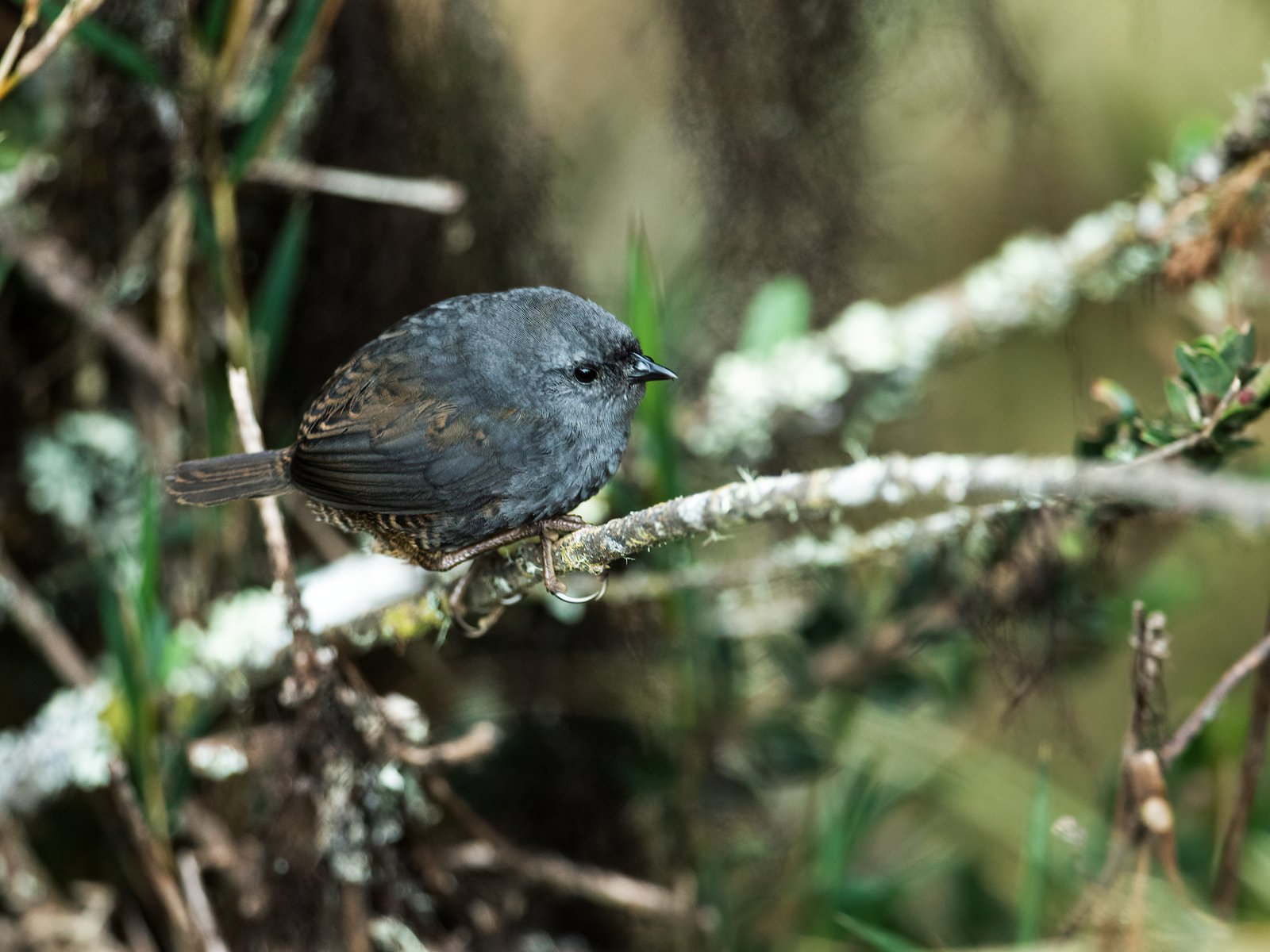
The Neblina Tapaculo is a small tapaculo of wet, misty elfin forest at the treeline on the Eastern Andes of northern and central Peru. It was described in 1939 as a subspecies of Magellanic Tapaculo and was raised to species rank in 1997 on the basis of its song. The English and Spanish names (neblina, mist) refer to its habitat.
Voice
A rapid series of descending, dry, churring phrases, often sustained for a long time from dense cover.
Recording: Andrew Spencer — CC BY-NC-SA 3.0 · xeno-canto
Identification
10–12 cm, round and short-tailed. The male is grey above, with a brown wash on the nape; the lower back and rump are brown with black bars. The underparts are paler grey, the flanks and undertail coverts ochre-brown with black barring. The female resembles the male but is browner above. Juveniles, as in related tapaculos, are browner and densely barred.
Confusion species
Jalca Tapaculo Scytalopus frankeae lives further south, mainly in open jalca, and the male has a silvery eyebrow. Trilling Tapaculo Scytalopus parvirostris lives lower, in montane forest up to about 2500 m, and sings a long, fast trill. Tschudi's Tapaculo Scytalopus acutirostris lives in similar forest in central Peru and sings differently. In this area tapaculos are separated mainly by voice and range.
Habitat
Elfin forest, the low, mossy cloud forest at the treeline, and the forest edge towards the grassland above, at roughly 2900 to 3700 m, in a very wet and misty climate. It lives on or just above the ground in dense vegetation and presumably feeds on insects. Almost nothing is known about its breeding; a juvenile has been recorded in July.
Where the bird is most at home, classified by the vegetation units of the Andes and the west coast.


Range and movements
Only in Peru, on the Eastern Andes from southern Amazonas to central Huánuco. Absent from Colombia, Ecuador, Bolivia and the Galápagos. Does not occur outside the guide area.
- Resident
- dark = core range, pale = thinly spread
How and when to look
Search high on the Eastern Andes, where roads or trails cross elfin forest at the treeline, and listen in mist or drizzle for the dry, churring series. The bird moves like a mouse through moss and shrubs and rarely comes into the open.
Conservation status
Least Concern. The species lives in a narrow elevational belt in remote areas where the forest is largely intact; locally the treeline and grassland are affected by fires and grazing.
Scientific name
Scytalopus altirostris | Zimmer, 1939
Zimmer described the species in 1939 and placed it straight away in the genus where it still stands. The genus Scytalopus was introduced in 1837 by Gould. The genus name combines Greek skutalē or skutalon, 'stick', with pous, 'foot'. The species name comes from Latin altirostris, from altus, 'high', and rostrum, 'bill': high-billed. The specimen the first description was based on came from Atuén, Amazonas, Peru.