All species › Passerines › Tapaculos › Jalca Tapaculo
Jalca Tapaculo | Scytalopus frankeae
Jalcatapaculo | Churrín de la jalca | Macuquinho-da-jalca
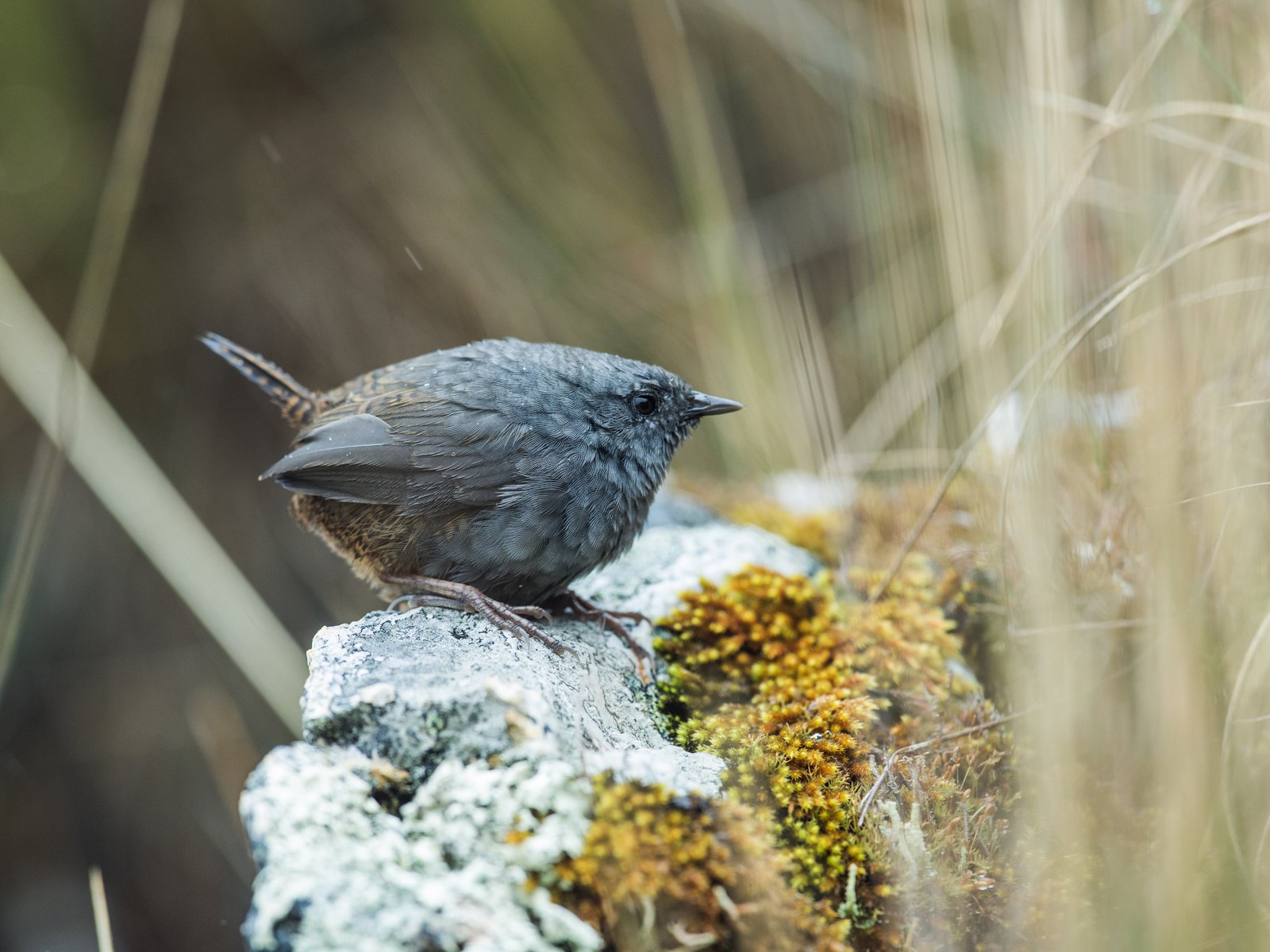
The Jalca Tapaculo is a small tapaculo of high-elevation grassland with shrubs in central Peru, described as a species in 2020. It lives hidden in dense bunchgrass and low shrubs in ravines and on steep, rocky slopes. Jalca is the local name for this humid grassland above the treeline; the scientific name honours the ornithologist Irma Franke, who contributed much to Peruvian ornithology.
Voice
A long series of regularly repeated, reverberating churrs (trrr), in bouts that can last several minutes. The songs of northern and southern birds differ slightly. There are also two simple calls.
Recording: GABRIEL LEITE — CC BY-NC-SA 4.0 · xeno-canto
Identification
10–11 cm, round and short-tailed. The male has a dark grey crown and a mostly dark grey face, with a silvery-white eyebrow of variable size; some males have a silvery crown. The nape and mantle are dark grey washed rufous-brown, the lower back and rump cinnamon-brown with blackish, curved bars. The throat and belly are pale grey, the breast darker grey, the rear flanks and undertail coverts tawny-brown with blackish markings. The female resembles the male but is browner, from cinnamon-brown to olive-brown.
Confusion species
Ampay Tapaculo Scytalopus whitneyi lives south of the Mantaro and mainly sings a series of identical single notes. Tschudi's Tapaculo Scytalopus acutirostris and Junin Tapaculo Scytalopus gettyae live in the same part of Peru, but mainly in humid montane forest below the jalca, and sing differently. Neblina Tapaculo Scytalopus altirostris lives further north in misty elfin forest and lacks the silvery eyebrow.
Habitat
Jalca: dense bunchgrass with scattered shrubs, especially in ravines and on steep, rocky slopes not grazed by livestock; also at the edge of treeline forest, in Polylepis woodland and in evergreen riparian forest, at roughly 3400 to 4200 m. It lives on the ground in dense vegetation and presumably feeds on small invertebrates. Little is known about its breeding.
Where the bird is most at home, classified by the vegetation units of the Andes and the west coast.


Range and movements
Only in Peru, in two areas about 150 km apart: in Huánuco and Pasco, bounded by the Huallaga, and in Junín, bounded by the Mantaro. Absent from Colombia, Ecuador, Bolivia and the Galápagos. Does not occur outside the guide area.
- Resident
- dark = core range, pale = thinly spread
How and when to look
The species has been recorded at the type locality of Millpo in Huánuco and in ungrazed, shrubby ravines in the jalca of Junín; listen in the early morning for the churring series lasting several minutes. Singing birds usually sit low in a grass tussock or shrub.
Conservation status
Not Evaluated. The range is small. In the north the species is scarce in many places because of heavy grazing; in the south, where fewer people live, it is more common. The describers considered it Least Concern.
Scientific name
Scytalopus frankeae | Rosenberg, Davis, Rosenberg, Hosner, Robbins, Valqui H & Lane, 2020
Rosenberg, Davis, Rosenberg, Hosner, Robbins, Valqui H & Lane described the species in 2020 and placed it straight away in the genus where it still stands. The genus Scytalopus was introduced in 1837 by Gould. The genus name combines Greek skutalē or skutalon, 'stick', with pous, 'foot'. The species name frankeae honours Irma Franke, Peruvian ornithologist and major contributor to recent Peruvian ornithology, who took part in the expedition that discovered the species in 1985. The specimen the first description was based on came from Millpo, Huánuco, Peru.