All species › Passerines › Ovenbirds and woodcreepers › Vilcabamba Spinetail
Vilcabamba Spinetail | Cranioleuca weskei
Vilcabambastekelstaart | Curutié de Vilcabamba | Arredio-de-vilcabamba
The Vilcabamba Spinetail is a white-crowned spinetail of high-elevation cloud forest in the Cordillera Vilcabamba and adjacent mountains of central Peru. It was described in 1984 as a subspecies of Marcapata Spinetail and is still treated as such by some authorities. Where the two approach each other, no intermediate crown colours have been found.
Voice
The song is a series of high notes that, compared with Marcapata Spinetail, is shorter, faster and more uniform, with a descending shape. In the south of the range the song closely resembles that of Marcapata Spinetail.
No recording with a suitable Creative Commons licence is available for this species yet.
Identification
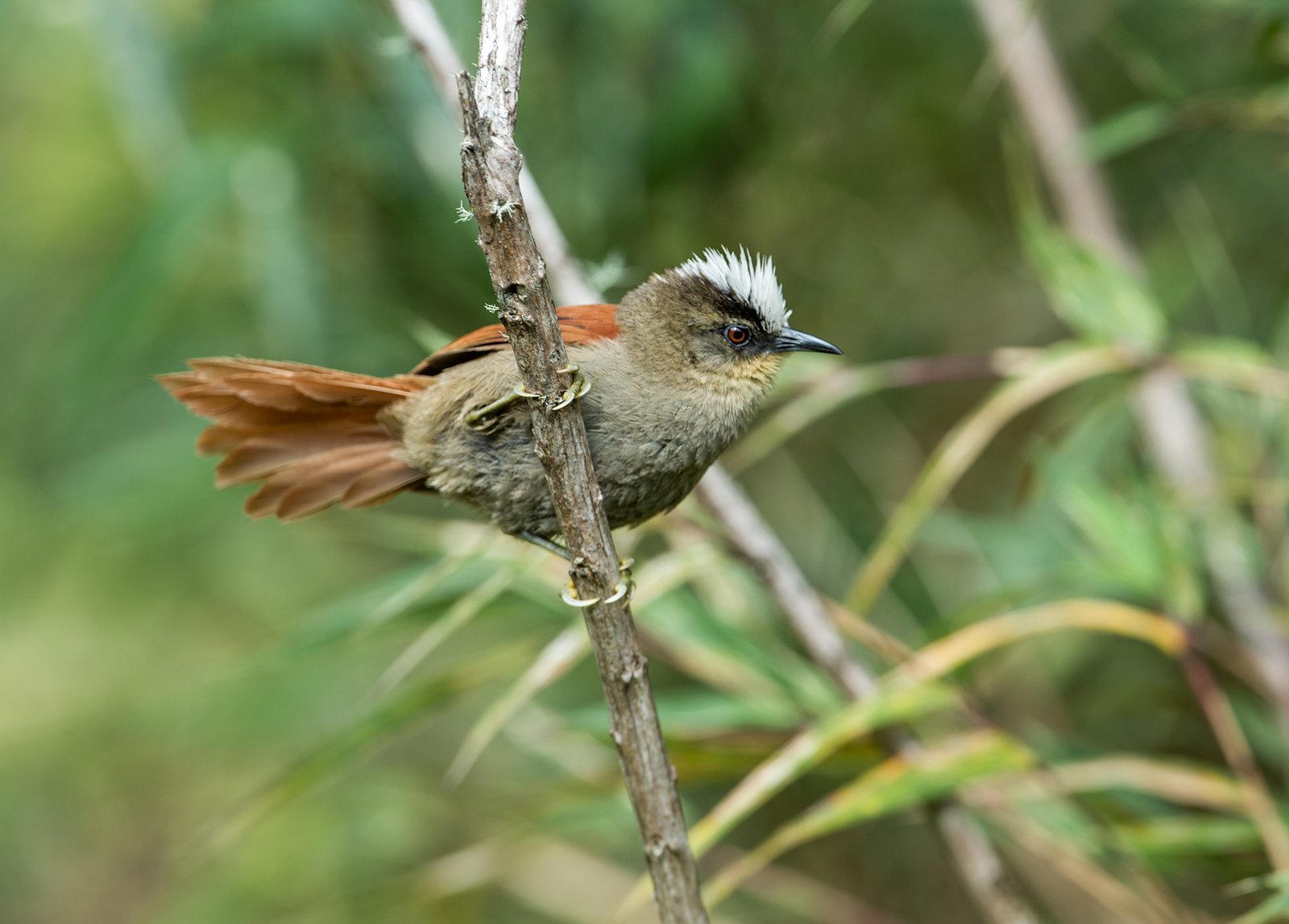
15–16 cm, with a straight, pointed bill and a graduated tail with spiny feather tips. The crown is white, sharply contrasting with the rufous back, wings and tail. The face and throat are buffy, the rest of the underparts greyish olive-brown. The sexes are alike.
Confusion species
Marcapata Spinetail Cranioleuca marcapatae to the south-east is almost identical, but has a rufous crown. Light-crowned Spinetail Cranioleuca albiceps also has a white crown, but lives far to the south-east, in Puno and Bolivia. Ash-browed Spinetail Cranioleuca curtata lives lower, with an olive-brown crown and a grey supercilium.
Habitat
Humid montane forest and high cloud forest, often with a Chusquea bamboo understorey, between about 2800 and 3600 m. It forages in pairs, often with mixed flocks, for arthropods in moss and epiphytes along branches. The nest has not been described; relatives build a hanging ball of moss.
Where the bird is most at home, classified by the vegetation units of the Andes and the west coast.


Range and movements
Colombia: absent. Ecuador: absent. Peru: endemic, in the northern Cordillera Vilcabamba in Cusco and Junín, and north of the Mantaro in Junín and in Ayacucho. Bolivia: absent. Absent from the Galápagos. Does not occur outside the guide area.
How and when to look
Much of the range lies far from roads. In Junín and Ayacucho, search along roads descending the eastern slope, in bamboo and cloud forest above 2800 m, and follow mixed flocks.
Conservation status
Least Concern. The range is small and largely remote; little is known about the population.
Scientific name
Cranioleuca weskei | Remsen, 1984
Remsen described the species in 1984 and placed it straight away in the genus where it still stands. The genus Cranioleuca was introduced in 1853 by Reichenbach. The genus name comes from Greek kranion, 'skull', and leukos, 'white'. The species name honours John S. Weske, American ornithologist and collector. The specimen the first description was based on came from Cordillera Vilcabamba, Cusco, Peru.