All species › Passerines › Ovenbirds and woodcreepers › Marcapata Spinetail
Marcapata Spinetail | Cranioleuca marcapatae
Marcapatastekelstaart | Curutié de Marcapata | Arredio-de-marcapata
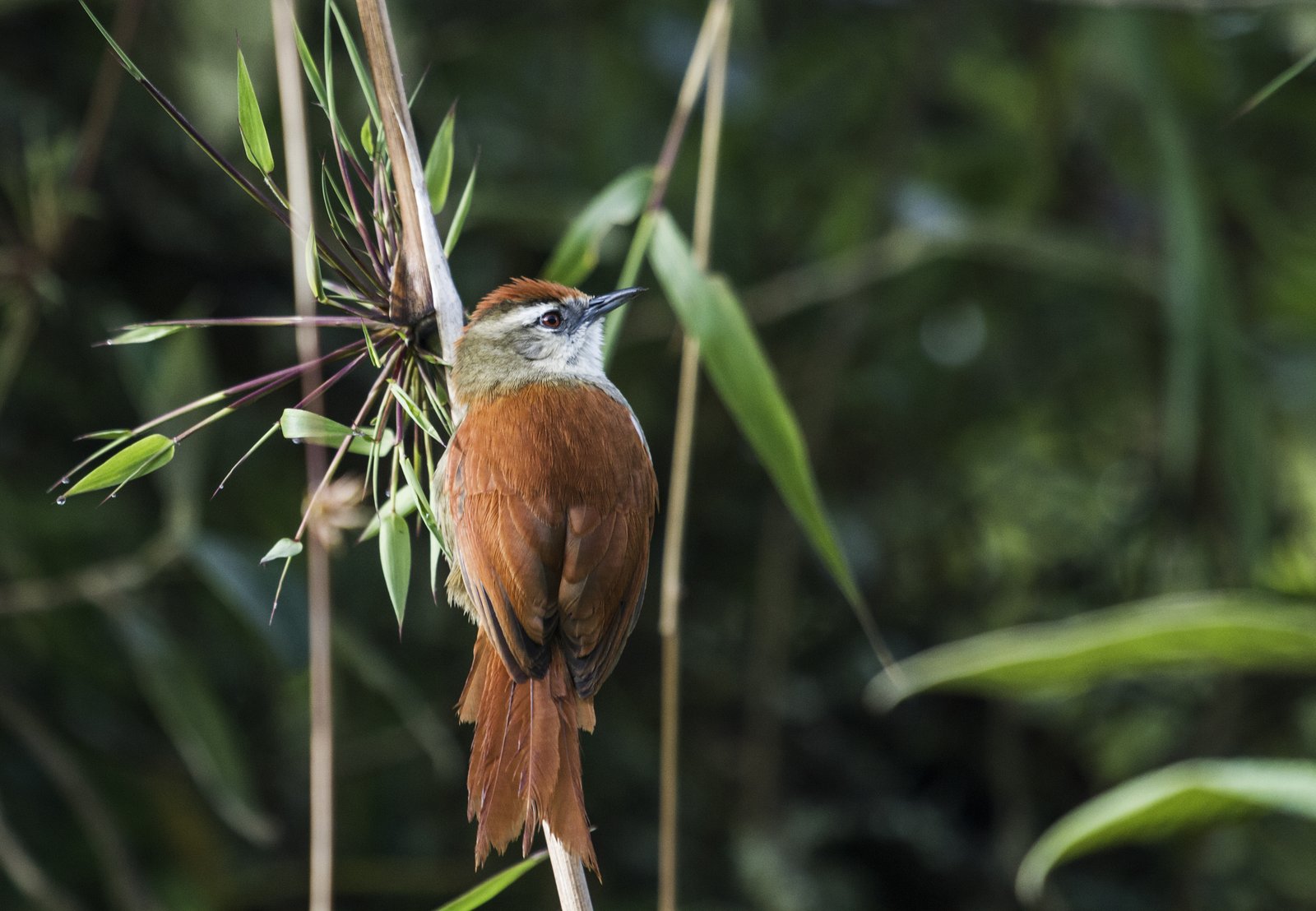
The Marcapata Spinetail is a rufous spinetail of bamboo-rich cloud forest in the Andes of Cusco, in south-eastern Peru. It occurs nowhere else. Unlike related species, its crown is the same rufous colour as the back.
Voice
The song is a thin, descending and accelerating series of high, liquid notes. Calls are a high tew-tik and tewp.
Recording: Herman van Oosten — CC BY-NC-SA 3.0 · xeno-canto
Identification
15–16 cm, with a straight, pointed bill and a graduated tail with spiny feather tips. The crown, back, wings and tail are rufous to chestnut, with a short crest. A pale supercilium; the face is greyish. The throat is paler, the rest of the underparts greyish olive-brown. The sexes are alike.
Confusion species
Vilcabamba Spinetail Cranioleuca weskei to the north-west has a white crown and a buffy face. Light-crowned Spinetail Cranioleuca albiceps in Puno and Bolivia also has a white to buff crown. Ash-browed Spinetail Cranioleuca curtata lives lower, with an olive-brown crown and back and a grey supercilium.
Habitat
The under- and mid-storey of humid evergreen montane forest, especially with dense Chusquea bamboo, between about 2400 and 3350 m. It forages in pairs or small groups, often with mixed flocks, for arthropods in moss, bromeliads and bark while hitching along branches, mostly 2 to 10 m above the ground. A nest attributed to this species was an oval ball of moss, bark strips and twigs hanging from a branch.
Where the bird is most at home, classified by the vegetation units of the Andes and the west coast.


Range and movements
Colombia: absent. Ecuador: absent. Peru: endemic, in Cusco, from the upper Urubamba drainage, including the southern Cordillera Vilcabamba near Machu Picchu, east to the Marcapata valley. Bolivia: absent. Absent from the Galápagos. Does not occur outside the guide area.
- Resident
- dark = core range, pale = thinly spread
How and when to look
Search bamboo in cloud forest above 2500 m in Cusco, for example along the road through the Marcapata valley. Watch mixed flocks; the bird hitches along mossy branches in the mid-storey.
Conservation status
Least Concern. The range is small and the population size unknown, but it is thought to be stable.
Scientific name
Cranioleuca marcapatae | Zimmer, 1935
Zimmer described the species in 1935 and placed it straight away in the genus where it still stands. The genus Cranioleuca was introduced in 1853 by Reichenbach. The genus name comes from Greek kranion, 'skull', and leukos, 'white'. The species name refers to Marcapata in south-eastern Peru. The specimen the first description was based on came from Marcapata, Cusco, Peru.