All species › Passerines › Ovenbirds and woodcreepers › Russet-mantled Softtail
Russet-mantled Softtail | Cranioleuca berlepschi
Berlepsch' stekelkruin | Colasuave dorsirrufo | Rabo-macio-de-manto-ruivo
The Russet-mantled Softtail is a rufous ovenbird of elfin forest at treeline in the Andes of northern Peru. It occurs nowhere else in the world. Long placed in the genus Thripophaga, genetic studies show it to be related to the spinetails of the genus Cranioleuca.
Voice
A short, descending, high-pitched chatter. Also gives short, high notes while foraging.
No recording with a suitable Creative Commons licence is available for this species yet.
Identification
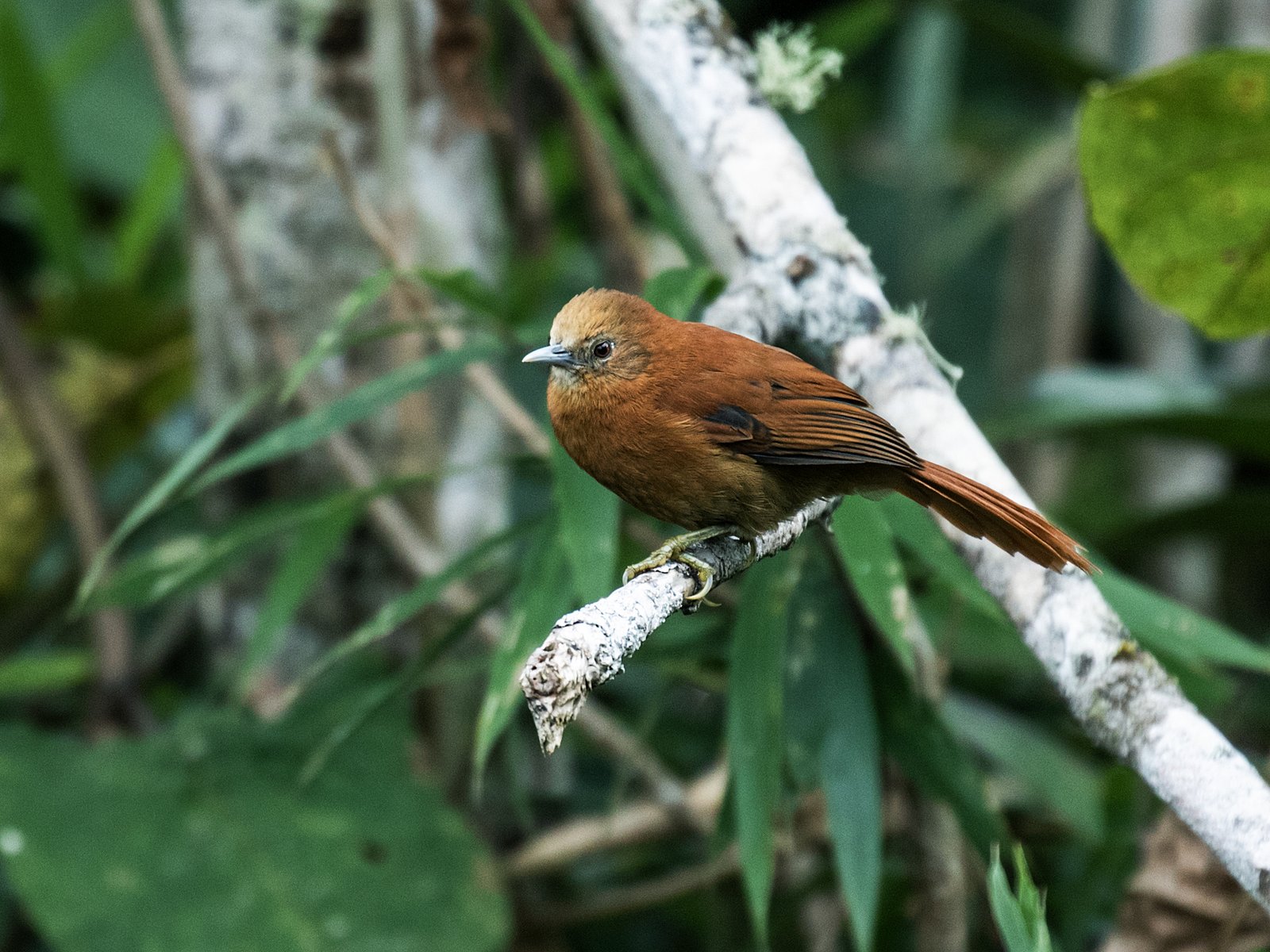
17–18 cm, slender, with a thin, straight bill and a fairly long tail. The head, nape, mantle, wings and tail are warm rufous, the breast reddish buff. The rump, uppertail coverts and belly are duller, olive-tawny. Juveniles have a whitish crown and a buffy breast with brown scaling. The sexes are alike.
Confusion species
Rufous Spinetail Synallaxis unirufa is also entirely rufous, but has black lores, a ragged tail of pointed feathers and stays low in bamboo. Ash-browed Spinetail Cranioleuca curtata lives lower, with an olive-brown back and a grey supercilium. Line-cheeked Spinetail Cranioleuca antisiensis has a white supercilium and streaked cheeks and lives in drier areas.
Habitat
Elfin forest and the edges of humid montane forest at treeline, preferably with Chusquea bamboo, abundant moss and bromeliads; mainly between 3000 and 3400 m, locally from 2500 m. It forages in pairs or small groups, often in mixed flocks, for insects in moss and epiphytes on branches. Little is known about the nest.
Where the bird is most at home, classified by the vegetation units of the Andes and the west coast.


Range and movements
Colombia: absent. Ecuador: absent. Peru: endemic, in the eastern Andes south of the Marañón, from Amazonas to La Libertad, possibly south to Huánuco. Bolivia: absent. Absent from the Galápagos. Does not occur outside the guide area.
- Resident
- dark = core range, pale = thinly spread
How and when to look
Search the mossy elfin forest just below treeline in southern Amazonas, for example along the road from Leimebamba over the Abra Barro Negro. Follow mixed flocks moving along the forest edge.
Conservation status
Near Threatened. The population is estimated at 1000 to 2500 mature birds and is declining. Regular burning of grassland for livestock pushes the treeline down by hundreds of metres, and clearing for agriculture and grazing fragments the remaining elfin forest.
Scientific name
Cranioleuca berlepschi | (Hellmayr, 1905)
Hellmayr described the species in 1905 as Thripophaga berlepschi; because it was later moved to another genus, the author and year stand in brackets. The genus Cranioleuca was introduced in 1853 by Reichenbach. The genus name comes from Greek kranion, 'skull', and leukos, 'white'. The species name honours Hans von Berlepsch (1850–1915), German ornithologist and collector of South American birds. The specimen the first description was based on came from Leimebamba, Amazonas, Peru.