All species › Passerines › Ovenbirds and woodcreepers › White-browed Spinetail
White-browed Spinetail | Hellmayrea gularis
Witbrauwstekelstaart | Pijuí paramero | João-de-sobrancelha-branca
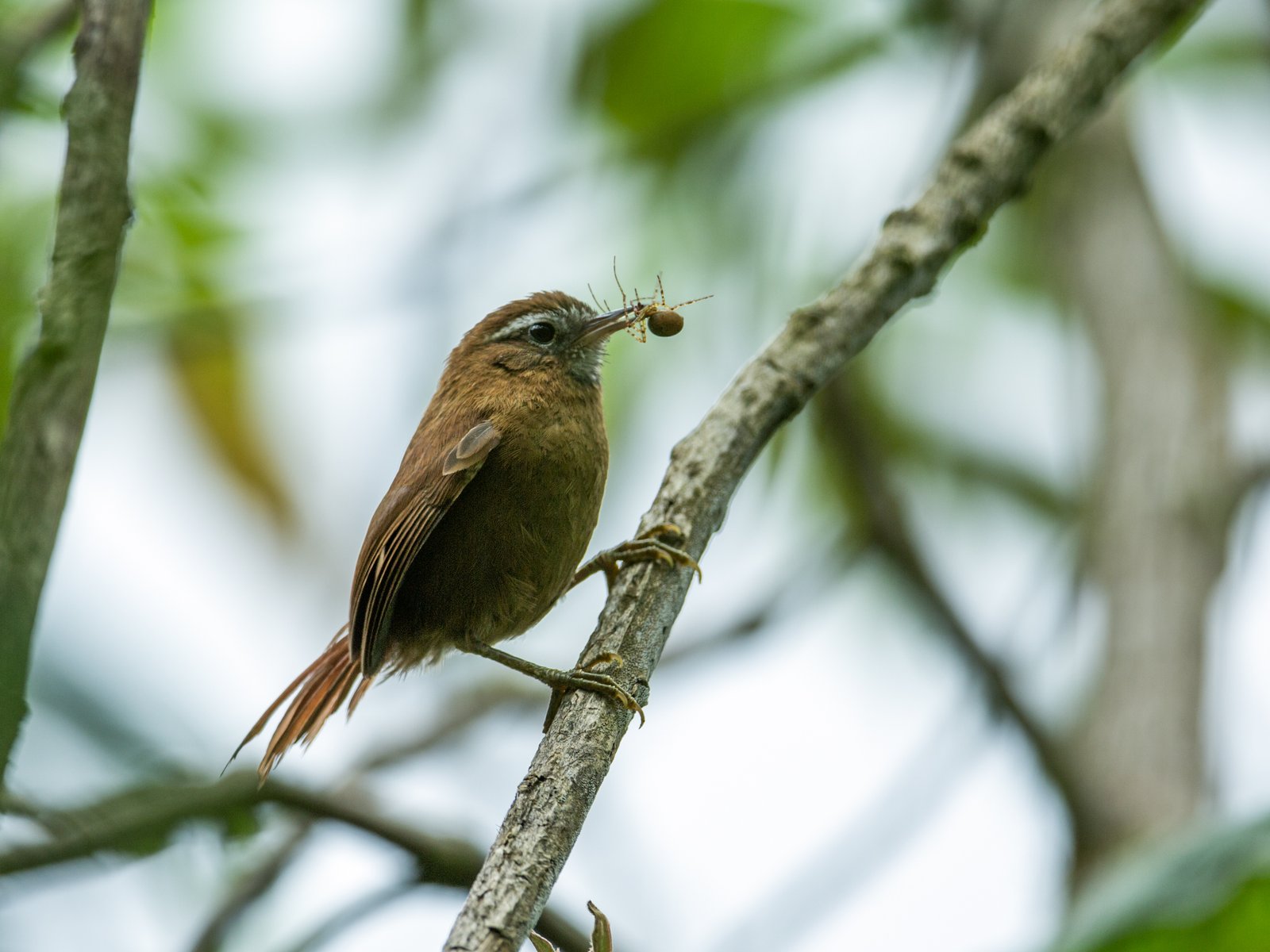
The White-browed Spinetail is a small, rufous-brown ovenbird of the treeline in the northern Andes. It creeps like a treecreeper through bamboo, moss and dense shrubbery, often close to the ground. Despite its name its tail is not spiny; it is the only species of the genus Hellmayrea.
Voice
High, thin tsit calls, often repeated as the bird creeps through the vegetation. The song is a fast, high, level trill.
Recording: José María Loaiza B. — CC BY-NC-SA 4.0 · xeno-canto
Identification
13 cm, with a thin, pointed, slightly upturned bill and a fairly short, soft tail. The upperparts are warm rufous-brown, with a slightly darker crown. A short white eyebrow and a bright white throat stand out against the rufous-brown head. The underparts are cinnamon-brown to greyish brown, depending on the subspecies. The sexes are alike.
Confusion species
Rufous Spinetail Synallaxis unirufa is larger and uniformly rufous, with black lores, no white on throat or brow and a long, graduated tail. White-chinned Thistletail Asthenes fuliginosa has a long, frayed, forked tail and a small orange chin patch. Pearled Treerunner Margarornis squamiger also climbs mossy branches, but has a white throat and white-scaled underparts.
Habitat
Dense shrubbery, bamboo (Chusquea) and low, mossy elfin forest at the upper edge of cloud forest and the transition to páramo and jalca, mostly between 2500 and 3700 m. It forages alone or in pairs, often with mixed flocks, among moss, leaves and dead bamboo for small insects and spiders. The nest is a ball of moss.
Where the bird is most at home, classified by the vegetation units of the Andes and the west coast.


Range and movements
In Colombia locally in all three cordilleras. In Ecuador on both slopes of the Andes. In Peru along the Andes south to Pasco and Junín. Absent from Bolivia and the Galápagos. Outside the guide area in the Andes of Venezuela and the Sierra de Perijá.
- Resident
- dark = core range, pale = thinly spread
How and when to look
Walk trails through bamboo and elfin forest just below the páramo and listen for thin tsit calls from the low vegetation; the bird often moves with mixed flocks.
Conservation status
Least Concern. Its treeline habitat is locally degraded by fire and grazing.
Scientific name
Hellmayrea gularis | (de Lafresnaye, 1843)
De Lafresnaye described the species in 1843 as Synnalaxis gularis; because it was later moved to another genus, the author and year stand in brackets. The genus Hellmayrea was introduced in 1926 by Sztolcman. The genus name honours Carl Eduard Hellmayr (1878–1944), Austrian ornithologist who published widely on South American birds. The species name comes from Latin gula, 'throat': gularis, 'of the throat', after the distinctive throat. The specimen the first description was based on came from Bogotá, Colombia.