All species › Passerines › Ovenbirds and woodcreepers › Yellow-chinned Spinetail
Yellow-chinned Spinetail | Certhiaxis cinnamomeus
Geelkinstekelstaart | Curutié colorado | Curutié
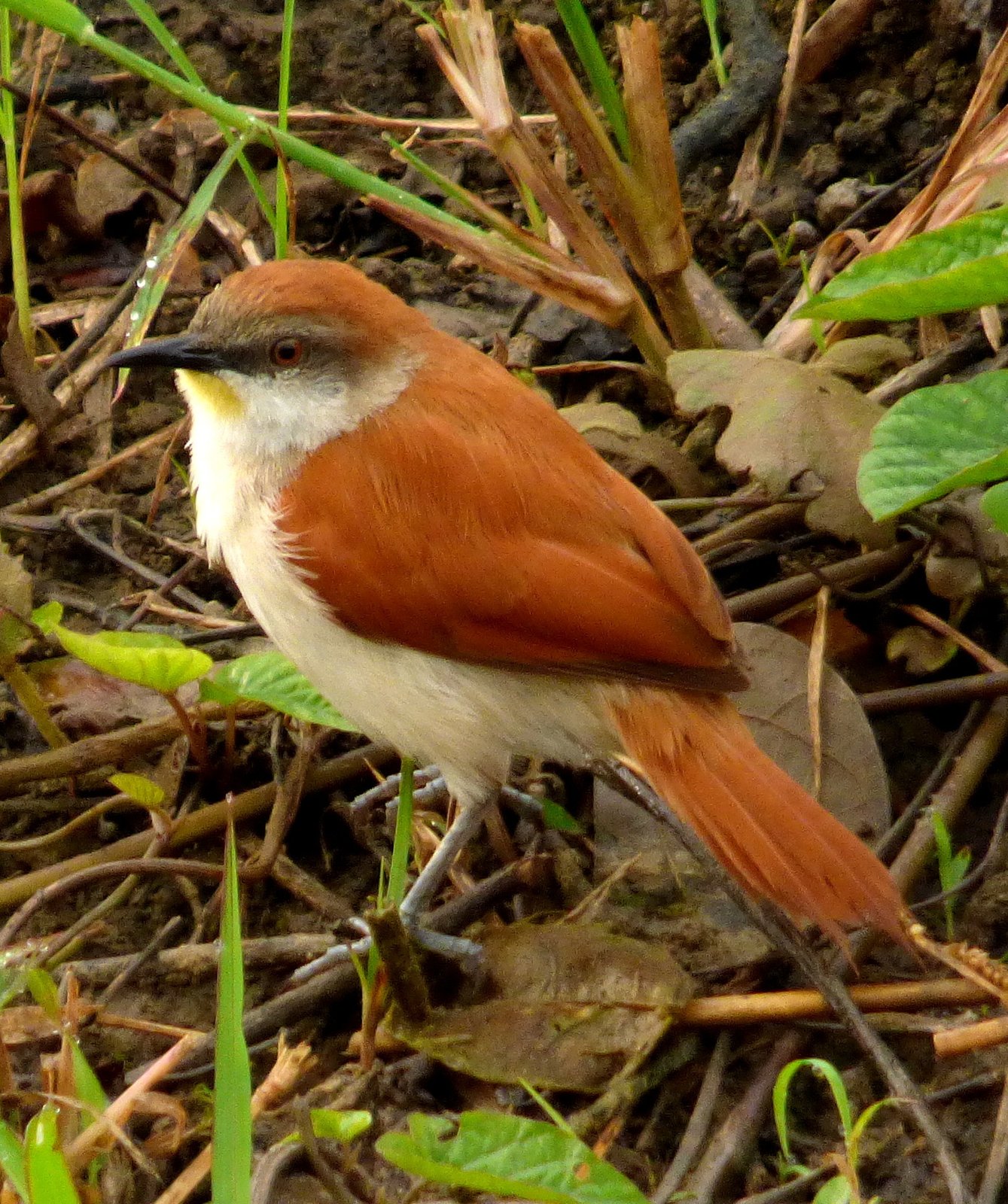
The Yellow-chinned Spinetail is a rufous spinetail of marshes and waterside vegetation over much of tropical South America. It forages low and often in the open and is noisy. The yellow chin spot to which its name refers is small.
Voice
A shrill, dry rattle, often repeated from low vegetation near water.
Recording: Franco Vushurovich — CC BY-NC-SA 4.0 · xeno-canto
Identification
14–15 cm, slender and with a fairly long, pointed tail. Head and upperparts are chestnut-brown to rufous; the colour of the forecrown and the tone of the upperparts vary by subspecies. A greyish-brown, poorly defined supercilium. The chin is pale yellow, the rest of the underparts whitish. The sexes are alike.
Confusion species
Red-and-white Spinetail Certhiaxis mustelinus has black lores and a pure white chin without yellow and lives along the Amazon. Plain-crowned Spinetail Synallaxis gujanensis has a greyish-brown crown and back, with rufous only on the wings and tail, and keeps to scrub. Chotoy Spinetail Schoeniophylax phryganophilus has a much longer tail, a streaked back and a black throat patch.
Habitat
Marshes, edges of lakes and rivers, wet grassland, rice fields and mangrove edges, in the lowlands. It searches for insects and spiders low in the vegetation, often in the open. The nest is a large, globular stick structure, low in marsh or mangrove vegetation, with an entrance tube that rises almost vertically from the base to the top. Striped Cuckoo Tapera naevia lays its eggs in the nest.
Where the bird is most at home, classified by the vegetation units of the Andes and the west coast.


Range and movements
Colombia: in the north, in the Caribbean lowlands and Magdalena valley, and in the Llanos. Peru: rare and local in the Amazonian lowlands. Bolivia: in the lowlands of the north and east, along the Madeira and up to the foot of the Andes. Absent from Ecuador and the Galápagos. Outside the guide area in Venezuela, Trinidad, the Guianas, most of Brazil, Paraguay, northern Argentina and Uruguay.
- Resident
- dark = core range, pale = thinly spread
How and when to look
Walk along the edges of marshes, rice fields and lakes in the Llanos or in the lowlands of Beni and Santa Cruz and listen for the shrill rattle. Birds often perch low in reeds and shrubs over the water.
Conservation status
Least Concern. The species has a large range and also uses man-made wetlands such as rice fields.
Scientific name
Certhiaxis cinnamomeus | (Gmelin, 1788)
Gmelin described the species in 1788 as Certhia cinnamomea; because it was later moved to another genus, the author and year stand in brackets. The genus Certhiaxis was introduced in 1844 by Lesson. The genus name combines the genera Certhia (treecreepers, Linnaeus 1758) and Synallaxis (spinetails, Vieillot 1818). The species name comes from Latin cinnamomeus, 'cinnamon-coloured'. The specimen the first description was based on came from Cayenne, French Guiana.