All species › Passerines › Ovenbirds and woodcreepers › Red-and-white Spinetail
Red-and-white Spinetail | Certhiaxis mustelinus
Roodwitte stekelstaart | Curutié rojiblanco | João-da-canarana
The Red-and-white Spinetail is a rufous and white spinetail of marshes along the large rivers of the Amazon basin. It lives in grass, shrubs and aquatic plants around old river islands. In the guide area it occurs only in north-eastern Peru and the far south-east of Colombia.
Voice
The song is a loud, dry, irregularly undulating rattle, tch-t-t-t-t-t-t-t-t. The call is a repeated chuck.
Recording: JAYRSON ARAUJO DE OLIVEIRA — CC BY-NC-SA 4.0 · xeno-canto
Identification
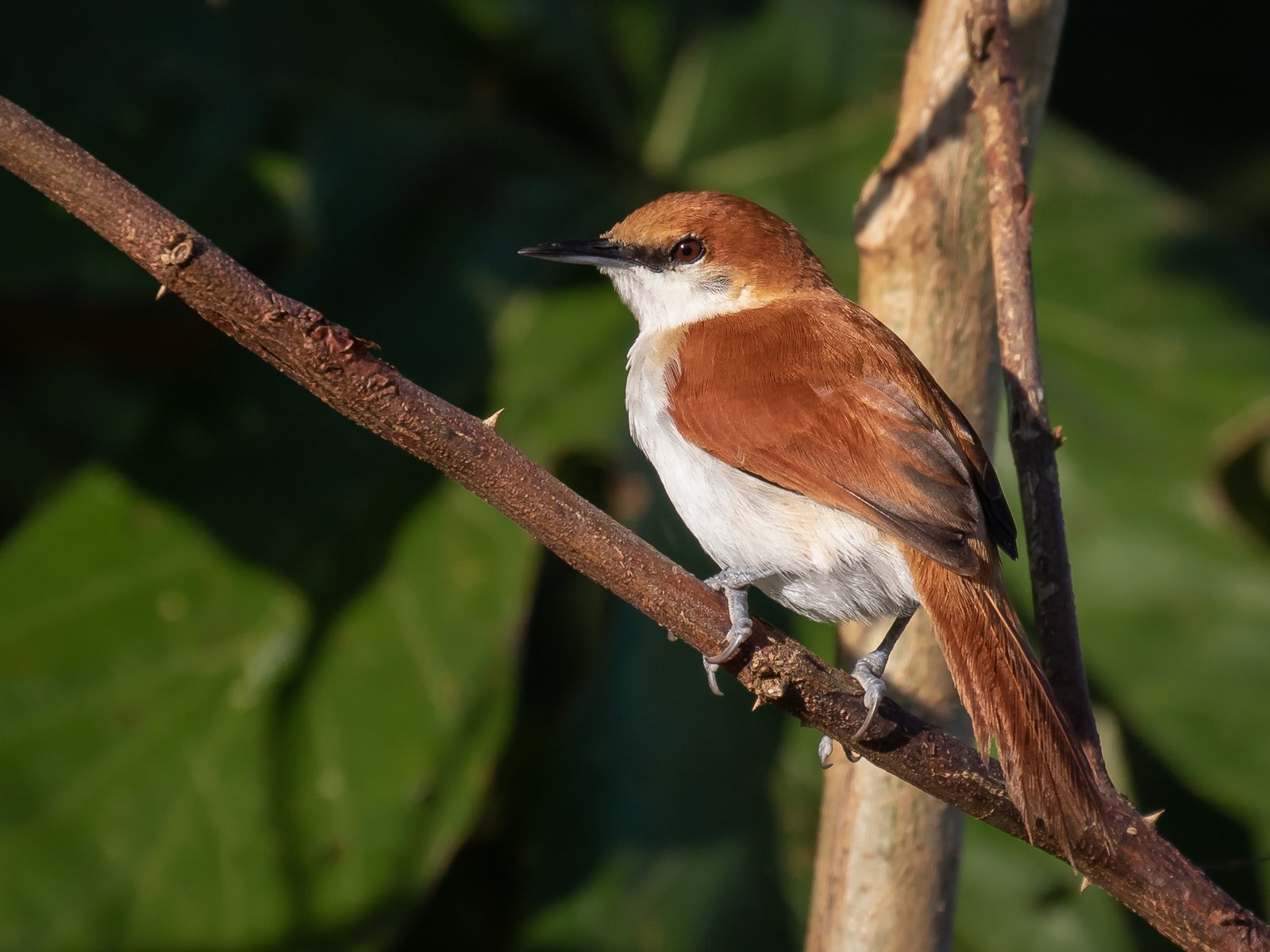
14–15 cm, with a pointed, rufous tail. Crown, back and cheeks are rufous; the lores are black, with a dusky line through the eye. The wings and tail are mostly rufous. The chin and throat are white, the rest of the underparts white with a pale buff wash. The sexes are alike. Juveniles have less uniform upperparts, a dusky crown and faint mottling on the breast.
Confusion species
Yellow-chinned Spinetail Certhiaxis cinnamomeus has a small pale yellow chin spot, no sharply black lores and a greyish-brown supercilium; it is rare in the Amazonian lowlands of the guide area. Parker's Spinetail Cranioleuca vulpecula also lives on river islands, but has a pale supercilium and dingier, greyish underparts and forages in shrubs and young trees.
Habitat
Freshwater marshes around old river islands, with shrubs, grasses and emergent plants, in Colombia also seasonally flooded grassland, up to about 150 m. It searches for insects low in the vegetation, often just above the water. The nest is a ball of thorny sticks in low vegetation over water.
Where the bird is most at home, classified by the vegetation units of the Andes and the west coast.


Range and movements
Colombia: very locally in the far south-east, along the Amazon. Peru: in the north-east, along the Amazon and the lower Ucayali. Absent from Ecuador, Bolivia and the Galápagos. Outside the guide area along the rivers of the Amazon basin in Brazil, such as the Amazon, Madeira, Juruá and Purus.
- Resident
- dark = core range, pale = thinly spread
How and when to look
Search from a boat or along the bank at the marshy edges of river islands and oxbows around Iquitos. The rattling song often comes from low vegetation over the water.
Conservation status
Least Concern. The species is tied to riverside marshes, which are still widespread in the Amazon basin.
Scientific name
Certhiaxis mustelinus | (Sclater, 1874)
Sclater described the species in 1874 as Synallaxis mustelina; because it was later moved to another genus, the author and year stand in brackets. The genus Certhiaxis was introduced in 1844 by Lesson. The genus name combines the genera Certhia (treecreepers, Linnaeus 1758) and Synallaxis (spinetails, Vieillot 1818). The species name comes from Latin mustelinus, 'weasel-like' or 'weasel-coloured' (from mustela, 'weasel'). The specimen the first description was based on came from Rio Madeira near the mouth of the Rio Marmelos, Brazil.