All species › Passerines › Ovenbirds and woodcreepers › Chestnut-throated Spinetail
Chestnut-throated Spinetail | Synallaxis cherriei
Bruinkeelstekelstaart | Pijuí gorjicastaño | Puruchém
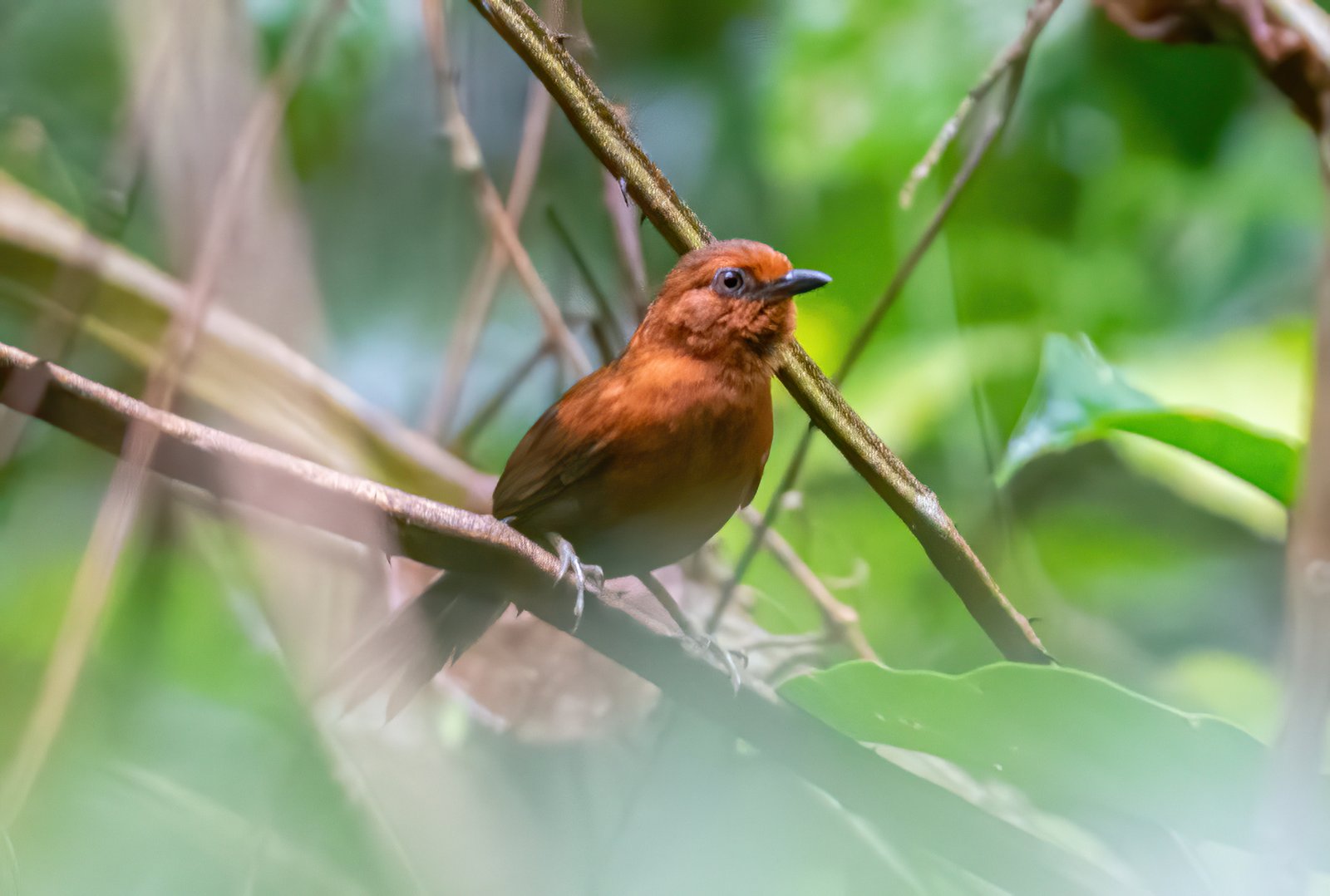
Chestnut-throated Spinetail is a small, short-tailed spinetail with a chestnut throat and breast. In the guide area it lives very locally in dense undergrowth at the foot of the Andes, mainly in Peru. The species is poorly known; almost nothing is known of its breeding biology.
Voice
The song is a series of prruh-pee notes, the second note higher, separated by short pauses. While foraging it gives high psiu and piwww calls.
Recording: GABRIEL LEITE — CC BY-NC-SA 4.0 · xeno-canto
Identification
13–14 cm, with a graduated, slaty-blackish tail of pointed feathers. Forecrown, face, throat and breast are deep chestnut; nape and back are chestnut washed olive-brown, the rump dark brown. The belly is grey. Females have a slightly paler throat and belly. In Peru the bird is paler and browner above, with a more orange-rufous throat and breast and a paler grey belly. Juveniles are darker and more olive above, with a whitish throat with dusky feather tips.
Confusion species
Ruddy Spinetail Synallaxis rutilans has a black throat and a dark olive-brown belly and lives in the lowlands. Cabanis's Spinetail Synallaxis cabanisi has a rufous tail and olive-brown underparts. Dark-breasted Spinetail Synallaxis albigularis has a white throat and a dark grey breast and lives in riverside scrub.
Habitat
Dense undergrowth at the edges of primary lowland and foothill forest and in secondary forest, roughly between 300 and 1100 m; in Brazil mainly in bamboo, in the guide area without a clear link to bamboo. It lives in pairs and searches for arthropods in dense vegetation, usually low above the ground, sometimes on the ground or higher. Nothing is known of the nest; juveniles with adults have been seen in May and June.
Where the bird is most at home, classified by the vegetation units of the Andes and the west coast.


Range and movements
In Colombia only a few records from Putumayo. In Ecuador very locally in the foothills of Sucumbíos and Napo. In Peru mainly in the foothills of San Martín and scattered in the east, south to Madre de Dios. In Bolivia only a few records from the north. Absent from the Galápagos. Outside the guide area in Amazonian Brazil.
- Resident
- dark = core range, pale = thinly spread
How and when to look
Search dense undergrowth at forest edges in the foothills around Moyobamba and Tarapoto in San Martín. Listen for the repeated two-note song; the bird usually stays low in dense cover.
Conservation status
Least Concern; formerly listed as threatened and later as Near Threatened. The population size is unknown and thought to be declining. The main threat is deforestation, especially for the small western populations; the species appears sensitive to forest fragmentation.
Scientific name
Synallaxis cherriei | Gyldenstolpe, 1930
Gyldenstolpe described the species in 1930 and placed it straight away in the genus where it still stands. The genus Synallaxis was introduced in 1818 by Vieillot. The genus name comes from Ancient Greek sunallaxis, 'exchange'. The species name honours George Kruck Cherrie (1865–1948), an American naturalist and collector in the Neotropics. The specimen the first description was based on came from Barão de Melgaço, Rondônia, Brazil.