All species › Passerines › Ovenbirds and woodcreepers › Ruddy Spinetail
Ruddy Spinetail | Synallaxis rutilans
Rode stekelstaart | Pijuí rojizo | João-teneném-castanho
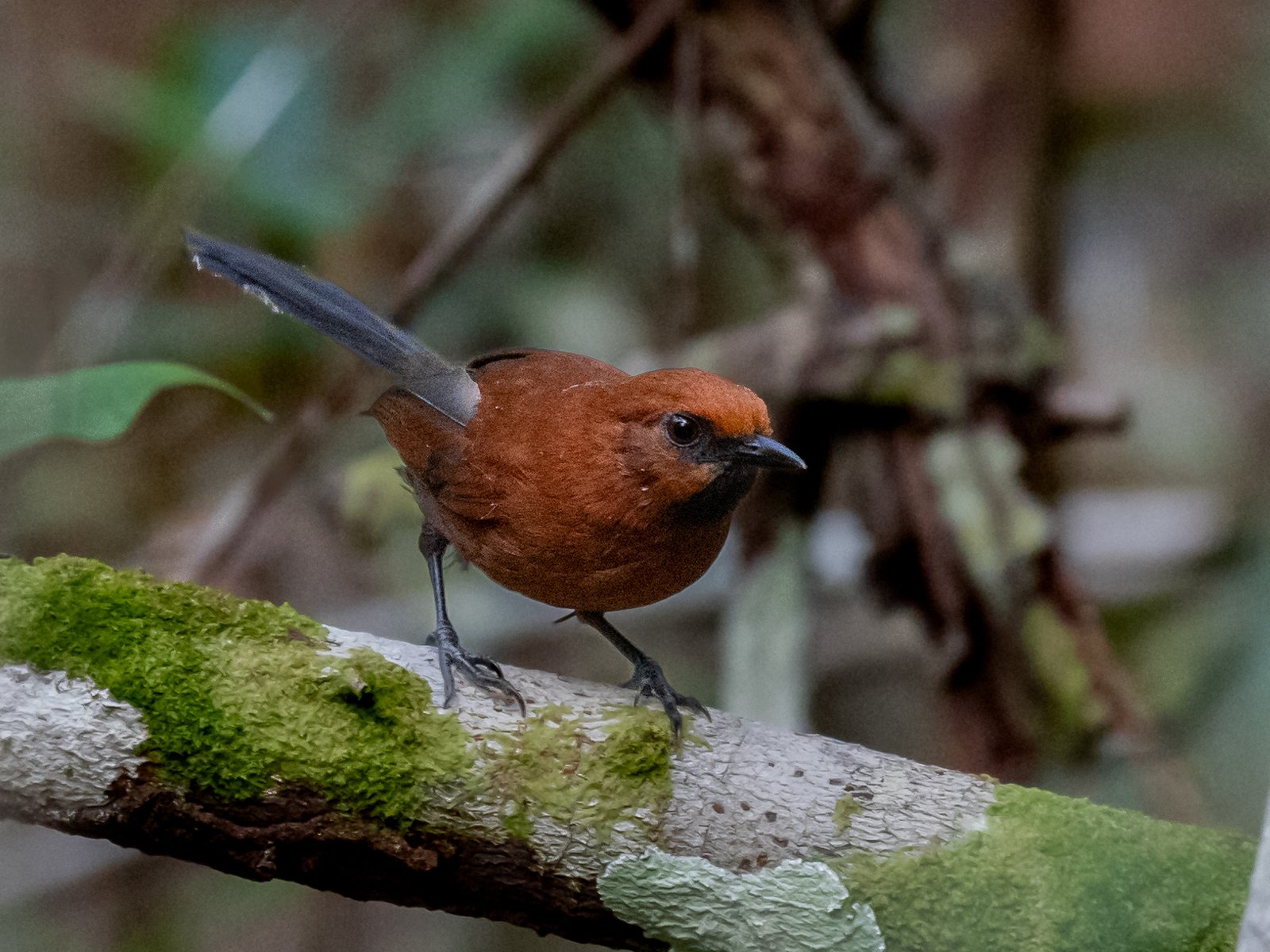
Ruddy Spinetail is a dark rufous spinetail with a black throat and a blackish tail, living in the undergrowth of Amazonian rainforest. It occurs in the lowlands east of the Andes, from Colombia to Bolivia. Its two-note call is repeated almost continuously.
Voice
The song is a two-note call, the second note lower, such as kee-kwah, repeated almost continuously.
Recording: JAYRSON ARAUJO DE OLIVEIRA — CC BY-NC-SA 4.0 · xeno-canto
Identification
14–15 cm, with a graduated, slaty-blackish tail. Face and breast are bright rufous to chestnut, the lores mottled blackish and the throat black. The belly is dark olive-brown. Females are slightly paler, with more of an olive wash. Juveniles are duller and less rufous, with a grey throat and vague streaks on the underparts.
Confusion species
Chestnut-throated Spinetail Synallaxis cherriei has a chestnut throat without black and a grey belly, and lives mainly in the foothills. Plain-crowned Spinetail Synallaxis gujanensis is paler, with a rufous tail and pale underparts, and lives in open, shrubby terrain along rivers. Dark-breasted Spinetail Synallaxis albigularis has a white throat and a dark grey breast and lives in riverside scrub. Cabanis's Spinetail Synallaxis cabanisi has a rufous tail and olive-brown underparts.
Habitat
Undergrowth of terra firme rainforest, also in other evergreen lowland forest, often at treefalls, forest edges and in vine tangles; mostly below 1000 m. It lives in pairs, sometimes in mixed flocks, and gleans arthropods from leaves, twigs, hanging dead leaves and leaf litter. The nest is a ball of twigs with a horizontal entrance tube; the clutch is three to four eggs.
Where the bird is most at home, classified by the vegetation units of the Andes and the west coast.


Range and movements
In Colombia in the lowlands east of the Andes, from Meta south and east to Vichada and Guainía. In Ecuador in the Amazonian lowlands, scarce and local. In Peru in the Amazonian lowlands throughout the east. In Bolivia in the north and east (Pando, Beni, La Paz and Santa Cruz). Absent from the Galápagos. Outside the guide area in Venezuela, the Guianas and Brazil.
- Resident
- dark = core range, pale = thinly spread
How and when to look
Listen in terra firme undergrowth for the repeated two-note call, for example along trails at lodges in the lowlands of south-eastern Peru. The bird usually stays in dense cover low above the ground.
Conservation status
Least Concern. The range is very large; the population is thought to be declining through deforestation. The species occurs in many protected areas.
Scientific name
Synallaxis rutilans | Temminck, 1823
Temminck described the species in 1823 and placed it straight away in the genus where it still stands. The genus Synallaxis was introduced in 1818 by Vieillot. The genus name comes from Ancient Greek sunallaxis, 'exchange'. The species name comes from Latin rutilans, 'reddish, glowing red'. The specimen the first description was based on came from Cametá, Rio Tocantins, Pará, Brazil.