All species › Passerines › Ovenbirds and woodcreepers › Stripe-breasted Spinetail
Stripe-breasted Spinetail | Synallaxis cinnamomea
Kaneelstekelstaart | Pijuí pechiestriado | João-de-peito-estriado
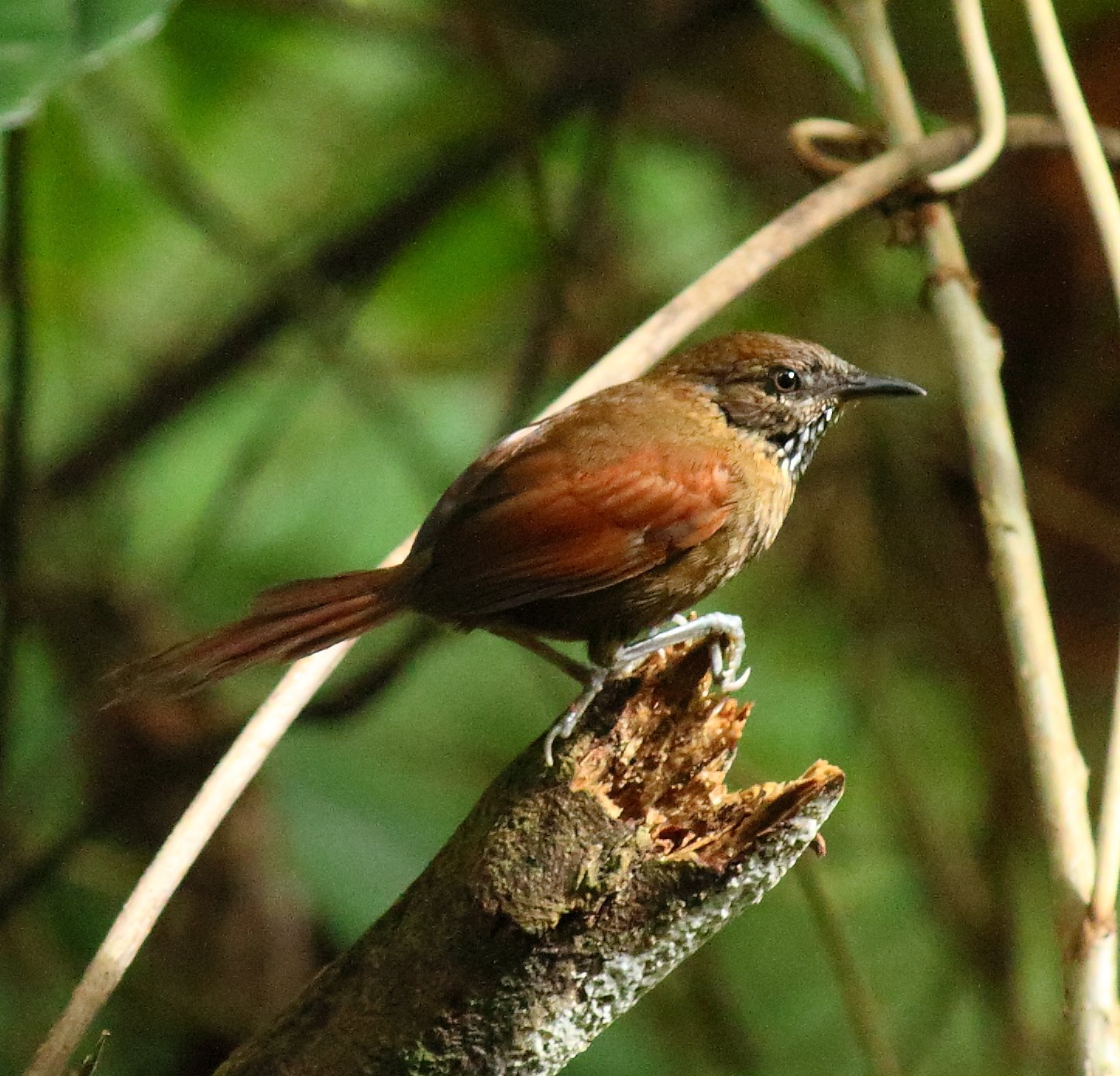
Stripe-breasted Spinetail has one of the shortest tails in the genus Synallaxis and, unlike most spinetails in the guide area, has a streaked throat and breast. It lives in undergrowth and scrub on the slopes of the Eastern Andes and the Serranía del Perijá in Colombia. Its two-note song is often repeated for long periods.
Voice
The song consists of two sharp, nasal notes, the second lower and rising, and is often repeated for long periods. The call is a soft, whining note.
Recording: Francisco contreras — CC BY-NC-SA 4.0 · xeno-canto
Identification
14–16 cm, with a relatively short tail of pointed feathers. There is a faint pale supercilium and a dull rufous face. The upperparts are brown, the wings chestnut with blackish tips to the flight feathers. The throat is white with black streaks, the underparts rufous with tawny streaks, paler on the belly. The sexes are alike. Juveniles are browner, with a less distinct throat pattern and fainter streaks.
Confusion species
Azara's Spinetail Synallaxis azarae has a rufous crown, unstreaked grey underparts and a longer tail. Pale-breasted Spinetail Synallaxis albescens has pale, unstreaked underparts and lives in open grassland. White-whiskered Spinetail Synallaxis candei lives in the dry Caribbean lowlands and has a black face with a white moustachial stripe.
Habitat
Undergrowth and edges of deciduous and semi-evergreen forest, gallery forest, dry montane scrub, second-growth scrub and overgrown coffee plantations; in Colombia from about 800 to 3100 m. It lives in pairs, sometimes in mixed flocks, and searches for arthropods in foliage and branches up to about 2 m and in leaf litter on the ground. The nest is a ball of twigs and leaves with an entrance tube at the top, placed on a slope or in a bush up to about 3 m.
Where the bird is most at home, classified by the vegetation units of the Andes and the west coast.


Range and movements
In Colombia in the Serranía del Perijá and in the Eastern Andes, from Norte de Santander and Santander south to Cundinamarca; scattered records also along the eastern base of the Andes. Absent from Ecuador, Peru, Bolivia and the Galápagos. Outside the guide area in Venezuela and on Trinidad and Tobago.
- Resident
- dark = core range, pale = thinly spread
How and when to look
Search shrubby forest edges and overgrown coffee plantations on the slopes of the Eastern Andes in Santander and Cundinamarca. Listen for the often repeated two-note song from low vegetation.
Conservation status
Least Concern. The range is large and the population is considered stable. The species is fairly common in Colombia and does well in cut-over and secondary forest.
Scientific name
Synallaxis cinnamomea | de Lafresnaye, 1843
De Lafresnaye described the species in 1843 and placed it straight away in the genus where it still stands. The genus Synallaxis was introduced in 1818 by Vieillot. The genus name comes from Ancient Greek sunallaxis, 'exchange'. The species name comes from Latin cinnamomeus, 'cinnamon-coloured'. The specimen the first description was based on came from Bogotá, Colombia.