All species › Passerines › Ovenbirds and woodcreepers › Rufous Spinetail
Rufous Spinetail | Synallaxis unirufa
Roeststekelstaart | Pijuí rufo | João-ruivo
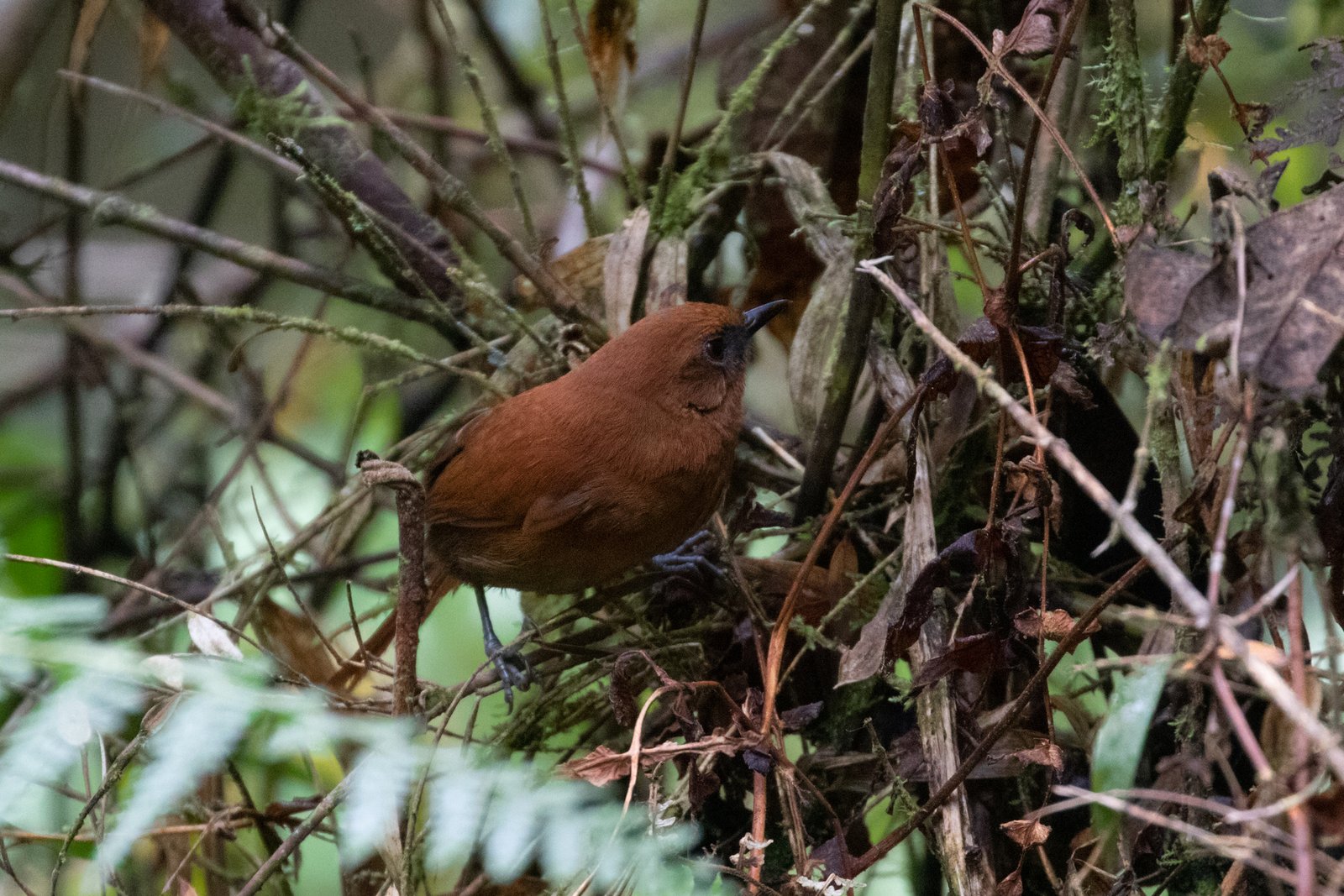
Rufous Spinetail is one of the larger spinetails and almost entirely bright rufous. It lives in the undergrowth of cloud forest in the Andes of Colombia, Ecuador and Peru, often in bamboo of the genus Chusquea. Its song differs between subspecies, which may indicate that more than one species is hidden under this name.
Voice
The song consists of short series or single high, nasal notes, such as kweek, repeated every one to two seconds, mainly in the morning and usually from dense cover. The song differs clearly between subspecies.
Recording: Juan Freile — CC BY-NC-SA 4.0 · xeno-canto
Identification
17–18 cm, with a long, graduated tail. Almost entirely bright rufous, with a slightly paler forehead and blackish lores; the throat feathers have largely hidden black bases. The sexes are alike. In Peru the underparts, especially the belly, are paler; in the Serranía del Perijá the bird is paler, with a faint buff supercilium and no black on the throat. Juveniles have brown upperparts and paler underparts.
Confusion species
Rufous Wren Cinnycerthia unirufa lives in the same bamboo and is similar in colour, but has a shorter tail with fine dark barring, moves in noisy groups and has a different song; in Peru the same applies to Peruvian Wren Cinnycerthia peruana. Azara's Spinetail Synallaxis azarae has a grey face and grey underparts and lives more in forest edges and shrubbery. Rusty-headed Spinetail Synallaxis fuscorufa is very similar, but occurs only in the Sierra Nevada de Santa Marta.
Habitat
Undergrowth and edges of cloud forest, evergreen montane forest and elfin forest, with a preference for bamboo of the genus Chusquea; mostly between 1800 and 3400 m. It lives in pairs, sometimes in mixed flocks, and gleans arthropods from leaves and twigs in dense cover. Little is known about the nest and breeding season.
Where the bird is most at home, classified by the vegetation units of the Andes and the west coast.


Range and movements
In Colombia in all three cordilleras and in the Serranía del Perijá. In Ecuador on the east slope of the Andes and on the west slope south to Cotopaxi. In Peru north of the Marañón in the far north and, south of it, on the east slope from Amazonas to Cusco. Absent from Bolivia and the Galápagos. Outside the guide area in western Venezuela.
- Resident
- dark = core range, pale = thinly spread
How and when to look
Search cloud forest with dense Chusquea bamboo, for example along trails in higher-elevation reserves on the east slope of Ecuador and northern Peru. Listen in the morning for the regularly repeated high call.
Conservation status
Least Concern. The range is very large and the population is considered stable; the species occurs in several protected areas, but has been little studied.
Scientific name
Synallaxis unirufa | de Lafresnaye, 1843
De Lafresnaye described the species in 1843 and placed it straight away in the genus where it still stands. The genus Synallaxis was introduced in 1818 by Vieillot. The genus name comes from Ancient Greek sunallaxis, 'exchange'. The species name comes from Latin unus, 'one', and rufus, 'rufous', for the uniformly rufous plumage. The specimen the first description was based on came from Bogotá, Colombia.