All species › Passerines › Ovenbirds and woodcreepers › Rusty-headed Spinetail
Rusty-headed Spinetail | Synallaxis fuscorufa
Santamartastekelstaart | Pijuí de Santa Marta | João-de-cabeça-ferrugínea
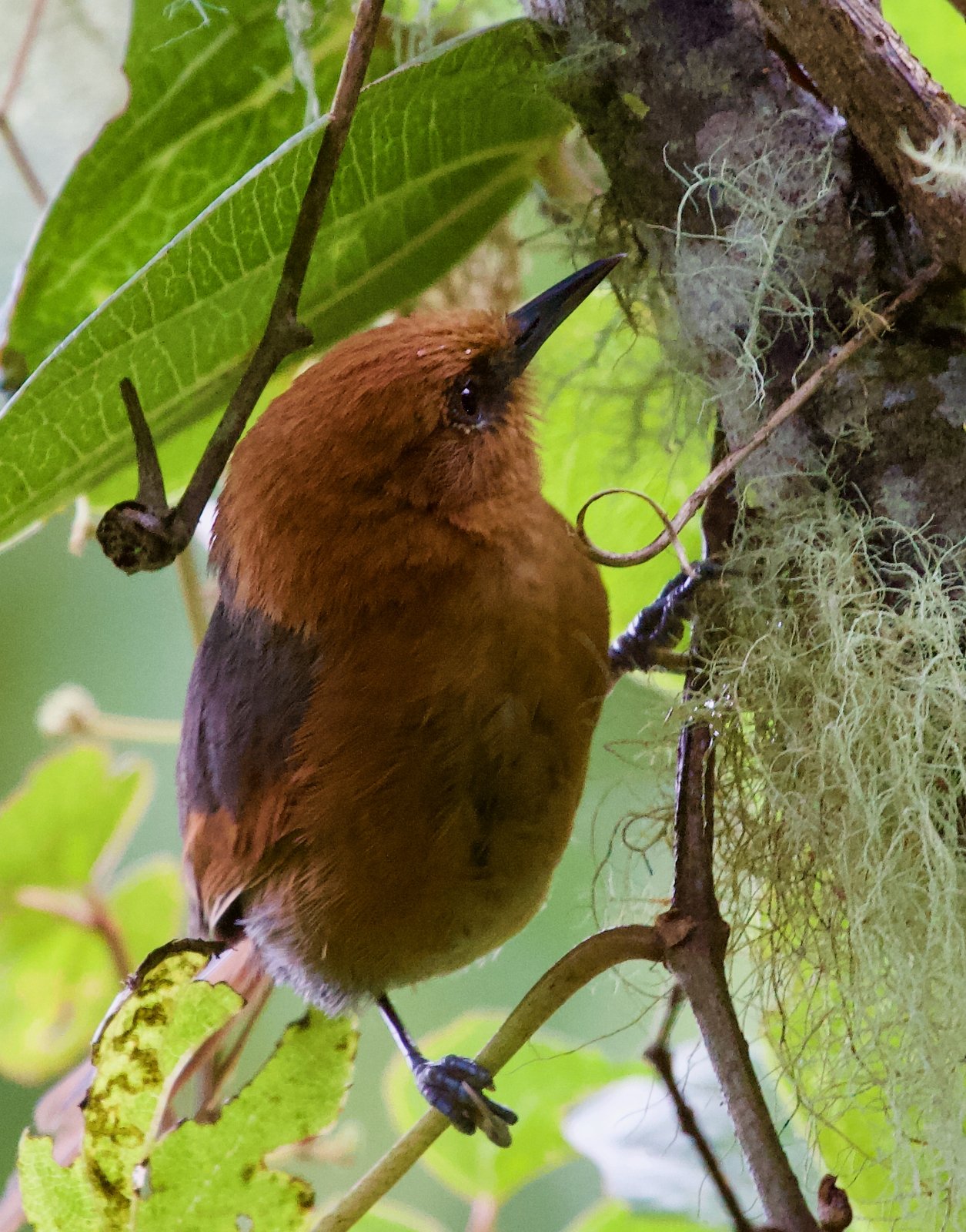
Rusty-headed Spinetail occurs only in the Sierra Nevada de Santa Marta in northern Colombia. It lives in dense forest edges and thickets on the middle and upper slopes of this isolated range. Its fast, three-note song is often heard there for minutes on end.
Voice
The song consists of three fast notes, di-di-doo, often repeated at short intervals for minutes on end.
Recording: Rolf A. de By — CC BY-NC-SA 4.0 · xeno-canto
Identification
16–17 cm, with a long, graduated tail. Head, neck and breast are bright rufous, with dark lores. The back is dull greyish olive, the flanks olive and the tail a duller rufous. The sexes are alike. Juveniles have a duller crown, tawny-olive feather edges on the underparts and faint barring on the belly.
Confusion species
Streak-capped Spinetail Cranioleuca hellmayri, also endemic to the Sierra Nevada de Santa Marta, has a streaked crown and a white supercilium and forages higher in trees, along branches and moss. Pale-breasted Spinetail Synallaxis albescens lives lower, in open grassland, and has pale underparts. Rufous Spinetail Synallaxis unirufa is very similar in colour, but does not occur in the Sierra Nevada de Santa Marta.
Habitat
Shrubby edges and undergrowth of evergreen montane forest, overgrown clearings and second-growth scrub, roughly between 1000 and 3000 m, mainly in the upper half of that range. It lives in pairs and gleans arthropods from leaves and twigs in dense cover, usually close to the ground. Little is known about the nest; the breeding season probably runs from January to June.
Where the bird is most at home, classified by the vegetation units of the Andes and the west coast.


Range and movements
In Colombia only in the Sierra Nevada de Santa Marta (Magdalena, La Guajira and Cesar). Absent from Ecuador, Peru, Bolivia and the Galápagos. Does not occur outside the guide area.
- Resident
- dark = core range, pale = thinly spread
How and when to look
Search along the road to the San Lorenzo ridge above Minca, for example around the El Dorado reserve, in thickets along the forest edge. Listen for the repeated three-note song.
Conservation status
Near Threatened. The population is estimated at 2500 to 10,000 mature birds and appears stable. Only about 15% of the original vegetation in the Sierra Nevada de Santa Marta remains unaltered; the forest is threatened by illegal agricultural expansion, logging and fires.
Scientific name
Synallaxis fuscorufa | Sclater, 1882
Sclater described the species in 1882 and placed it straight away in the genus where it still stands. The genus Synallaxis was introduced in 1818 by Vieillot. The genus name comes from Ancient Greek sunallaxis, 'exchange'. The species name comes from Latin fuscus, 'dusky', and rufus, 'rufous'. The specimen the first description was based on came from San Sebastián, Sierra Nevada de Santa Marta, Colombia.