All species › Passerines › Ovenbirds and woodcreepers › Blackish-headed Spinetail
Blackish-headed Spinetail | Synallaxis tithys
Zwartkopstekelstaart | Pijuí cabecinegro | João-de-cabeça-escura
Blackish-headed Spinetail is a spinetail of the Tumbesian dry forest of south-western Ecuador and north-western Peru, and occurs nowhere else. It lives in the understorey of deciduous forest, which is disappearing through grazing over large parts of its range. The species is classed as Vulnerable.
Voice
The song is a short, dry, rising trill, repeated every few seconds. Excited birds give a repeated series of wee-dee notes.
Recording: Juan Freile — CC BY-NC-SA 4.0 · xeno-canto
Identification
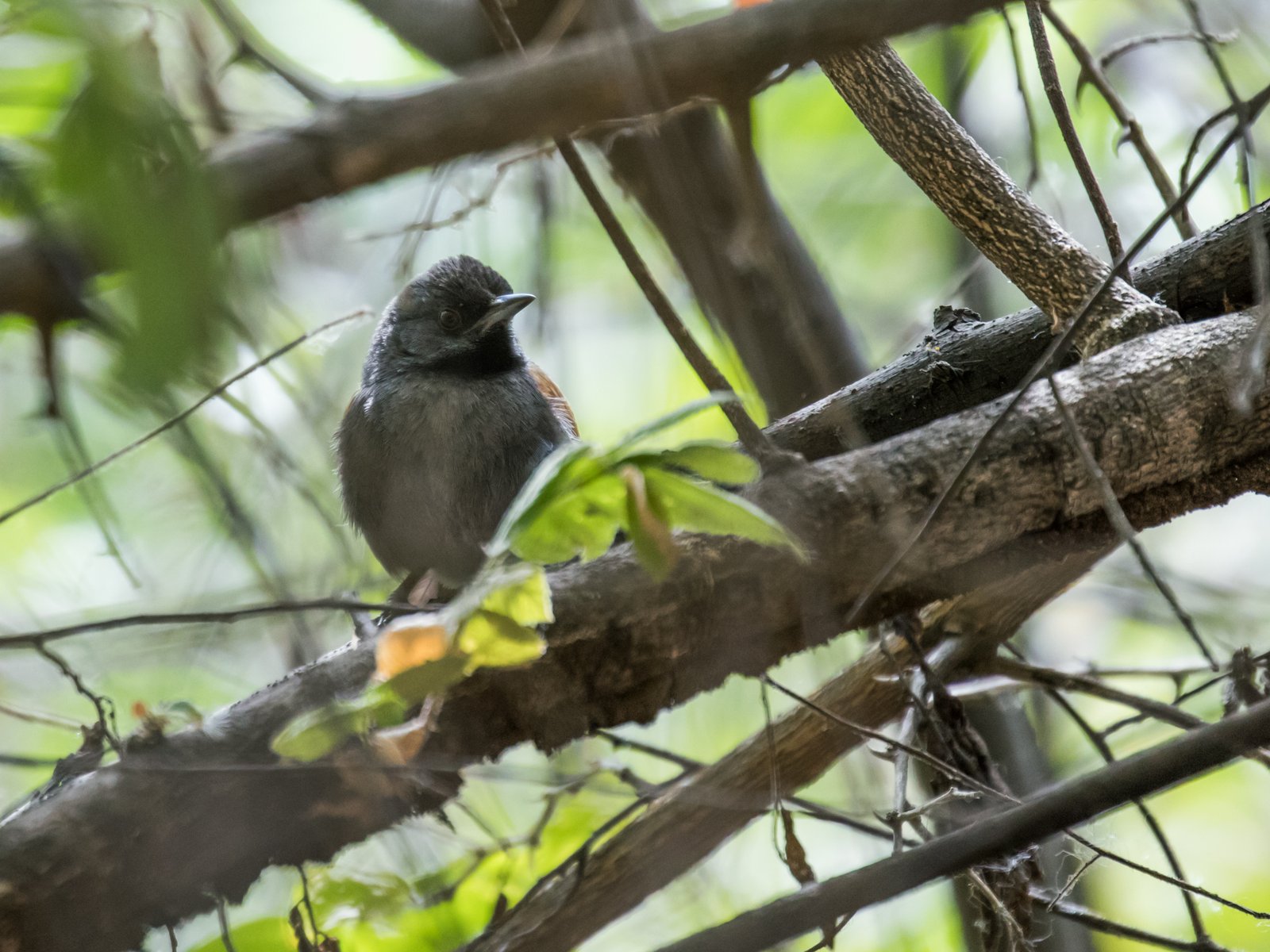
14–15 cm, with a graduated, dark tail of pointed feathers. The face is largely black, with whitish flecks on the cheeks; hindcrown and upper back are dark grey. The wing coverts are warm rufous and form a contrasting patch on the wing. The underparts are grey, paler on the belly. The sexes are alike. Juveniles are more olive, with an ill-defined black forehead and grey-mottled underparts.
Confusion species
Necklaced Spinetail Synallaxis stictothorax lives in the same dry lowlands, but has a white throat, a streaked breast band and a rufous tail. Slaty Spinetail Synallaxis brachyura has a rufous crown and lives in more humid forest. Azara's Spinetail Synallaxis azarae has a rufous crown and a grey face and lives higher in the mountains.
Habitat
Understorey of deciduous dry forest, secondary forest and adjacent scrub, from sea level to about 1000 m; there are indications of slight elevational movements. It lives in pairs, occasionally in mixed flocks, and searches for arthropods in leaf litter, foliage and twigs in dense cover. The nest is a ball of twigs in a vine tangle; breeding probably takes place in the rainy season from January to April.
Where the bird is most at home, classified by the vegetation units of the Andes and the west coast.


Range and movements
In Ecuador in the dry south-west: Loja, El Oro and Guayas, with scattered records north to Santa Elena and Manabí. In Peru in Tumbes and Piura. Absent from Colombia, Bolivia and the Galápagos. Does not occur outside the guide area.
- Resident
- dark = core range, pale = thinly spread
How and when to look
Search the dry forests around Macará and Zapotillo in Loja, for example in the Jorupe reserve, or Tumbes National Reserve in Peru. The dry trill gives the bird away; it usually stays in dense undergrowth.
Conservation status
Vulnerable. The population is estimated at 2500 to 10,000 mature birds and is declining. Agriculture has greatly reduced the forests within its range; grazing by goats and cattle removes the understorey and prevents the forest from recovering.
Scientific name
Synallaxis tithys | Taczanowski, 1877
Taczanowski described the species in 1877 and placed it straight away in the genus where it still stands. The genus Synallaxis was introduced in 1818 by Vieillot. The genus name comes from Ancient Greek sunallaxis, 'exchange'. The species name comes from Late Greek titis, a small chirping bird mentioned by Photios; in 1555 Gessner used the name 'Titys' for the black redstart. The specimen the first description was based on came from Lechugal, Tumbes, Peru.