All species › Passerines › Ovenbirds and woodcreepers › White-whiskered Spinetail
White-whiskered Spinetail | Synallaxis candei
Zwartoorstekelstaart | Pijuí barbiblanco | João-de-bigode-branco
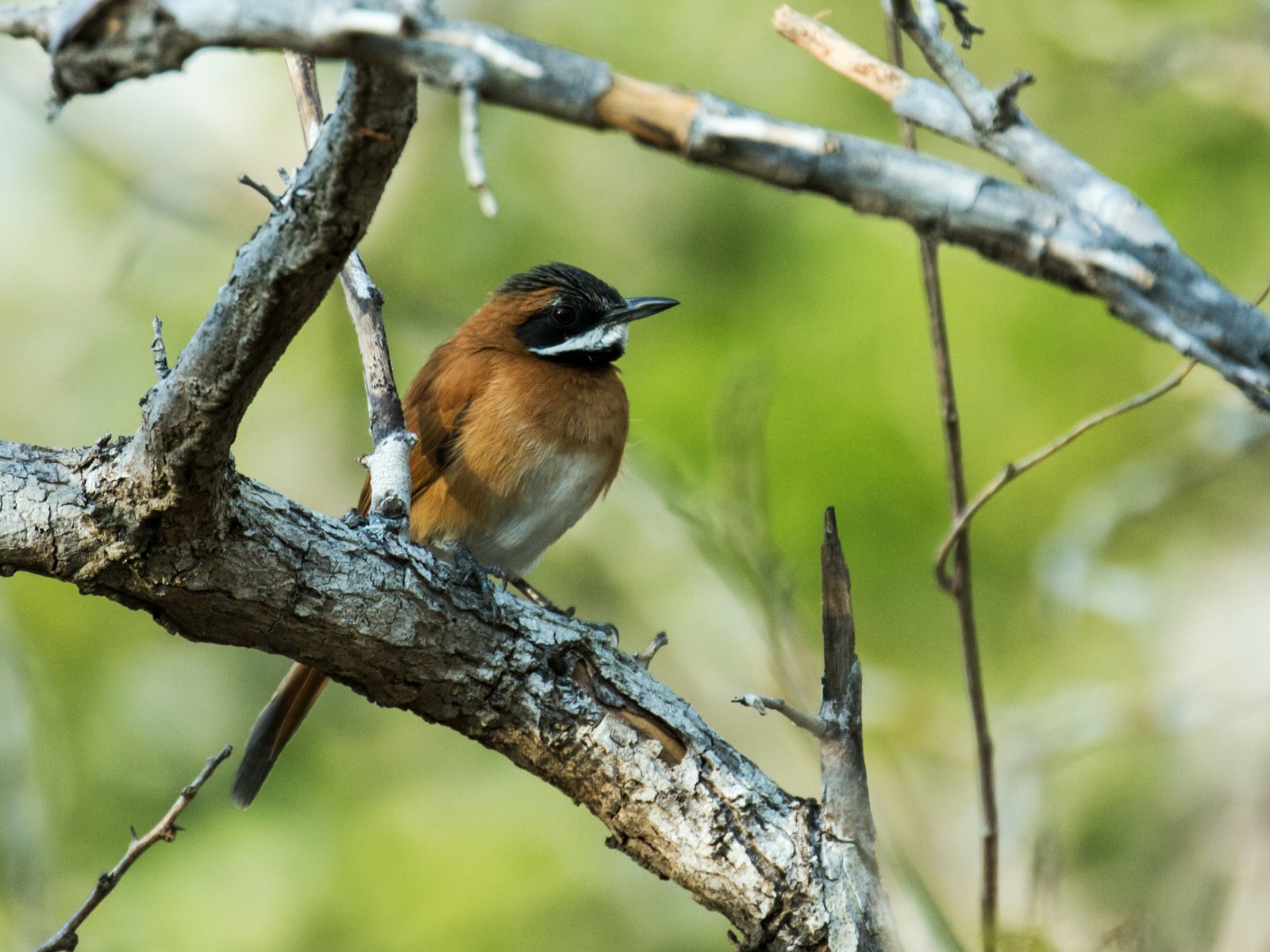
White-whiskered Spinetail is a spinetail of dry scrub and deciduous forest in the Caribbean lowlands of northern Colombia. A black face with a broad white moustachial stripe sets it apart from the other spinetails in the guide area. It takes much of its food on the ground.
Voice
The song consists of four notes, the middle two the strongest. The call is a nasal paa-pip, the alarm a drawn-out, nasal naaa.
Recording: Jerome Fischer — CC BY-NC-SA 4.0 · xeno-canto
Identification
15–17 cm, with a graduated tail that is rufous for about two thirds of its length and has a dark tip. Upperparts, wings and breast are bright rufous, with a rufous supercilium. The face is blackish, bordered below by a broad white moustachial stripe. The chin is white, the throat black and the belly white. In the subspecies of the middle Magdalena valley the back is brown, the supercilium is lacking and the breast is duller; in Cesar and La Guajira the bird is paler, with a white throat and a black band below it. The sexes are alike.
Confusion species
Pale-breasted Spinetail Synallaxis albescens has pale greyish-white underparts, a rufous crown and no black face. Stripe-breasted Spinetail Synallaxis cinnamomea lives higher on the mountain slopes and has a streaked throat and breast. Yellow-chinned Spinetail Certhiaxis cinnamomeus has white underparts with a yellow chin spot and lives in marshes and along water.
Habitat
Deciduous forest, dry thorn scrub, overgrown pastures and mangrove edges; in Colombia from sea level to about 300 m. It lives in pairs and searches for arthropods, mainly on the ground and also in twigs and branches up to about 2 m. The nest is a large ball of thorny twigs with a side entrance tube, 1.3–2.5 m up in a thorny bush.
Where the bird is most at home, classified by the vegetation units of the Andes and the west coast.


Range and movements
In Colombia in the Caribbean lowlands, from La Guajira and Cesar west through Magdalena and Atlántico to Bolívar, Sucre and Córdoba, and south into the middle Magdalena valley. Absent from Ecuador, Peru, Bolivia and the Galápagos. Outside the guide area in north-western Venezuela.
- Resident
- dark = core range, pale = thinly spread
How and when to look
Search dry scrub and thorn woodland in La Guajira, for example around Riohacha and in the dry lowlands east of the Sierra Nevada de Santa Marta. Watch for birds walking on the ground under bushes, and listen for the nasal call.
Conservation status
Least Concern. The range is fairly large and the population is considered stable; the species is locally fairly common to common.
Scientific name
Synallaxis candei | d'Orbigny, ACVMD & de Lafresnaye, 1838
D'Orbigny, ACVMD & de Lafresnaye described the species in 1838 and placed it straight away in the genus where it still stands. The genus Synallaxis was introduced in 1818 by Vieillot. The genus name comes from Ancient Greek sunallaxis, 'exchange'. The species name honours Antoine Marie Ferdinand de Maussion de Candé, a French admiral and explorer of South America. The specimen the first description was based on came from Cartagena, Colombia.