All species › Pigeons and doves › Doves and pigeons › West Peruvian Dove
West Peruvian Dove | Zenaida meloda
Peruaanse treurduif | Tórtola melódica | Pomba-melódica
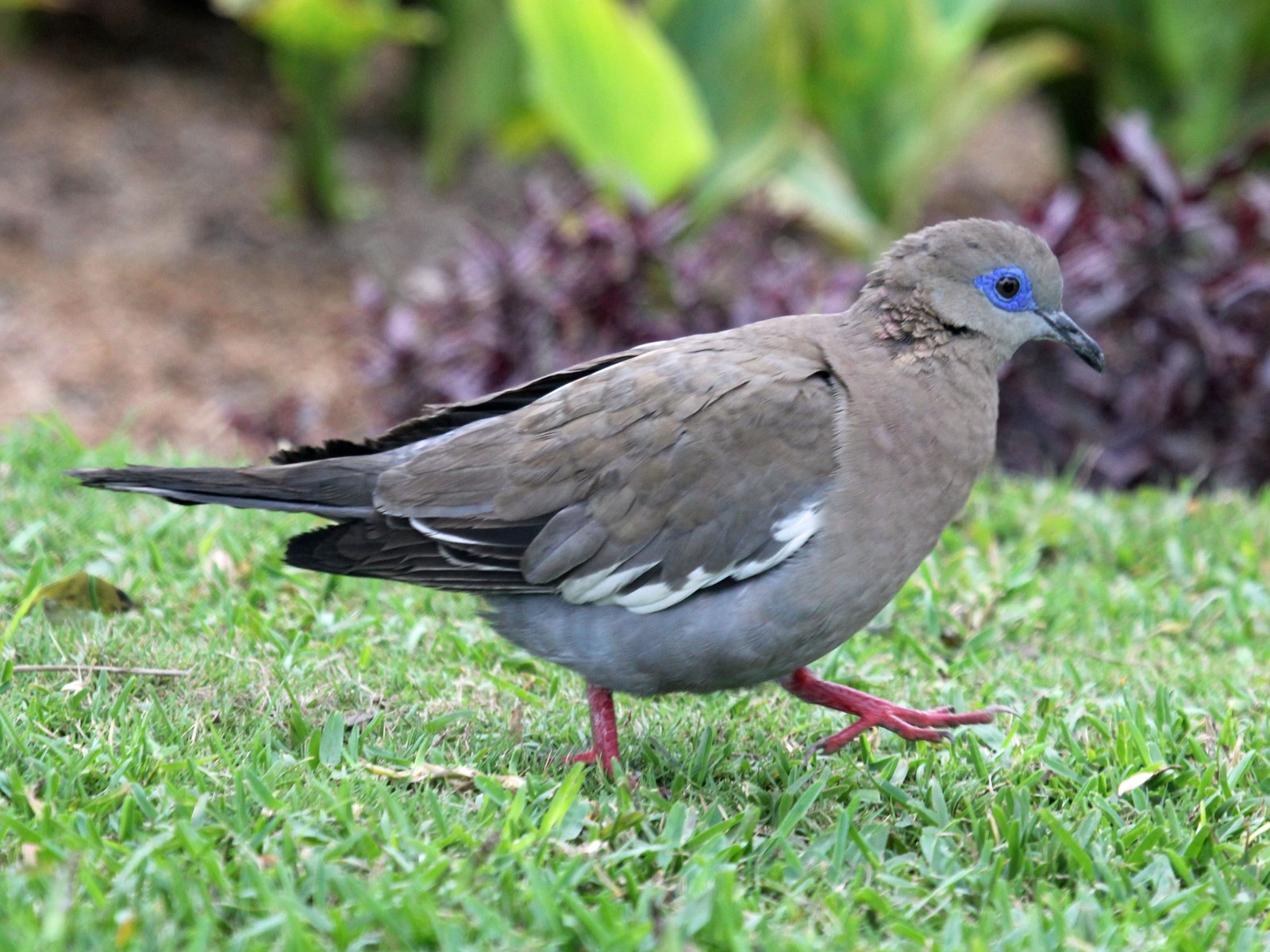
The West Peruvian Dove is the large, greyish-brown dove of the coastal desert and oases of Ecuador, Peru and northern Chile, with a broad white wing band and blue skin around the eye. It is one of the commonest birds in coastal cities such as Lima. The scientific name meloda refers to its melodious call.
Voice
A rhythmic, melodious series of cooing notes, roughly coo-coo-croo-cooo, longer and more varied than that of Eared Dove, often from antennas, roofs and treetops.
Recording: Jerome Fischer — CC BY-NC-SA 4.0 · xeno-canto
Identification
26–29 cm, stocky, with a fairly short, rounded tail. Upperparts greyish brown, head and underparts paler grey with a pinkish-brown tinge on the breast. A small black spot below the ear coverts and a purplish gloss on the sides of the neck. The bare skin around the eye is bright blue, the iris red to orange. A broad white band runs along the folded wing, visible in flight as a white patch on the wing against blackish flight feathers. The tail has a black band and white tips to the outer feathers. Legs red. The sexes are nearly alike; young birds are duller and browner.
Confusion species
Eared Dove Zenaida auriculata is smaller and slimmer, with two black lines on the head, black spots on the wing and no white wing band. White-winged Dove Zenaida asiatica, with which it was formerly treated as one species, occurs in the guide area only on San Andrés and Providencia; it has less blue skin around the eye and a different song. White-tipped Dove Leptotila verreauxi has no white wing band and a pale head, and lives more in woodland.
Habitat
Coastal desert with oases and scrub, irrigated farmland in the coastal valleys, dry forest and thorn scrub, riparian woodland, parks, gardens and cities, from sea level to about 2500 m in the western Andean valleys, locally higher. It eats seeds, grain and fruit, on the ground and in trees. It nests in trees, also in cities, and breeds almost year-round.
Where the bird is most at home, classified by the vegetation units of the Andes and the west coast.


Range and movements
In Ecuador in the south-west, along the coast and in the dry valleys of El Oro and Loja; in Peru along the entire coast and in the dry valleys of the west slope, locally also in dry inter-Andean valleys. Absent from Colombia, Bolivia and the Galápagos. Outside the guide area in northern Chile.
- Resident
- dark = core range, pale = thinly spread
How and when to look
Almost everywhere in Lima, Trujillo, Arequipa and other coastal cities of Peru, in squares, parks and on roofs; also in the oases and fields of the coastal valleys.
Conservation status
Least Concern. Very common and expanding, benefiting from irrigated agriculture and urban greenery.
Scientific name
Zenaida meloda | (Tschudi, 1843)
Tschudi described the species in 1843 as Columba meloda; because it was later moved to another genus, the author and year stand in brackets. The genus Zenaida was introduced in 1838 by Bonaparte. The genus name honours Zénaïde Laetitia Julie Bonaparte (1801–1854), wife of Charles Lucien Bonaparte, who described the genus, and niece of Napoleon. The species name comes from Greek melōidos, 'singing, melodious', after the call. The specimen the first description was based on came from Western slope of the Andes, Peru.