All species › Passerines › Tanagers and allies › White-throated Sierra Finch
White-throated Sierra Finch | Idiopsar erythronotus
Witkeelsierragors | Yal gorjiblanco | Tico-tico-serrano-de-garganta-branca
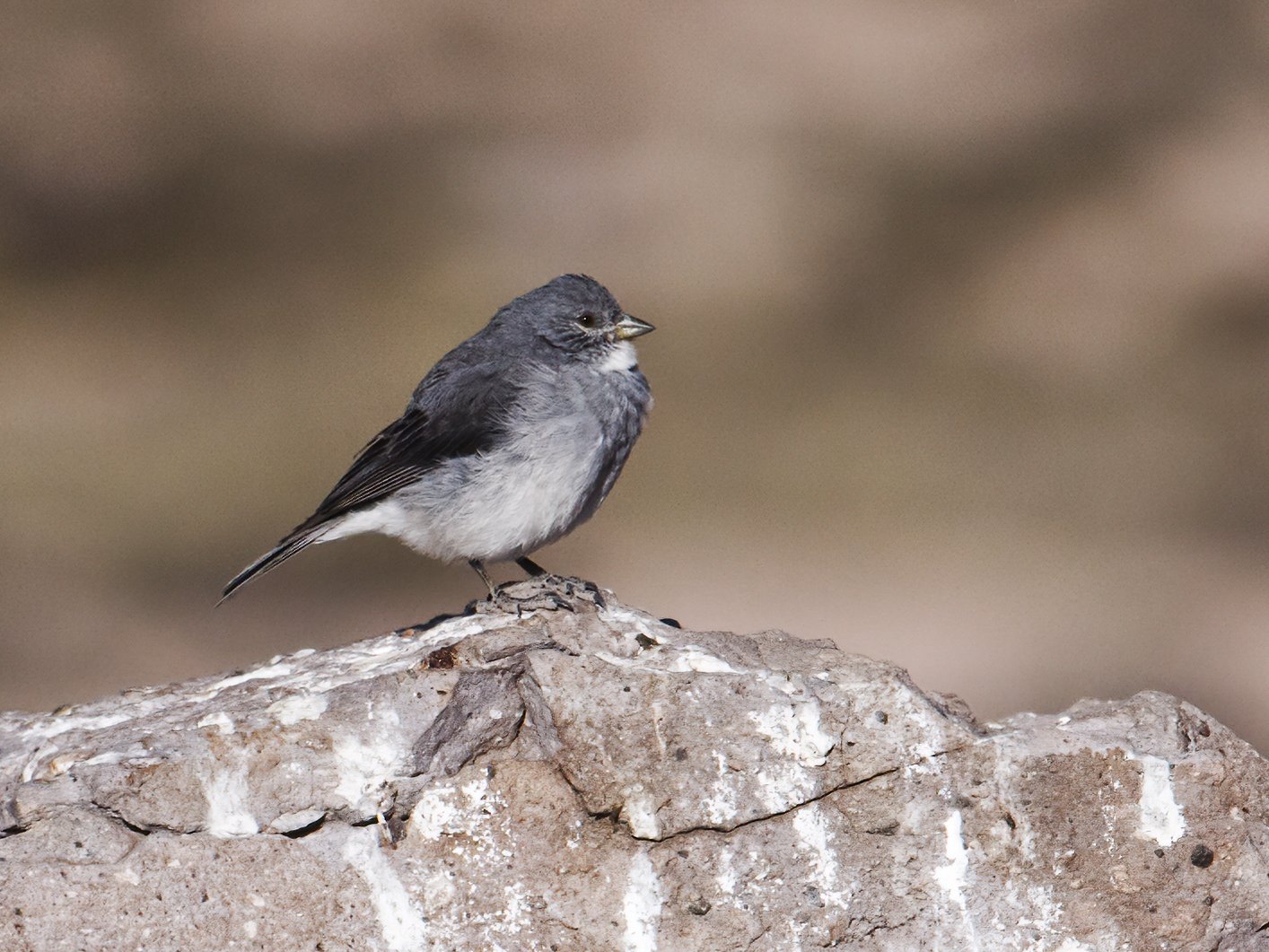
The White-throated Sierra Finch is a large, grey sierra finch of the puna of southern Peru, western Bolivia and northern Chile. Despite the scientific name erythronotus ('red-backed'), adults have a grey back; only young birds are warm brown above. It occurs patchily and locally.
Voice
Mainly short, whistled contact calls; the song is poorly described.
Recording: Niels Krabbe — CC BY-NC-SA 3.0 · xeno-canto
Identification
17 cm, with a long, conical, blackish bill. The adult plumage is largely grey, with a white throat and whitish underparts; the wings are darker, almost blackish, and contrast with the grey body. The sexes are similar. Young birds have a warm brown back and are duller.
Confusion species
Red-backed Sierra Finch Idiopsar dorsalis lives farther south and has a chestnut-red back; young White-throated Sierra Finches can look similar. Plumbeous Sierra Finch Geospizopsis unicolor is smaller and plain lead-grey, without a white throat, and has a shorter bill. Glacier Finch Idiopsar speculifer has a white wing patch and a white crescent below the eye. Ash-breasted Sierra Finch Geospizopsis plebejus is much smaller, with a streaked back.
Habitat
Rocky slopes, scree and the edges of bofedales on the puna, roughly between 3800 and 4800 m. It feeds on the ground on seeds and insects, often among stones. The nest is poorly described.
Where the bird is most at home, classified by the vegetation units of the Andes and the west coast.


Range and movements
In Peru in the south, in the highlands of Arequipa, Moquegua, Tacna and Puno. In Bolivia in the west, in the highlands of La Paz and Oruro. Absent from Colombia, Ecuador and the Galápagos. Outside the guide area in the far north of Chile.
- Resident
- dark = core range, pale = thinly spread
How and when to look
Search the highlands of Tacna and the border area with Chile and Bolivia, along rocky slopes near bofedales; the species is patchily distributed and locally scarce. In Lauca National Park in Chile, just outside the guide area, it is seen regularly.
Conservation status
Least Concern. Patchily distributed and not numerous, but with no known specific threats.
Scientific name
Idiopsar erythronotus | (Philippi & Landbeck, 1861)
Philippi & Landbeck described the species in 1861 as Chlorospiza erythronotus; because it was later moved to another genus, the author and year stand in brackets. The genus Idiopsar was introduced in 1867 by Cassin. The genus name combines Greek idios, 'distinct, peculiar', with psar, 'starling'. The species name comes from Greek eruthros, 'red', and nōton, 'back'. The specimen the first description was based on came from Putre or Parinacota, Arica, Chile.