All species › Passerines › Tanagers and allies › Red-backed Sierra Finch
Red-backed Sierra Finch | Idiopsar dorsalis
Roodrugsierragors | Yal dorsirrojo | Tico-tico-serrano-de-dorso-ruivo
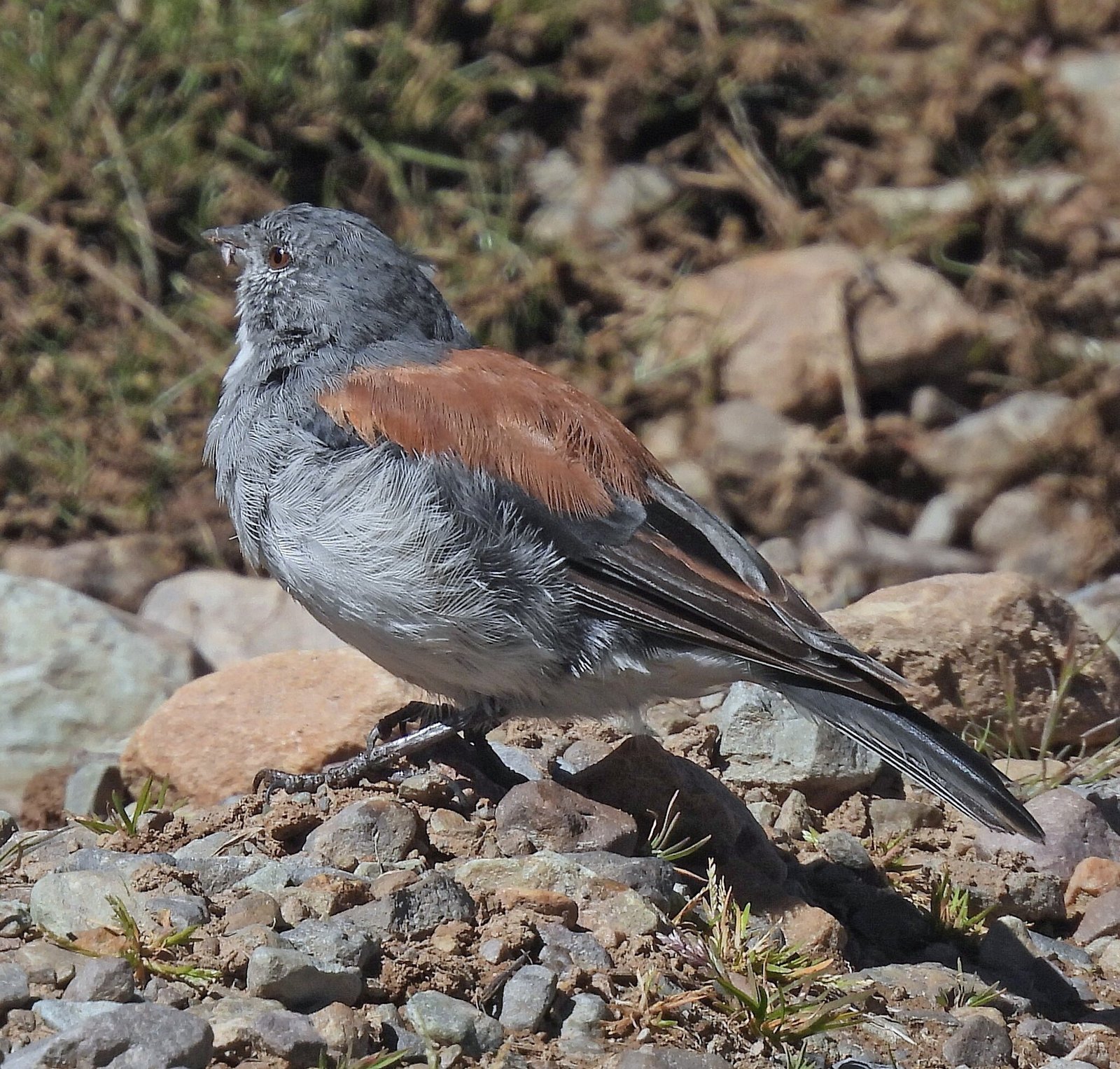
The Red-backed Sierra Finch is a large, grey sierra finch of the high altiplano, with a chestnut-red back as its clearest feature. It is closely related to the White-throated Sierra Finch, which lives to its north and west; the two are sometimes treated as one species and hybrids have been reported. In the guide area it lives mainly in south-western Bolivia.
Voice
A quiet species; mainly short, whistled contact calls. The song is poorly described.
Recording: Nick Athanas — CC BY-NC-SA 3.0 · xeno-canto
Identification
17 cm, with a fairly long, conical, dark grey bill. The head, neck and breast are grey, the throat is white and the belly whitish. The back and scapulars are chestnut-red and contrast sharply with the grey head and the dark wings and tail. The sexes are similar; the female is slightly duller. Young birds are browner and faintly streaked.
Confusion species
Adult White-throated Sierra Finch Idiopsar erythronotus has a grey back without red; young birds of that species do have a warm brown back and have been mistaken for Red-backed. Plumbeous Sierra Finch Geospizopsis unicolor is smaller and plain grey, without a white throat. Glacier Finch Idiopsar speculifer has a white wing patch and a white crescent below the eye. Black-hooded Sierra Finch Phrygilus atriceps has a black head and yellow underparts.
Habitat
Rocky slopes on the high altiplano, often near streams and bofedales, roughly between 3800 and 5000 m. It feeds on the ground among stones and low vegetation on seeds and insects. The nest is poorly described.
Where the bird is most at home, classified by the vegetation units of the Andes and the west coast.


Range and movements
In Bolivia mainly in the south-west, in the highlands of Potosí and southern Oruro. Absent from Colombia, Ecuador and the Galápagos; reports from southern Peru are uncertain, because young White-throated Sierra Finches look similar. Outside the guide area in the highlands of Antofagasta in Chile and locally in north-western Argentina.
- Resident
- dark = core range, pale = thinly spread
How and when to look
Search south-western Bolivia, for example the highlands of Sud Lípez, along rocky stream valleys and bofedales; watch for the chestnut-red back as a bird flies off between the stones.
Conservation status
Least Concern. The range is limited and thinly occupied, but largely remote; no threats are known.
Scientific name
Idiopsar dorsalis | (Cabanis, 1883)
Cabanis described the species in 1883 as Phrygilus dorsalis; because it was later moved to another genus, the author and year stand in brackets. The genus Idiopsar was introduced in 1867 by Cassin. The genus name combines Greek idios, 'distinct, peculiar', with psar, 'starling'. The species name comes from Latin dorsalis, 'of the back', from dorsum, 'back'. The specimen the first description was based on came from Cerro Bayo, Tucumán, Argentina.