All species › Passerines › Tanagers and allies › Many-colored Chaco Finch
Many-colored Chaco Finch | Saltatricula multicolor
Veelkleurige chacogors | Pepitero chico | Bico-de-pimenta-do-chaco
The Many-colored Chaco Finch is a small, saltator-like bird of the dry woodland and scrub of the Gran Chaco, with a yellow bill and a black face. Together with the Black-throated Saltator it forms the genus Saltatricula. In the guide area it lives only in the Chaco of south-eastern Bolivia.
Voice
The song is a fast, persistent series of repeated notes, given from a prominent perch and often also in the heat of the day. Calls are a dull chup or chu-chup and a high sweep.
Recording: Nick Athanas — CC BY-NC-SA 3.0 · xeno-canto
Identification
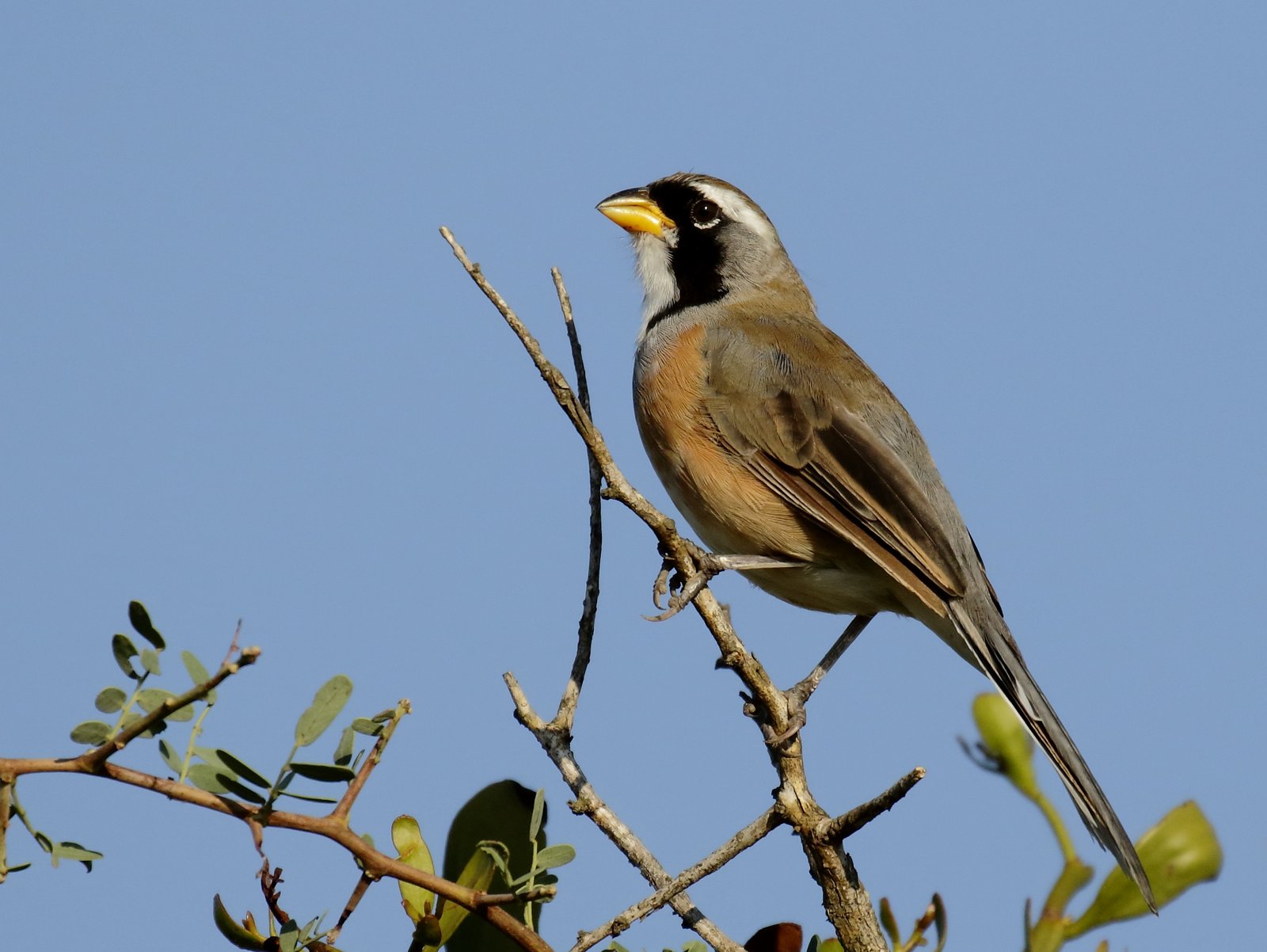
16–18 cm, with a yellow, conical bill with a dark culmen. The crown is pale brown. The forehead, lores, cheeks and sides of the neck form a black mask, with a bold white stripe behind the eye; the chin and throat are whitish. The upperparts are pale brown, turning grey towards the rump. The breast forms a grey band; the sides of the breast and the flanks are bright cinnamon, and the belly is white. The long, blackish tail has white corners. The female is slightly duller, with a smaller mask. Juveniles are paler, with a blackish bill with yellow edges.
Confusion species
Black-throated Saltator Saltatricula atricollis is larger, with an orange bill, a black throat and no cinnamon flanks, and lives in the cerrado further north. Golden-billed Saltator Saltator aurantiirostris is larger, with an orange bill, a white throat and a black breast band. Chaco Sparrow Rhynchospiza strigiceps has a striped head and a dark upper mandible, without a black mask.
Habitat
Dry Chaco woodland, thorn scrub with grassy edges, roadsides, field edges and open country with shrubs, in the lowlands, mostly below 500 m. It forages mainly on the ground and in low vegetation for seeds, as well as insects and fruit. The nest is a well-hidden cup of grass low in a shrub or on the ground; it is often parasitised by Shiny Cowbird.
Where the bird is most at home, classified by the vegetation units of the Andes and the west coast.


Range and movements
In Bolivia only in the Chaco of the south-east, in southern Santa Cruz, Chuquisaca and Tarija. Absent from Colombia, Ecuador, Peru and the Galápagos. Outside the guide area in the Chaco of Paraguay and northern Argentina and into north-western Uruguay; at the northern edge of the range numbers vary, which may point to wandering.
- Resident
- dark = core range, pale = thinly spread
How and when to look
Drive or walk in the Bolivian Chaco along roadsides and the edges of thorn scrub; the birds sing from the tops of shrubs and forage on the verges.
Conservation status
Least Concern. The species tolerates open, grazed country, but Chaco woodland is disappearing rapidly through clearance for agriculture and ranching.
Scientific name
Saltatricula multicolor | (Burmeister, 1860)
Burmeister described the species in 1860 as Saltator multicolor; because it was later moved to another genus, the author and year stand in brackets. The genus Saltatricula was introduced in 1861 by Burmeister. The genus name is a Latin diminutive of the genus Saltator, introduced by Vieillot in 1816. The species name comes from Latin multicolor, 'many-coloured'. The specimen the first description was based on came from Paraná, Entre Ríos, Argentina.