All species › Passerines › Tanagers and allies › Black-throated Saltator
Black-throated Saltator | Saltatricula atricollis
Zwartkeelsaltator | Pepitero gorjinegro | Bico-de-pimenta
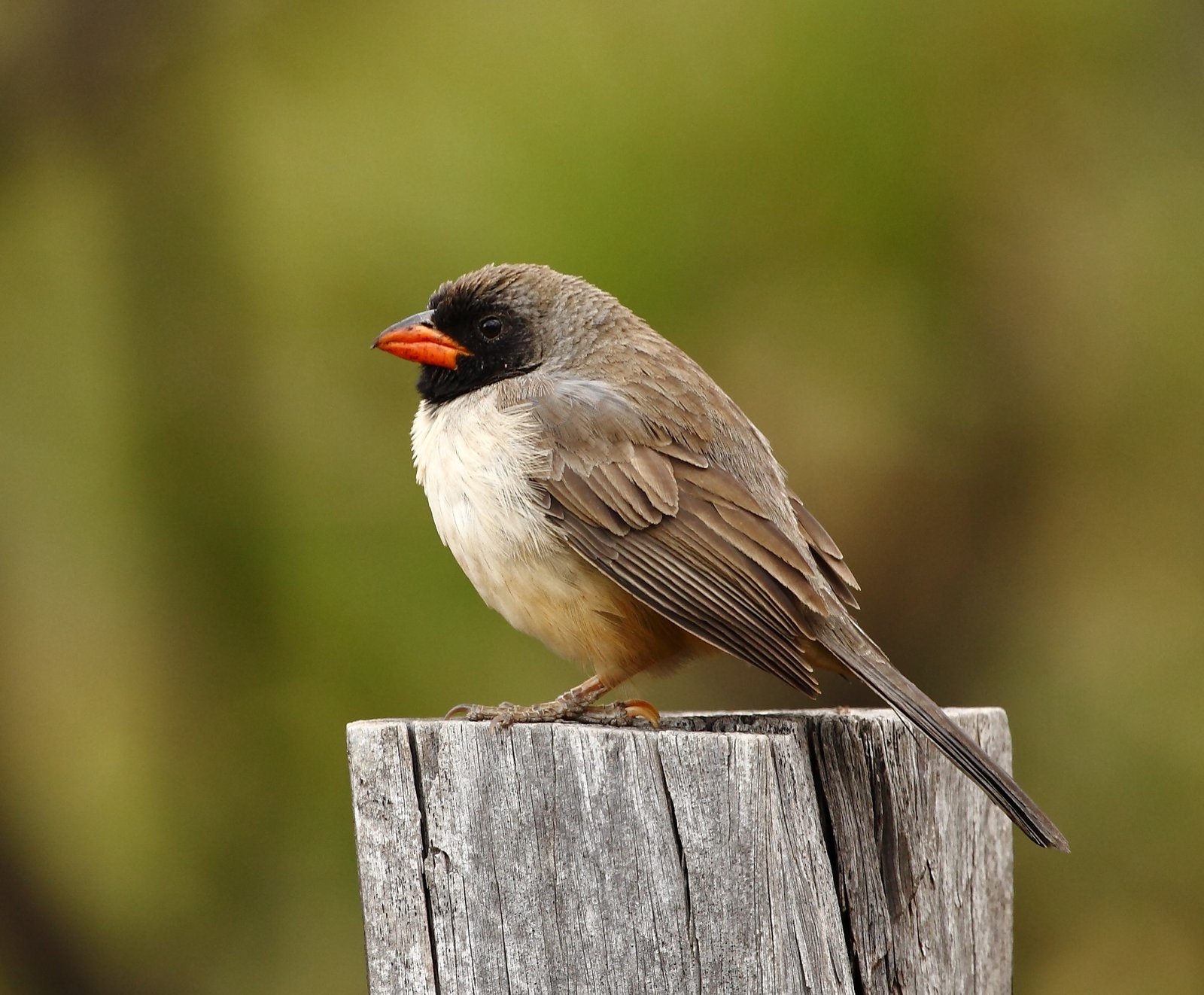
The Black-throated Saltator is a saltator of the cerrado and open savannas of interior South America, with a black face and an orange bill. It is now placed with the Many-colored Chaco Finch in the genus Saltatricula, apart from the true saltators. In the guide area it occurs only in eastern Bolivia.
Voice
The song consists of short, clear, somewhat musical phrases, often given from a prominent perch. The call is a short, metallic chip. Pairs and small groups keep in touch with soft calls.
Recording: Robson Silva e Silva — CC BY-NC-SA 4.0 · xeno-canto
Identification
20 cm, with a thick, conical, orange to orange-red bill. The forehead, face and throat are black. The upperparts are brownish grey, the wings and tail slightly darker. The underparts are whitish to pale buff, with a warmer, brownish wash on the breast and flanks. The sexes are alike. Juveniles are duller, with less black on the face and a darker bill.
Confusion species
Many-colored Chaco Finch Saltatricula multicolor is smaller, with a yellow bill, a white stripe behind the eye, a grey breast band and cinnamon flanks, and lives in the Chaco. Golden-billed Saltator Saltator aurantiirostris also has an orange bill, but has grey upperparts, a white eyebrow, a white throat and a black breast band. Pampa Finch Embernagra platensis is greenish, with an orange bill and no black throat, and lives in wet grassland.
Habitat
Cerrado, open savanna with scattered trees and shrubs, and the edges of dry forest, in the guide area in lowlands and hills up to about 1000 m. It lives in pairs or small groups and often perches on top of shrubs. It eats seeds, fruit and insects, partly on the ground. The nest is a cup in a shrub or small tree.
Where the bird is most at home, classified by the vegetation units of the Andes and the west coast.


Range and movements
In Bolivia only in the east, in the cerrado and open savannas of Santa Cruz along the border with Brazil. Absent from Colombia, Ecuador, Peru and the Galápagos. Outside the guide area in interior central and eastern Brazil and in north-eastern Paraguay.
- Resident
- dark = core range, pale = thinly spread
How and when to look
Search in eastern Santa Cruz in open cerrado with scattered shrubs, especially in the early morning, when the birds perch on top of shrubs and sing.
Conservation status
Least Concern. The cerrado is being converted to cropland and pasture on a large scale, which may cause local declines.
Scientific name
Saltatricula atricollis | (Vieillot, 1817)
Vieillot described the species in 1817 as Saltator atricollis; because it was later moved to another genus, the author and year stand in brackets. The genus Saltatricula was introduced in 1861 by Burmeister. The genus name is a Latin diminutive of the genus Saltator, introduced by Vieillot in 1816. The species name comes from Latin ater, 'zwart', en collum, 'hals', for the black throat. The specimen the first description was based on came from Paraguay.