All species › Passerines › Tanagers and allies › White-winged Shrike-Tanager
White-winged Shrike-Tanager | Lanio versicolor
Witvleugelklauwiertangare | Tangara aliblanca | Pipira-de-asa-branca
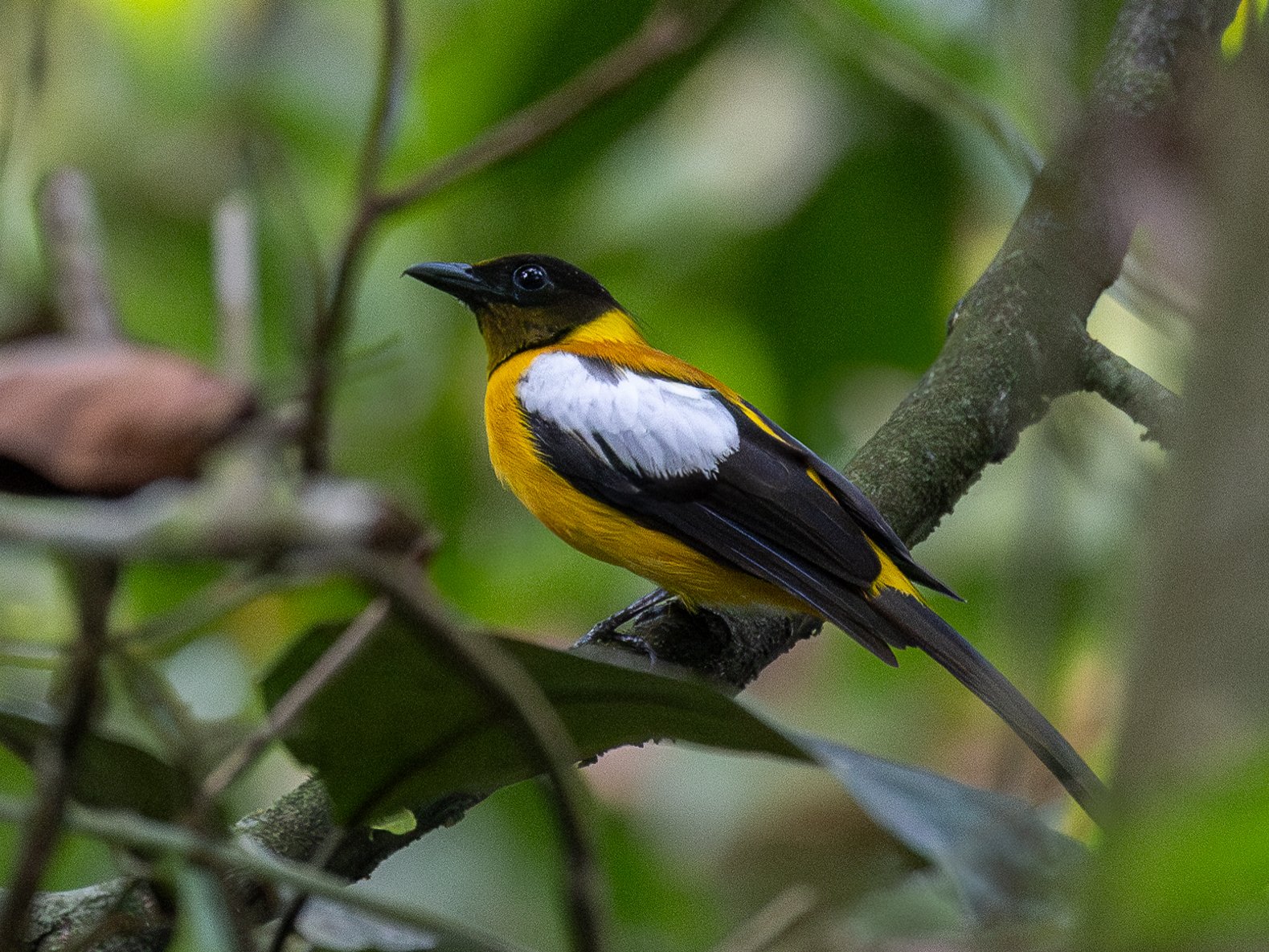
The White-winged Shrike-Tanager is a tanager with a heavy, hook-tipped bill, of the canopy of Amazonian forest south of the Amazon and the Marañón. The male is black and yellow, with a large white wing patch. It lives almost always in mixed flocks and gives loud alarm calls within them.
Voice
A loud, sharp chew or chip, often repeated, with which it alerts the mixed flock; the song is a simple series of clear notes.
Recording: Fernando Igor de Godoy — CC BY-NC-SA 4.0 · xeno-canto
Identification
16–17 cm, with a heavy, dark bill with a small hook at the tip. The male has a black head, black wings with a large white patch and a black tail; the rest of the body is yellow to ochre-yellow, often with an ochre-brown tinge on the breast. The female is olive-brown, paler below with a yellowish centre to the belly. Juveniles resemble the female.
Confusion species
Male Fulvous Shrike-Tanager Lanio fulvus is ochre-brown below and lacks the large white wing patch; that species lives north of the Amazon and the Marañón. The female resembles female ant tanagers Habia and Grey-headed Tanager Eucometis penicillata, but has the heavy, hooked bill. Male Yellow-crested Tanager Loriotus rufiventer is smaller, with a pointed bill, a yellow crown and only white scapulars.
Habitat
Middle levels and canopy of humid terra firme and foothill forest, also várzea and tall secondary forest, up to about 1200 m. It often perches upright on an open branch and takes large insects, picking them from leaves or catching them in short sallies. Little is known about the nest.
Where the bird is most at home, classified by the vegetation units of the Andes and the west coast.


Range and movements
In Peru in the Amazonian lowlands and foothills south of the Amazon and the Marañón, mainly in the centre and south-east. In Bolivia in the lowlands of the north and centre, from Pando and Beni to La Paz, Cochabamba and Santa Cruz. Absent from Colombia, Ecuador and the Galápagos. Outside the guide area in Amazonian Brazil south of the Amazon.
- Resident
- dark = core range, pale = thinly spread
How and when to look
In Madre de Dios, for example at Tambopata and in the Manu lowlands, in mixed canopy flocks; listen for the sharp alarm calls and look for a bird sitting upright on an open branch.
Conservation status
Least Concern. The species is widespread and fairly common in undisturbed forest; deforestation in southern Amazonia is the main threat.
Scientific name
Lanio versicolor | (d'Orbigny, ACVMD & de Lafresnaye, 1837)
D'Orbigny, ACVMD & de Lafresnaye described the species in 1837 as T[achyphonus] versicolor; because it was later moved to another genus, the author and year stand in brackets. The genus Lanio was introduced in 1816 by Vieillot. The genus name is derived from the shrike genus Lanius, from Latin lanius, 'butcher'. The species name comes from Latin versicolor, 'many-coloured, changing colour', probably after the difference between the colourful male and the brown female. The specimen the first description was based on came from Yuracarés, Bolivia.