All species › Gamebirds › Guans, curassows and chachalacas › Yellow-knobbed Curassow
Yellow-knobbed Curassow | Crax daubentoni
Geelknobbelhokko | Pavón porú | Mutum-de-carúncula-amarela
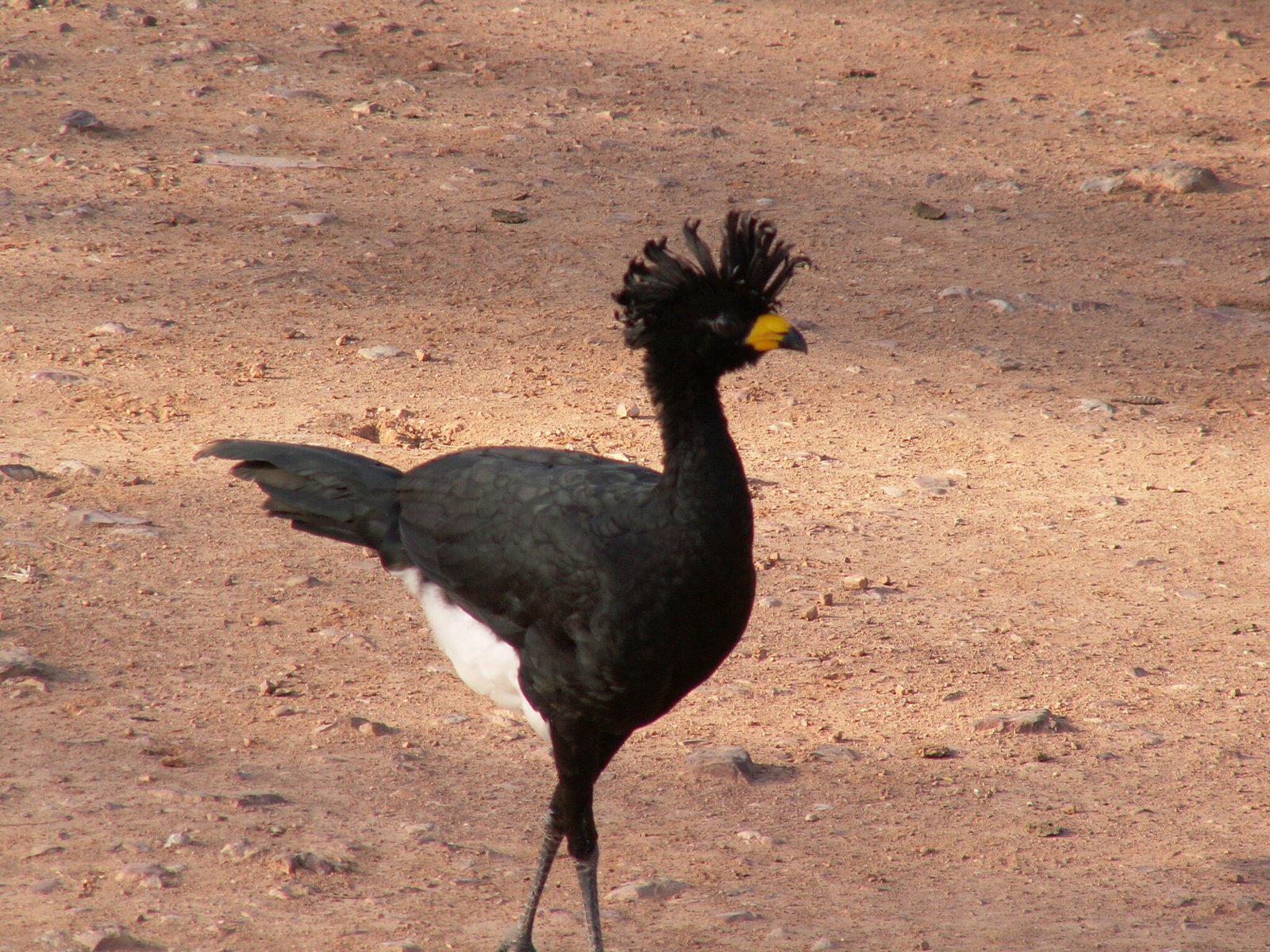
The Yellow-knobbed Curassow is a curassow of the forests in and around the Venezuelan Llanos, reaching the guide area only in north-eastern Colombia. The male bears a conspicuous yellow knob and yellow wattles at the base of the bill. The species lives more in drier and more open forest than most other curassows.
Voice
The male gives a low, humming sound, mainly at dusk and dawn. Also high, shrill whistles as an alarm.
Recording: Joe Klaiber — CC BY-NC-SA 4.0 · xeno-canto
Identification
84–92 cm. The male is glossy black with a crest of curled feathers, a white lower belly and undertail and a white tail tip; a round yellow knob and yellow wattles sit at the base of the bill. The female is black with white barring on the breast, a white belly and a black-and-white barred crest; she lacks the knob. Young birds resemble the female.
Confusion species
Blue-billed Curassow Crax alberti has a blue bill base in the male and lives further west. Black Curassow Crax alector of the Amazon and Orinoco lowlands lacks the knob and has a red to orange-yellow bill base. Helmeted Curassow Pauxi pauxi has a grey-blue casque and a red bill and lives in montane forest.
Habitat
Gallery forest along rivers, deciduous and semi-evergreen forest and forest edges in and around the savannas, from the lowlands into the foothills, locally to about 1400 m. It forages on the ground for fruit, seeds and leaves. The nest is in a tree.
Where the bird is most at home, classified by the vegetation units of the Andes and the west coast.


Range and movements
In Colombia only locally in the north-east, near the Venezuelan border; the limits of its occurrence are poorly known. Absent from Ecuador, Peru and Bolivia. Outside the guide area in northern Venezuela, especially in the Llanos and at the foot of the Andes and the coastal cordillera.
- Resident
- dark = core range, pale = thinly spread
How and when to look
In the guide area the species has been recorded only rarely. In Venezuela birds are often seen in the early morning as they come out of gallery forest into open places.
Conservation status
Near Threatened. Numbers are declining through hunting and clearance of gallery forest; in protected areas and on large ranches without hunting the species is still locally common.
Scientific name
Crax daubentoni | Gray, 1867
Gray described the species in 1867 and placed it straight away in the genus where it still stands. The genus Crax was introduced in 1758 by Linnaeus. The genus name comes from Greek kra, a humorous abbreviation of kranos, 'helmet', for the head feathers. Linnaeus introduced the name in 1744. The species name honours the French naturalist Edmé Louis Daubenton (or d’Aubenton) (1732–1788). The specimen the first description was based on came from Venezuela.