All species › Gamebirds › Guans, curassows and chachalacas › Blue-billed Curassow
Blue-billed Curassow | Crax alberti
Blauwknobbelhokko | Pavón piquiazul | Mutum-de-bico-azul
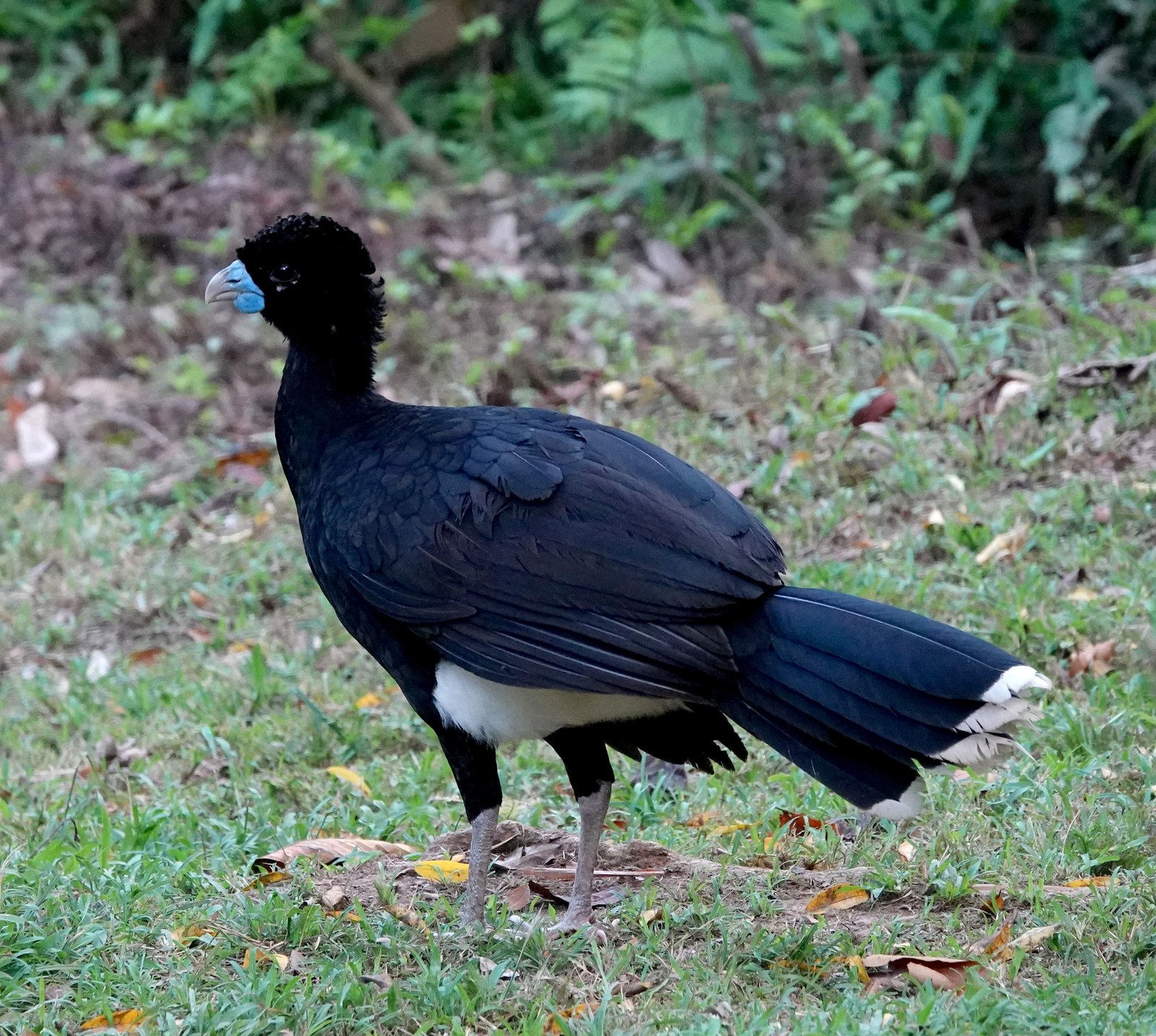
The Blue-billed Curassow occurs only in northern Colombia and is one of the most threatened gamebirds of the Americas. The male is identified by the blue skin and wattles at the base of the bill, found in no other curassow. The remaining population lives scattered in small forest fragments in the Magdalena valley and adjacent mountain slopes.
Voice
The male gives a very low, humming sound, mainly in the breeding season and before dawn. Also high whistles as contact and alarm calls.
Recording: Iván Lau — CC BY-NC-SA 4.0 · xeno-canto
Identification
82–92 cm. A large curassow with a crest of curled black feathers. The male is glossy black with a white lower belly, undertail and tail tip; the cere and wattles at the base of the bill are bright blue. The female is black with fine white barring on the wings, a rufous belly and undertail and a black-and-white barred crest; the bill base is bluish without wattles. Young birds resemble the female.
Confusion species
Great Curassow Crax rubra lives further west; the male has a yellow knob, the female is usually rufous. Yellow-knobbed Curassow Crax daubentoni of the north-east has a yellow knob and wattles in the male. Helmeted Curassow Pauxi pauxi lives higher in montane forest and has a grey-blue casque on the forehead and a red bill.
Habitat
Humid forest in the lowlands and foothills, roughly up to 1200 m, mainly in undisturbed forest on slopes; locally in old secondary forest. It forages on the ground for fruit, seeds and small animals. The nest is in a tree; the clutch is usually two eggs.
Where the bird is most at home, classified by the vegetation units of the Andes and the west coast.


Range and movements
Endemic to Colombia: in the middle Magdalena valley, the Serranía de San Lucas and the foothills of the Central and Eastern Andes, with old records from around the Sierra Nevada de Santa Marta. Absent from Ecuador, Peru and Bolivia.
- Resident
- dark = core range, pale = thinly spread
How and when to look
The El Paujil reserve in the Serranía de las Quinchas (Boyacá) was set up specifically for this species. Birds are shy and walk away over the forest floor; in the early morning the low humming of the male can be heard.
Conservation status
Critically Endangered. The population is very small and fragmented through forest clearance for cattle, farming and mining, and through hunting. Protection of forest fragments and captive breeding programmes aim to conserve the species.
Scientific name
Crax alberti | Fraser, 1852
Fraser described the species in 1852 and placed it straight away in the genus where it still stands. The genus Crax was introduced in 1758 by Linnaeus. The genus name comes from Greek kra, a humorous abbreviation of kranos, 'helmet', for the head feathers. Linnaeus introduced the name in 1744. The species name honours Prince Albert of Saxe-Coburg and Gotha (1819–1861), consort of Queen Victoria. The specimen the first description was based on came from (per the description).