All species › Gamebirds › Guans, curassows and chachalacas › Great Curassow
Great Curassow | Crax rubra
Bruine hokko | Hocofaisán | Mutum-grande
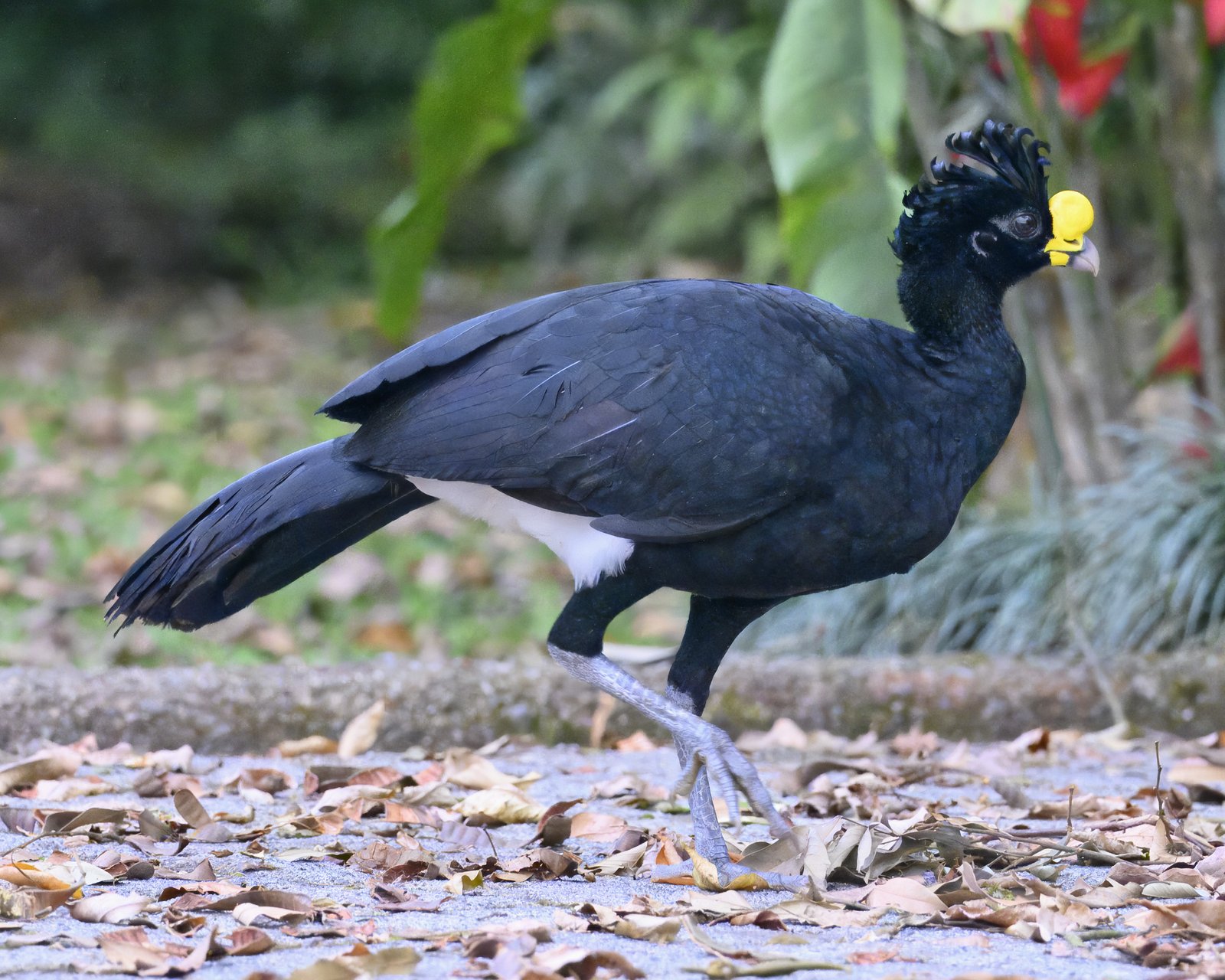
The Great Curassow is one of the heaviest gamebirds in the guide area and the only curassow of the Pacific lowlands of Colombia and Ecuador. Male and female differ strongly: the male is black with a yellow knob on the bill, the female usually rufous with a black-and-white barred head. The species lives on the floor of undisturbed lowland forest and has declined sharply through hunting.
Voice
The male gives a very low, humming ummm, often in a short series, mainly in the twilight before dawn. Also a high, thin whistle, used as an alarm as well.
Recording: Ilias Van Hende — CC BY-NC-SA 4.0 · xeno-canto
Identification
78–92 cm. Large and heavy, with a long, broad tail and a crest of forward-curled feathers. The male is glossy black with a white lower belly and undertail; a round, yellow knob sits at the base of the bill. The female is variable: usually rufous with finely barred wings and tail, a black-and-white barred head and neck and a black-and-white crest; darker and more heavily barred forms also occur. Young birds resemble the female.
Confusion species
Blue-billed Curassow Crax alberti of northern Colombia has a blue rather than yellow bill base in the male; the female is black with a rufous belly. Their ranges barely meet. Crested Guan Penelope purpurascens is smaller and slimmer, brown with white streaks on the neck and breast and a red dewlap, and is more often in the trees.
Habitat
Undisturbed humid lowland forest and old secondary forest, mainly below 1000 m. It forages on the forest floor for fallen fruit, seeds, leaves and small animals; it roosts in trees and flies up into them when disturbed. The nest is a small cup of twigs and leaves in a tree or among climbers, usually with two eggs.
Where the bird is most at home, classified by the vegetation units of the Andes and the west coast.


Range and movements
In Colombia in the Pacific and north-western lowlands, from Urabá and the Chocó southwards. In Ecuador in the north-west, mainly in Esmeraldas, where it has become very rare. Absent from Peru, Bolivia and the Galápagos. Outside the guide area from eastern Mexico through Central America.
- Resident
- dark = core range, pale = thinly spread
How and when to look
The best chance is in large, protected forest areas in the Chocó with little hunting. Birds usually walk away quietly over the forest floor; in the early morning the male gives itself away by its low humming.
Conservation status
Vulnerable. Numbers are declining through hunting and the loss of lowland forest; the species has disappeared from large parts of the guide area and is very rare in Ecuador.
Scientific name
Crax rubra | Linnaeus, 1758
Linnaeus described the species in 1758 and placed it straight away in the genus where it still stands. He introduced the genus Crax in that same work. The genus name comes from Greek kra, a humorous abbreviation of kranos, 'helmet', for the head feathers. Linnaeus introduced the name in 1744. The species name comes from Latin ruber, 'red', for the rufous female. The specimen the first description was based on came from (per the description).