All species › Gamebirds › Guans, curassows and chachalacas › Yungas Guan
Yungas Guan | Penelope bridgesi
Yungassjakohoen | Pava de las yungas | Jacu-das-yungas
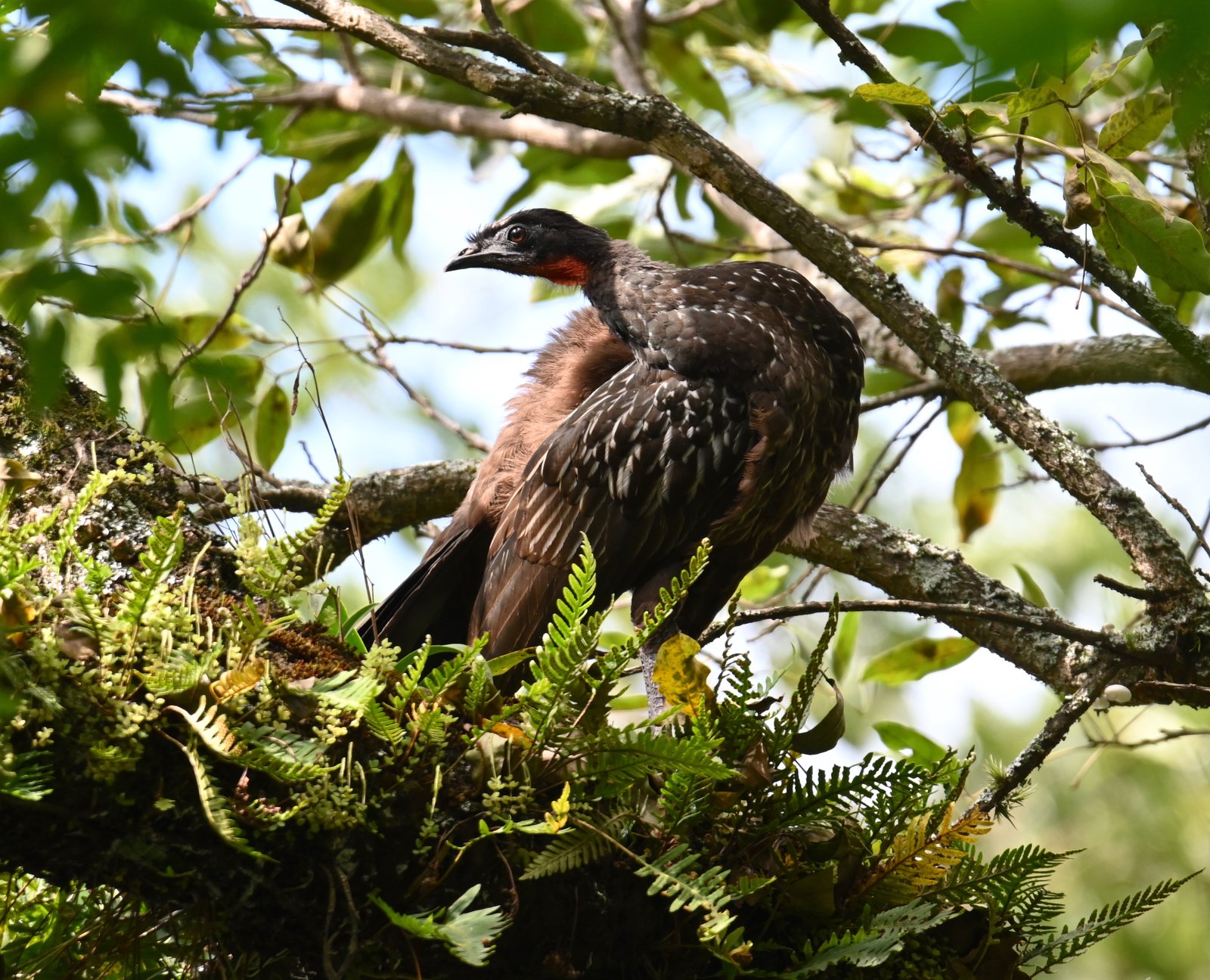
The Yungas Guan is the guan of the Yungas forests on the eastern slope of the Andes in Bolivia and north-western Argentina. It was long included in Dusky-legged Guan, with which it shares dark legs. In Bolivia it is one of the most frequently seen gamebirds in forested mountain valleys.
Voice
Loud, harsh, honking calls and a raucous cackle, mainly in the morning and at dusk. At dawn a rattling wing-drumming during a short flight.
Recording: Luis Fernandez Campos — CC BY-NC-SA 4.0 · xeno-canto
Identification
68–75 cm, a large, dark olive-brown guan with a long tail and a short crest. The neck, breast and mantle have narrow white feather edges, giving a streaked pattern; the belly is browner and plainer. The bare skin around the eye is blue-grey and the dewlap is bright red. The legs are dark grey to blackish. The sexes are alike.
Confusion species
Red-faced Guan Penelope dabbenei has red bare facial skin, no or a very small dewlap and reddish legs, and in the south often lives higher. Andean Guan Penelope montagnii is smaller, with a grey-frosted face, a small dewlap and reddish legs. Spix's Guan Penelope jacquacu is larger, with red legs, and lives lower, in the lowlands and foothills.
Habitat
Humid montane and cloud forest of the Yungas, foothill forest, wooded riverbanks and forest edges, roughly between 500 and 2800 m. It eats fruit, leaves, buds and flowers, mainly in the canopy. The nest is a platform of twigs in a tree.
Where the bird is most at home, classified by the vegetation units of the Andes and the west coast.


Range and movements
In Bolivia on the eastern slope of the Andes, in the Yungas of La Paz, Cochabamba, Santa Cruz, Chuquisaca and Tarija. Absent from Colombia, Ecuador, Peru and the Galápagos. Outside the guide area in north-western Argentina, from Jujuy and Salta to Tucumán and Catamarca.
- Resident
- dark = core range, pale = thinly spread
How and when to look
Search forest edges and roads through the Yungas early in the morning, for example in Amboró or in the mountains of Tarija; birds often sit in the open in fruiting tree crowns and call.
Conservation status
Not evaluated separately; in the older, broader concept of Dusky-legged Guan the species was listed as Least Concern. It suffers locally from hunting and the clearing of montane forest.
Scientific name
Penelope bridgesi | Gray, 1860
Gray described the species in 1860 and placed it straight away in the genus where it still stands. The genus Penelope was introduced in 1786 by Merrem. The genus name comes from Greek mythology: Penelope was the daughter of the Spartan king Icarius and the wife of Odysseus. The species name honours Thomas Charles Bridges (1807–1865), English botanist, zoologist and collector in tropical America. The specimen the first description was based on came from Bolivia.