All species › Passerines › Tapaculos › Zimmer's Tapaculo
Zimmer's Tapaculo | Scytalopus zimmeri
Zimmers tapaculo | Churrín de Zimmer | Macuquinho-de-zimmer
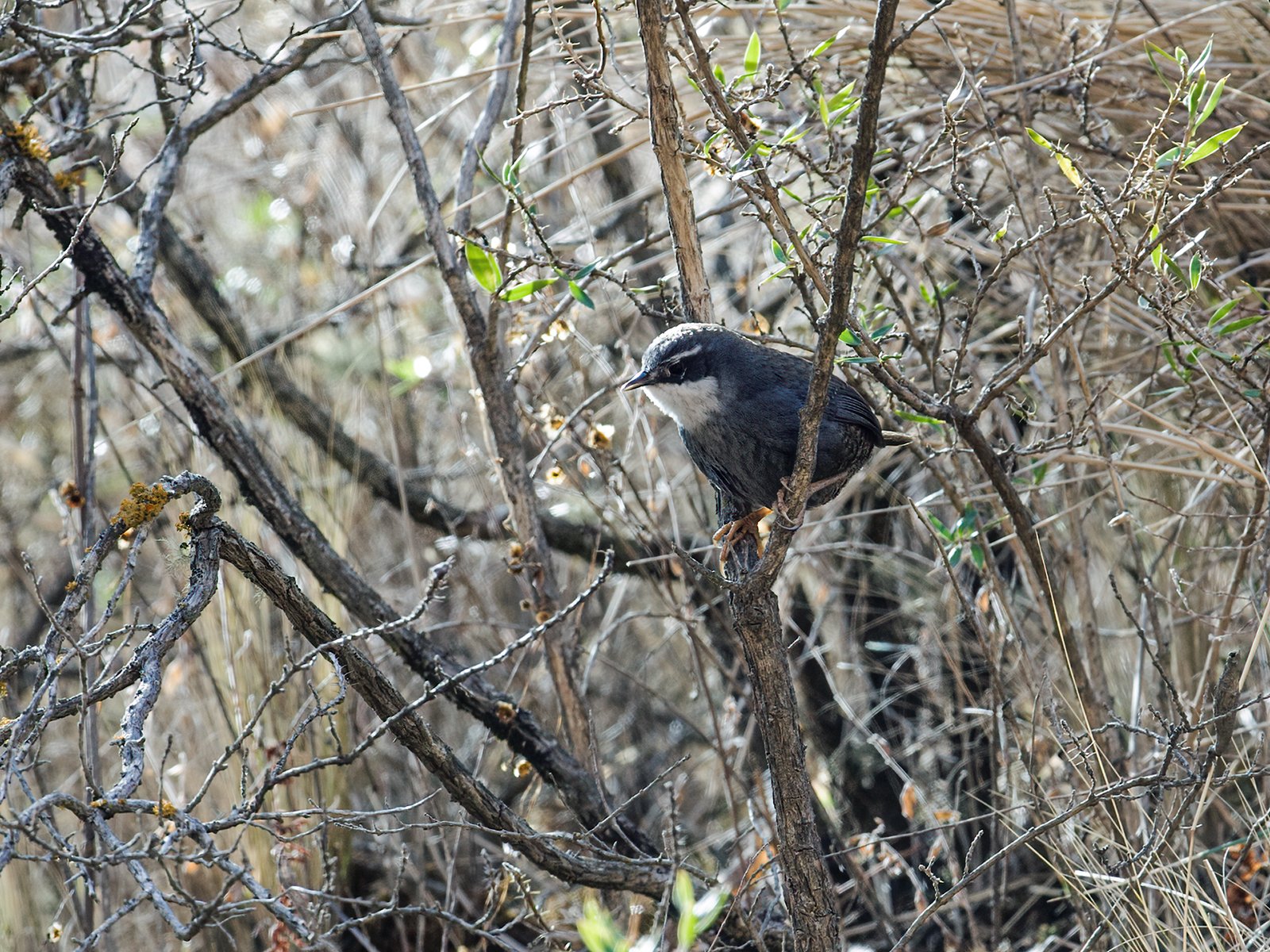
Zimmer's Tapaculo is the southernmost Scytalopus of the guide area, with a pale supercilium and brown, barred flanks. It lives in seasonally humid montane woodland with alder, Podocarpus and Polylepis in southern Bolivia and north-western Argentina. The species is named after the American ornithologist John Todd Zimmer.
Voice
The song is a series of three to five rough notes, repeated at intervals, sometimes for many minutes. The call consists of one or two short, quick notes, repeated at intervals.
Recording: Niels Krabbe — CC BY-SA 3.0 · xeno-canto
Identification
11 cm, round, with a short, often cocked tail, short wings and fairly long legs. The head, back and wings are grey, the back with a brown wash. A pale, whitish supercilium runs above the eye; the throat and upper breast are pale grey, the lower breast and belly grey. The flanks and undertail are olive-brown with dark barring. Juveniles have a faint buff supercilium, olive-brown, barred upperparts and buff, barred flanks.
Confusion species
Bolivian Tapaculo Scytalopus bolivianus lives further north and lower, in humid Yungas forest, and lacks the pale supercilium. Puna Tapaculo Scytalopus simonsi, further north and higher, has a narrower supercilium and a different song. White-browed Tapaculo Scytalopus superciliaris of north-western Argentina, outside the guide area, has a more prominent white supercilium; the two species are closely related.
Habitat
Seasonally humid montane woodland with alder (Alnus), Podocarpus and Polylepis, especially in ravines and shady spots, and open, wet, rocky slopes with bunch grass and shrubs, between about 1700 and 3200 m. It forages on or just above the ground, hidden among roots, rocks and ferns; it also eats seeds. A nest with young was found in October in a crevice in a bank of earth and stones.
Where the bird is most at home, classified by the vegetation units of the Andes and the west coast.


Range and movements
In Bolivia only in the south: in southern Chuquisaca and in Tarija. Absent from Colombia, Ecuador, Peru and the Galápagos. Outside the guide area in north-western Argentina (Jujuy and Salta).
- Resident
- dark = core range, pale = thinly spread
How and when to look
In the morning, search wooded ravines with alder in the mountains of Tarija and listen for the repeated, rough notes. The bird stays close to the ground among rocks and ferns; wait quietly at a spot with a view of the ground.
Conservation status
Least Concern. The range is fairly small and the population size is unknown, but the steep terrain and its tolerance of some habitat disturbance make an immediate threat unlikely.
Scientific name
Scytalopus zimmeri | Bond & Meyer de Schauensee, 1940
Bond & Meyer de Schauensee described the species in 1940 and placed it straight away in the genus where it still stands. The genus Scytalopus was introduced in 1837 by Gould. The genus name combines Greek skutalē or skutalon, 'stick', with pous, 'foot'. The species name zimmeri honours John Todd Zimmer (1889–1957), American ornithologist at the American Museum of Natural History and author of much work on Peruvian birds. The specimen the first description was based on came from Padilla, Chuquisaca, Bolivia.