All species › Passerines › Tapaculos › Puna Tapaculo
Puna Tapaculo | Scytalopus simonsi
Simons' tapaculo | Churrín de la puna | Macuquinho-da-puna
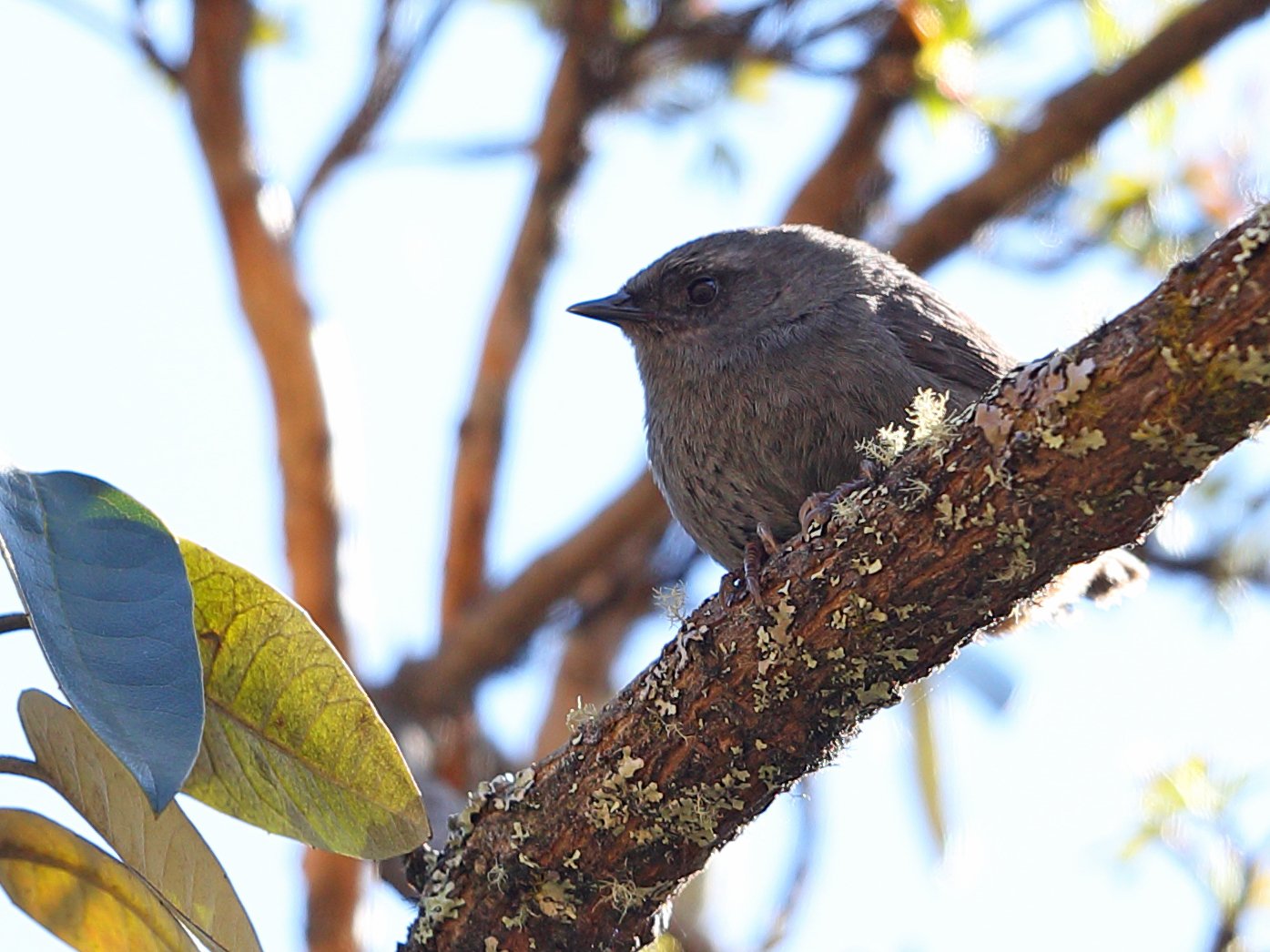
The Puna Tapaculo is a small, grey tapaculo of the treeline on the eastern slope of the Andes in south-eastern Peru and Bolivia. It lives in elfin forest, Polylepis groves and shrubs among grass tussocks above the treeline. Its scientific name honours the American collector Perry O. Simons; since 1997 it has been treated as a separate species on the basis of its voice.
Voice
The song is a series of descending, churring phrases. The call is a descending, whinnying series.
Recording: Niels Krabbe — CC BY-NC-SA 4.0 · xeno-canto
Identification
10–12 cm, round, with a short, often cocked tail, short wings and fairly long legs. The male is grey above, often with a brown wash on the neck and back, and has a narrow, pale supercilium. The throat and breast are grey; the rump, flanks and belly are cinnamon to olive-buff with dark barring. The female resembles the male, but is often browner and paler. Juveniles are paler, with a stronger brown wash above and entirely barred underparts.
Confusion species
Diademed Tapaculo Scytalopus schulenbergi has a silvery-white forecrown and supercilium in the male and lives somewhat lower, in bamboo and dense montane forest. Vilcabamba Tapaculo Scytalopus urubambae, further west in Cuzco, lacks the pale supercilium and has more faintly barred flanks. Trilling Tapaculo Scytalopus parvirostris lives lower in humid montane forest, is darker and has a long trill as its song. In tapaculos the song is the main identification feature.
Habitat
Elfin forest at and near the treeline, small shrubs and trees among grass tussocks above the treeline, and Polylepis groves, between about 2900 and 4300 m. It forages low in the vegetation and on the ground for insects and probably also eats seeds. The only described nest was a grass-lined cup at the end of a burrow about 1 m long, with a loose grass dome and two eggs; both parents fed the young.
Where the bird is most at home, classified by the vegetation units of the Andes and the west coast.


Range and movements
On the eastern slope of the Andes. In Peru in the south-east, from the Cordillera Vilcanota in Cuzco east through Puno. In Bolivia in La Paz and south-east to Cochabamba. Absent from Colombia, Ecuador and the Galápagos. Does not occur outside the guide area.
- Resident
- dark = core range, pale = thinly spread
How and when to look
In the early morning, listen along roads descending from the high plateau across the eastern Andean range to the Yungas, in shrubbery around the treeline, for the descending, churring phrases. The bird sometimes shows briefly on a rock or grass tussock.
Conservation status
Least Concern. The range is limited and the population has not been quantified, but in the short term the species is little affected by human activity; fire and grazing around the treeline degrade the habitat locally.
Scientific name
Scytalopus simonsi | Chubb, 1917
Chubb described the species in 1917 and placed it straight away in the genus where it still stands. The genus Scytalopus was introduced in 1837 by Gould. The genus name combines Greek skutalē or skutalon, 'stick', with pous, 'foot'. The species name simonsi honours Perry O. Simons (1869–1901), American collector who worked in the Andes and was murdered in Argentina. The specimen the first description was based on came from Choquecamate, Cochabamba, Bolivia.