All species › Passerines › Tapaculos › Diademed Tapaculo
Diademed Tapaculo | Scytalopus schulenbergi
Diadeemtapaculo | Churrín diademado | Macuquinho-de-diadema
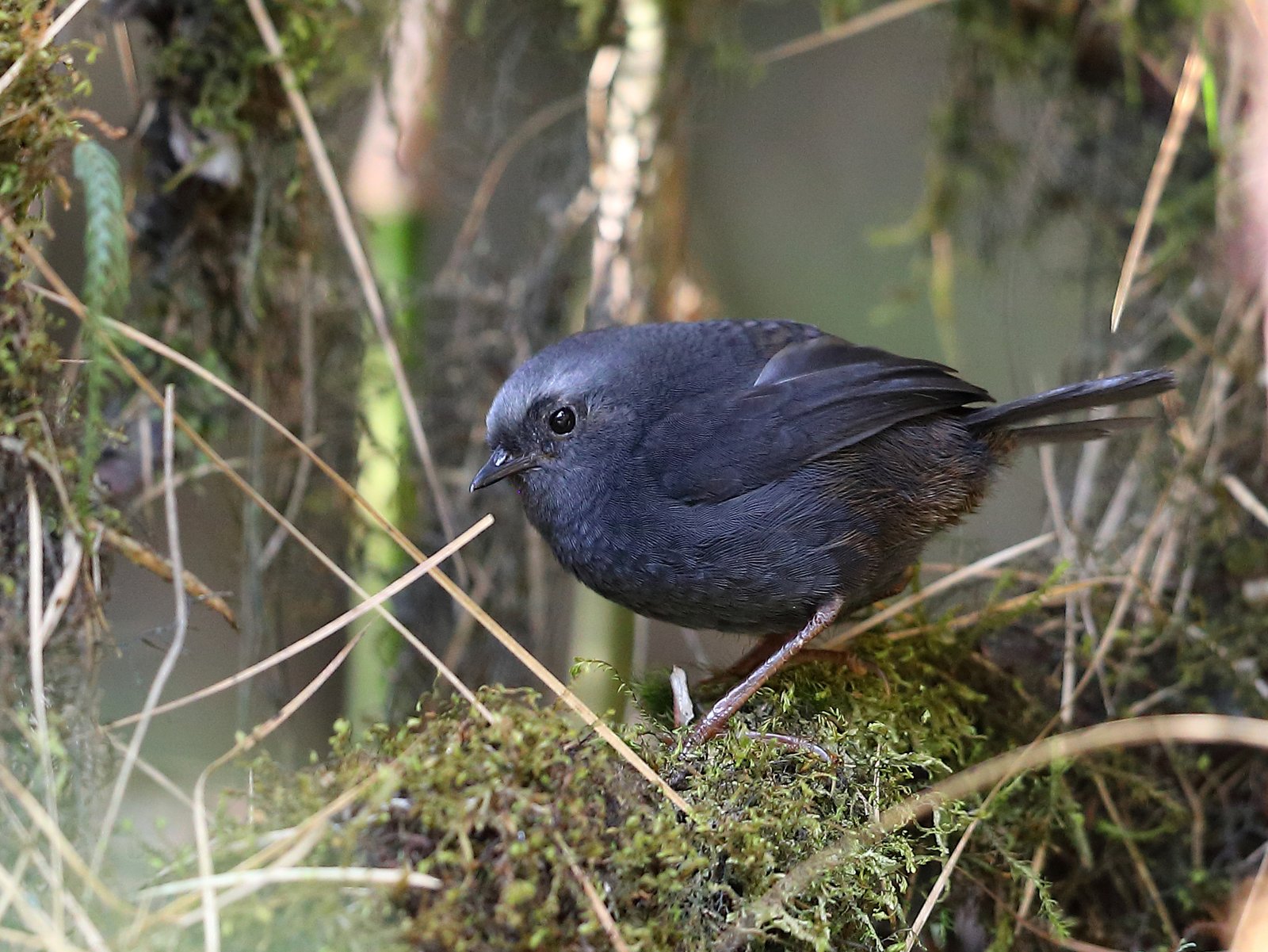
The Diademed Tapaculo is a small tapaculo of the highest montane forest in south-eastern Peru and Bolivia, the male of which has a silvery-white forecrown and supercilium. It lives in bamboo and dense undergrowth just below the treeline. The species was described only in 1994 and is named after the American ornithologist Thomas Schulenberg.
Voice
The song is a trill that varies in intensity, pitch and pace and can last up to about 15 seconds. The scold call is a series of soft notes lasting about one second.
Recording: Niels Krabbe — CC BY-NC-SA 4.0 · xeno-canto
Identification
11 cm, round, with a short, often cocked tail, short wings and fairly long legs. The male has a silvery forecrown and supercilium, with a black mask below. The upperparts are dark grey with a brown wash, and the rump is orange-rufous with dark barring. The underparts are grey, paler in front and darker towards the rear; the flanks and undertail are orange-rufous with dark barring. The female has a smaller, duller pale forecrown and a darker brown wash on the upperparts. Juveniles are golden brown, paler below, with barring and spots.
Confusion species
Puna Tapaculo Scytalopus simonsi lacks the silvery-white forecrown, has only a narrow, pale supercilium and often lives higher, above the treeline. Trilling Tapaculo Scytalopus parvirostris lives lower in humid montane forest, lacks the pale forecrown and has an even, long trill. Bolivian Tapaculo Scytalopus bolivianus also lives lower and lacks the silvery-white markings. In tapaculos the song is the main identification feature.
Habitat
Bamboo and other dense undergrowth in humid montane forest and elfin forest just below the treeline, between about 2800 and 3400 m. It forages quickly on and just above the ground, gleaning insects from moss and leaves and probing mossy branches. The breeding season probably runs from September to January; the only described nest was a ball of moss and lichens.
Where the bird is most at home, classified by the vegetation units of the Andes and the west coast.


Range and movements
On the eastern slope of the Andes. In Peru in the south-east, in Cuzco and Puno. In Bolivia in La Paz and south-east to Cochabamba. Absent from Colombia, Ecuador and the Galápagos. Does not occur outside the guide area.
- Resident
- dark = core range, pale = thinly spread
How and when to look
In the early morning, listen in bamboo and dense forest just below the treeline, along roads descending from the high plateau to the Yungas, for the long, varying trill. The bird stays low in the vegetation; watch for the silvery-white forehead when it appears briefly in a gap.
Conservation status
Least Concern. The population has not been quantified but appears stable, and the species occurs in several protected areas.
Scientific name
Scytalopus schulenbergi | Whitney, 1994
Whitney described the species in 1994 and placed it straight away in the genus where it still stands. The genus Scytalopus was introduced in 1837 by Gould. The genus name combines Greek skutalē or skutalon, 'stick', with pous, 'foot'. The species name schulenbergi honours Thomas S. Schulenberg, American ornithologist who worked extensively in the Andes of Peru and Bolivia. The specimen the first description was based on came from Chuspipata, La Paz, Bolivia.