All species › Passerines › Tapaculos › Vilcabamba Tapaculo
Vilcabamba Tapaculo | Scytalopus urubambae
Cuzcotapaculo | Churrín de Vilcabamba | Macuquinho-de-vilcabamba
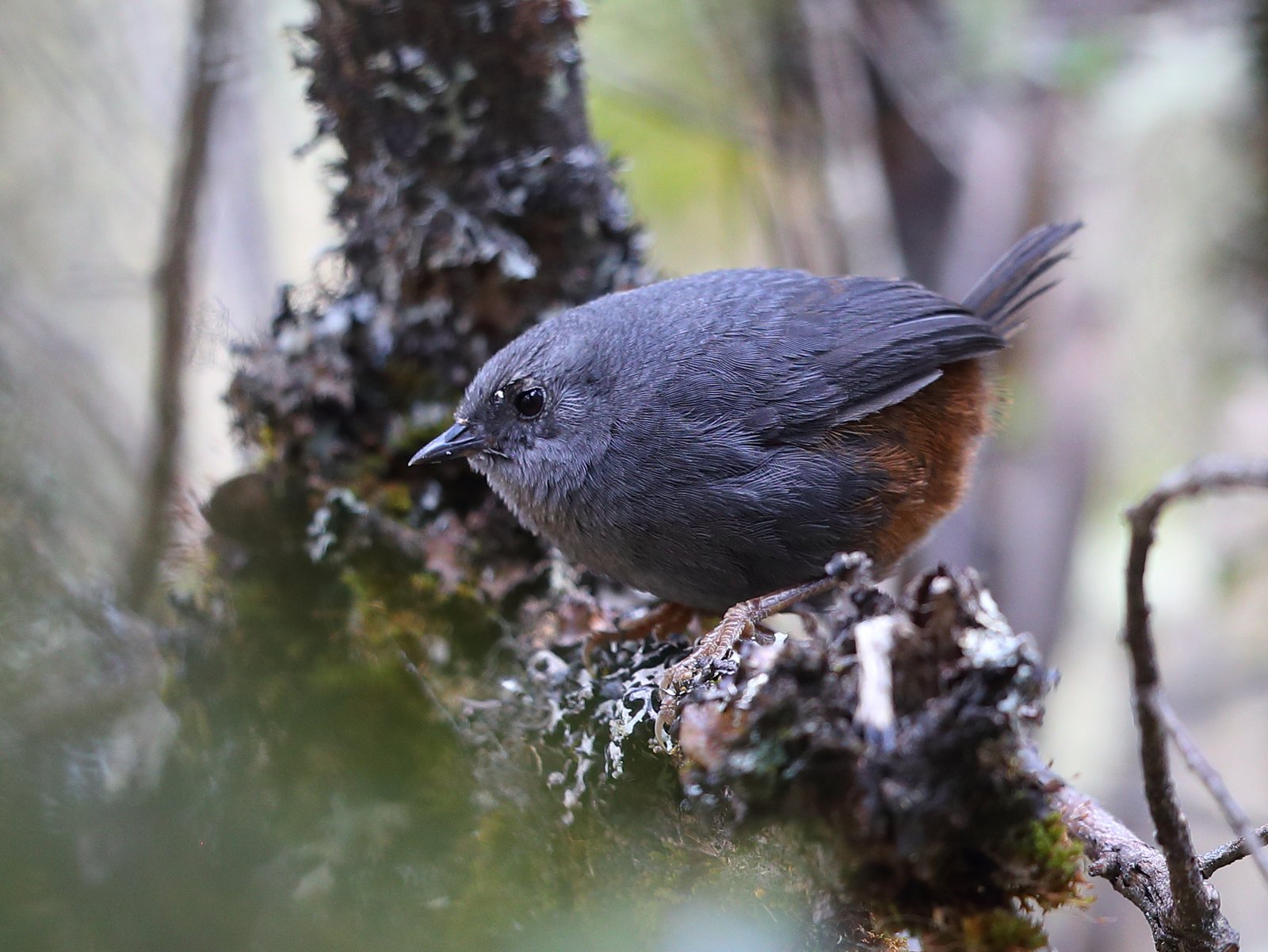
The Vilcabamba Tapaculo is a small, grey tapaculo found only in the high mountains around the upper Urubamba valley in Cuzco, Peru. It lives in mossy elfin forest and Polylepis woodland among large boulders, higher than most other tapaculos. It was described as a subspecies in 1939 and has been treated as a separate species since 1997 on the basis of its voice.
Voice
The song is a repeated, raspy note, rendered by observers variously as chree, chit-chit or a churr. The call is a rising and falling series, kikikikiki.
Recording: Jian Mei — CC BY-SA 4.0 · xeno-canto
Identification
10–12 cm, wren-like, with a thin bill, fairly long legs and a short, cocked tail. The male is dark grey above; the breast is medium grey, grading into a pale grey belly. The rump is rufous-brown with faint barring, and the flanks and undertail are cinnamon, also faintly barred. The female is paler grey above, with a brown wash on the neck, and has brighter rufous-brown, unbarred flanks. Juveniles are brown above and greenish buff below.
Confusion species
Puna Tapaculo Scytalopus simonsi, further east from the Cordillera Vilcanota, has a narrow, pale supercilium and more strongly barred flanks. Ampay Tapaculo Scytalopus whitneyi lives further west, in Apurímac. Trilling Tapaculo Scytalopus parvirostris lives lower in humid montane forest and is darker, with a long trill as its song. In tapaculos the song is the main identification feature.
Habitat
Humid montane forest and elfin forest, often with much moss and large boulders, and Polylepis woodland, between about 3500 and 4200 m. It forages on or just above the ground among moss and rocks for small arthropods. Diet and breeding are hardly studied and are probably similar to those of other high-mountain tapaculos.
Where the bird is most at home, classified by the vegetation units of the Andes and the west coast.


Range and movements
Only in Peru: in Cuzco, in the high mountains along the upper Urubamba valley, in the Cordillera Vilcabamba and Cordillera Urubamba. Absent from Colombia, Ecuador, Bolivia and the Galápagos. Does not occur outside the guide area.
- Resident
- dark = core range, pale = thinly spread
How and when to look
The Polylepis woods around the Abra Málaga pass, on the road from Ollantaytambo to the eastern slope, are a well-known site. Listen there in the morning among the mossy boulders for the repeated, raspy notes; the pass lies above 4000 m.
Conservation status
Least Concern. The range is very small, but the population is considered stable and is not immediately threatened by human activity; cutting and burning of Polylepis woods can reduce the habitat locally.
Scientific name
Scytalopus urubambae | Zimmer, 1939
Zimmer described the species in 1939 and placed it straight away in the genus where it still stands. The genus Scytalopus was introduced in 1837 by Gould. The genus name combines Greek skutalē or skutalon, 'stick', with pous, 'foot'. The species name urubambae refers to the Urubamba valley in Cuzco, Peru; this is not necessarily the type locality. The specimen the first description was based on came from Cedrobamba, Urubamba Valley, Cuzco, Peru.