All species › Passerines › New World warblers › American Redstart
American Redstart | Setophaga ruticilla
Amerikaanse roodstaart | Candelita norteña
The American Redstart is an active warbler that moves through foliage with its tail fanned and wings drooped, flushing insects that it catches in short sallies. It is not related to the Old World redstarts; the name refers to the orange or yellow patches in the tail and wings. In winter it is one of the commonest migrant warblers throughout the Caribbean, from the Bahamas to Trinidad and the ABC Islands.
Voice
The call is a sharp, slightly breathy chip; in flight a thin tseep. The song, also heard on the islands in spring, is variable: a series of high notes with an emphatic ending, like tsee tsee tsee tsee-o, or a repeated tseebe tseebe tseebe.
Recording: Scott Olmstead — CC BY-NC-SA 4.0 · converted to mono · xeno-canto
Identification
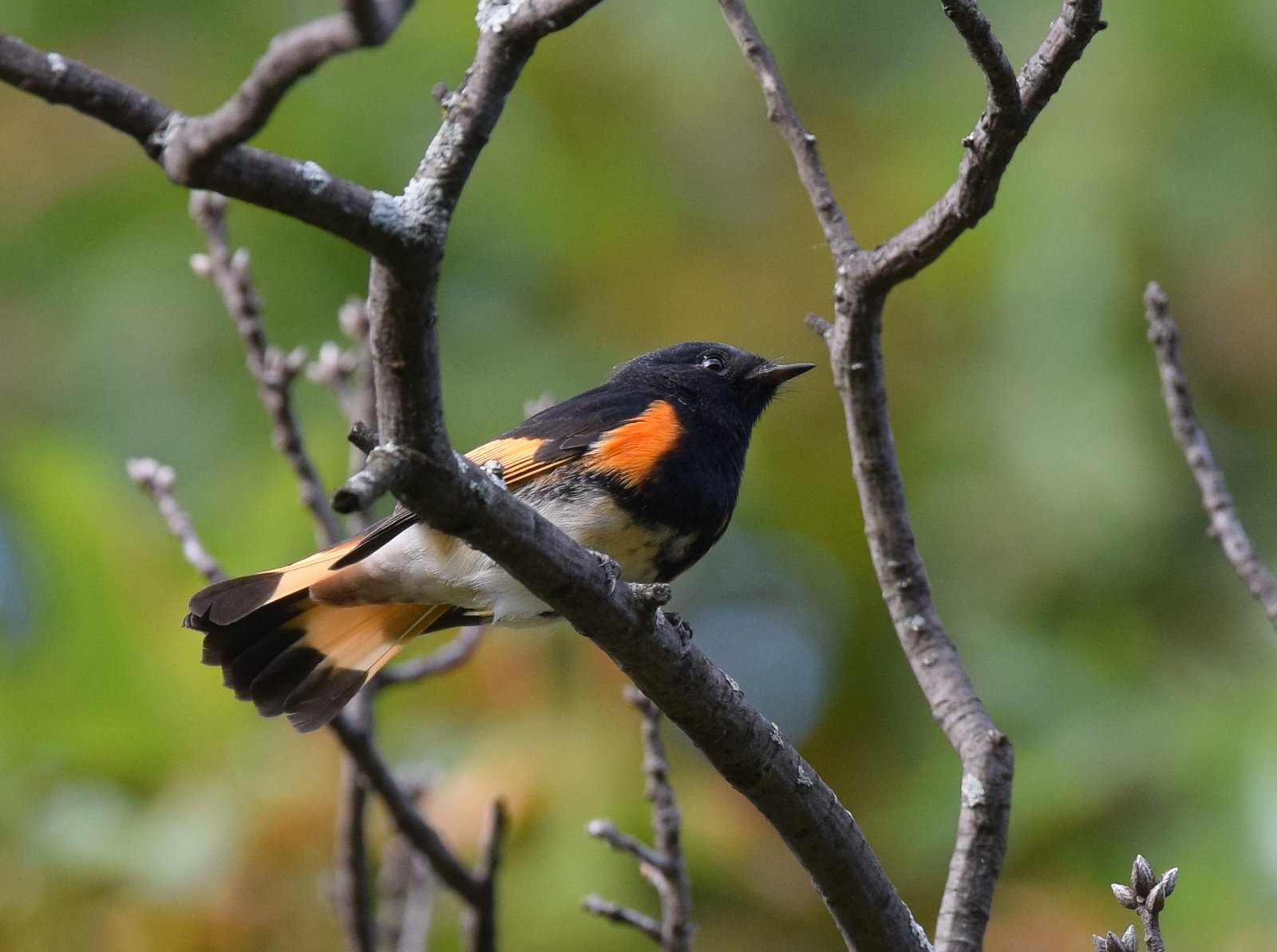
11–14 cm, slim, with a fairly long tail and a broad, flat bill with prominent rictal bristles. The adult male is glossy black with orange patches on the sides of the breast, an orange band across the flight feathers and orange bases to the outer tail feathers; the belly is white. The female is olive-grey above, with a greyer head, a thin white eye-ring and whitish underparts; where the male is orange, she is yellow. First-year males resemble females, with salmon-tinged breast patches and sometimes a few black feathers on the head or breast. The tail is fanned almost constantly and the wings held half open.
Confusion species
The tail pattern, with coloured bases and a dark terminal band, is diagnostic. Magnolia Warbler Setophaga magnolia has a white band across the middle of the tail, wing bars and streaked flanks. Female American Yellow Warbler Setophaga aestiva has yellow tail spots but is yellowish throughout and lacks the grey head. The behaviour, with fanned tail and fluttering sallies, identifies the species even at a distance.
Habitat
In winter almost any forest with a shrub or canopy layer: dry and moist broadleaf forest, coastal woodland, mangroves, montane forest up to middle elevations, shade-coffee plantations and gardens and parks with trees. Adult males more often hold territories in mangroves and moist forest, females and young birds more often in drier scrub forest. It catches mainly flying insects in short sallies.
Where the bird is most at home, classified by the vegetation types of the Caribbean.







Range and movements
A common winter visitor and passage migrant in the Bahamas, the Turks and Caicos Islands, Cuba, the Cayman Islands, Jamaica, Hispaniola (Haiti and the Dominican Republic), Puerto Rico, the Virgin Islands and throughout the Lesser Antilles; also on Trinidad and Tobago, the ABC Islands and San Andrés. Breeds across much of Canada and in the eastern and north-western United States, and winters from Mexico through Central America and the Caribbean to northern South America.
- Resident
- Summer visitor (c. Oct–Mar)
- Winter visitor (c. Apr–Sep)
- Passage (Mar–Apr, Oct–Nov)
- dark = core range, pale = thinly spread
How and when to look
Common in almost any woodland and in hotel grounds. Adult males are most likely in mangroves and moist lowland forest. The constantly fanned tail with its coloured patches is a good clue even against the light.
Conservation status
Not threatened. The population is large. Research on Jamaica showed that the quality of wintering habitat carries over into departure dates and breeding success in the north; conserving mangroves and moist lowland forest therefore matters for this species too.
Scientific name
Setophaga ruticilla | (Linnaeus, 1758)
Linnaeus described the species in 1758 as Motacilla ruticilla; because it was later moved to another genus, the author and year stand in brackets. The genus Setophaga was introduced in 1827 by Swainson. Setophaga is Greek, from sēs, sētos 'moth' and -phagos '-eating': 'moth-eater'. ruticilla is New Latin for 'redstart', from rutilus 'red' and the diminutive -cilla; the tail has orange patches. The specimen the first description was based on came from Virginia, United States.