All species › Passerines › Thrushes › American Robin
American Robin | Turdus migratorius
Roodborstlijster | Zorzal robín
The American Robin is one of the best known garden birds in North America, but reaches the Caribbean only exceptionally. In some winters small flocks appear in the northern Bahamas and Cuba, often after cold spells in the southeastern United States; in other years the species is absent.
Voice
In winter mainly calls: a rapid tuk-tuk-tuk or peek-tuk-tuk when alarmed and a high, thin tseep in flight. The song, a series of cheerful, whistled phrases of two or three notes, is seldom heard in the region.
Recording: Christian Kerihuel — CC BY-NC-SA 4.0 · converted to mono · xeno-canto
Identification
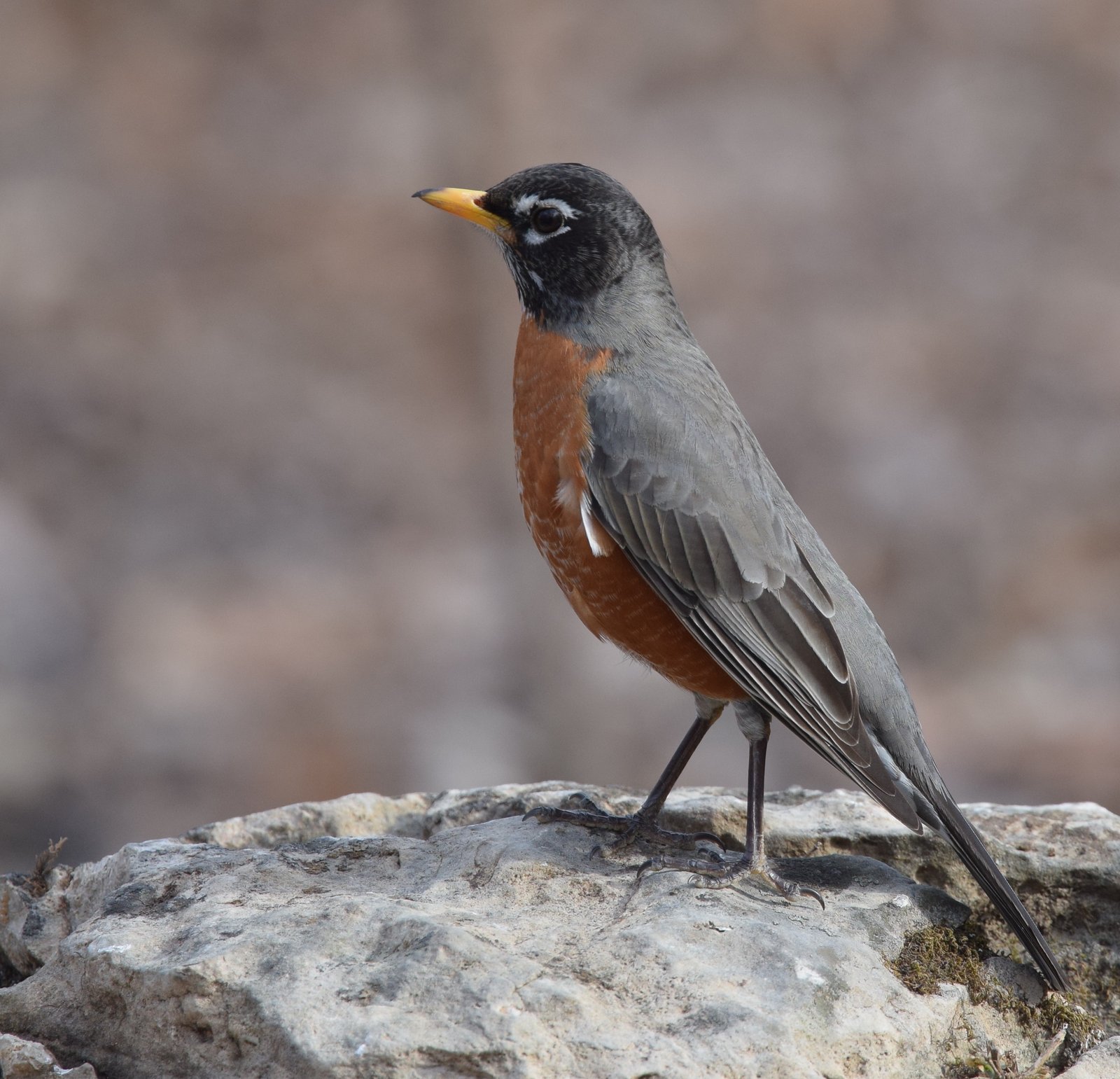
23–28 cm, a large, upright thrush. The upperparts are grey-brown to slate grey, the head darker, blackish in the male. There are white marks above and below the eye, and the throat is white with black streaks. Breast and belly are uniform red-orange, the lower belly and undertail white. The bill is yellow with a dark tip, the legs dark. Females are paler, with a greyer head and a lighter orange breast. Juveniles, not expected in the region, have a black-spotted breast.
Confusion species
Western Red-legged Thrush Turdus plumbeus is slate grey with a streaked throat, but has orange-red legs and bill and at most an orange-tinged lower belly, never a uniform red-orange breast. White-chinned Thrush Turdus aurantius of Jamaica is grey with a blackish head and orange bill and legs. Other thrushes in the region lack the red-orange underparts.
Habitat
In winter in open country with trees: lawns, golf courses, parks, gardens and woodland edges, also pine forest. It searches short grass for earthworms and insects and in winter eats many berries and fruits, often in small groups at fruiting trees.
Where the bird is most at home, classified by the vegetation types of the Caribbean.




Range and movements
Rare and irregular winter visitor to the northern Bahamas (Grand Bahama, Abaco, New Providence) and Cuba; recorded as a vagrant from, among others, Jamaica, Hispaniola, Puerto Rico and the Virgin Islands. Breeds across almost all of North America into Mexico and winters from southern Canada to Guatemala.
How and when to look
Most likely after cold spells in Florida, in December and January, on golf courses, lawns and at fruiting trees on Grand Bahama, Abaco and in western Cuba. Records elsewhere are worth documenting.
Conservation status
Globally not threatened and one of the most numerous birds in North America. In the Caribbean a vagrant and irregular winter visitor.
Scientific name
Turdus migratorius | Linnaeus, 1766
Linnaeus described the species in 1766 and placed it straight away in the genus where it still stands. The genus Turdus was introduced in 1758 by Linnaeus. Turdus is the ordinary Latin word for 'thrush'. migratorius is Latin for 'migratory, wandering', from migrare 'to migrate', after the movements of the northern birds. The specimen the first description was based on came from North America.