All species › Pelicans, herons and ibises › Pelicans › American White Pelican
American White Pelican | Pelecanus erythrorhynchos
Amerikaanse witte pelikaan | Pelícano blanco americano
The American White Pelican is one of the largest birds to reach the Caribbean. It breeds on lakes in the interior of North America and winters on the Gulf of Mexico and in Mexico and Central America. It was long considered a vagrant in the West Indies, but since the early years of this century flocks of hundreds, at times well over a thousand birds, have wintered in western Cuba. On the other islands it remains a rarity.
Voice
Almost silent away from breeding colonies. At the colony adults give low grunts and groans, roughly hroh; young beg with hoarse screeches.
Recording: Bruce Lagerquist — CC BY-NC-SA 4.0 · converted to mono · xeno-canto
Identification
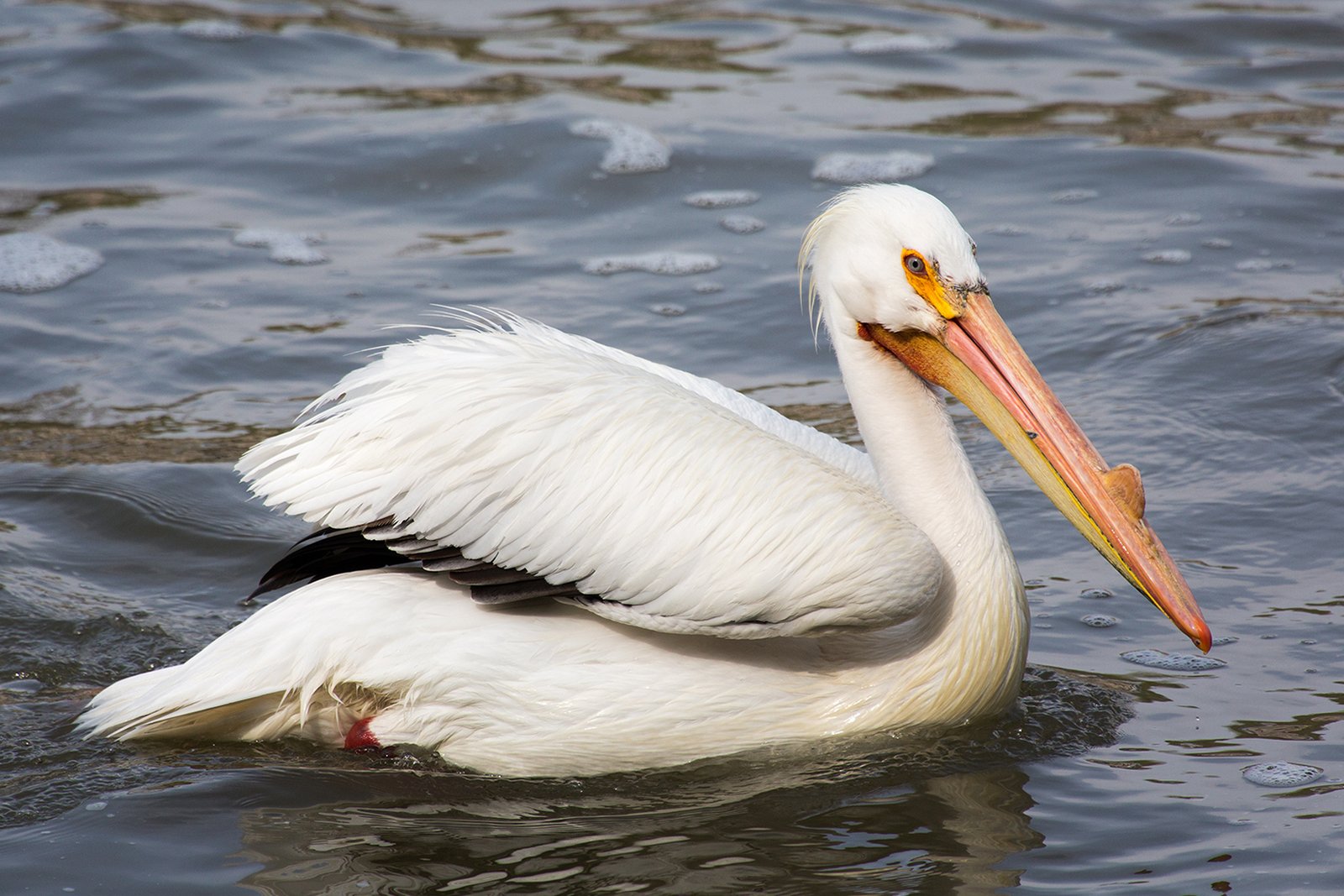
127–165 cm, with a wingspan of more than two and a half metres. Heavily built, with a long neck and short tail. The plumage is white; in flight the black primaries and outer secondaries stand out, while at rest they are largely hidden. Bill, pouch and legs are yellow-orange, a brighter orange in the breeding season. In spring adults grow a flat, upright horny plate on the upper mandible and a short yellowish crest; the plate is shed after egg-laying. Juveniles are white with a grey-brown wash on the head, neck and wing coverts and have a duller bill. It flies with the head drawn back, often in V-formation or long lines, and soars high on thermals.
Confusion species
Brown Pelican Pelecanus occidentalis is smaller and grey-brown, also as a juvenile, and fishes by diving from the air, never by swimming in groups. At a distance and in flight, American White Pelican shares the pattern of white with black flight feathers with Wood Stork Mycteria americana, which flies with the neck outstretched and long legs trailing, and with Masked Booby Sula dactylatra, which is far smaller and slimmer, with a pointed bill and a black tail. Great Egret Ardea alba is all white and flies with the neck drawn in, but has no black in the wing.
Habitat
Shallow lakes, lagoons, inland saline and brackish pools, marshes with open water and above all fish ponds and flooded rice fields. It fishes while swimming: groups drive shoals of fish into shallow water in a half-circle and scoop them up with their bills in unison. It rests in groups on embankments, sandbars and mudbanks. It does not dive from the air. It does not breed in the region.
Where the bird is most at home, classified by the vegetation types of the Caribbean.




Range and movements
Most numerous in western Cuba, in Pinar del Río province (including Maspotón lagoon and the wetlands near Los Palacios, where about three hundred birds stay year-round) and in the Zapata swamps; scarcer further east in Cuba. Rare in the Bahamas, the Cayman Islands and Puerto Rico, where birds sometimes stay for long periods. Isolated records come from the Dominican Republic, the Turks and Caicos Islands, Anguilla, Sint Maarten/Saint-Martin, Antigua, Dominica, Trinidad and San Andrés. Beyond the region it breeds in interior Canada and the western United States and winters from California and the Gulf Coast to Central America.
- Resident
- Winter visitor (c. Apr–Sep)
- Passage (Mar–Apr, Oct–Nov)
- dark = core range, pale = thinly spread
How and when to look
The best chance is in winter at the fish farms and lagoons of Pinar del Río and in the Ciénaga de Zapata, where flocks feed on open water or rest on the embankments. Cooperative fishing, with a whole flock dipping their bills at once, is best watched early in the morning. On other islands records almost always involve single birds, often after a storm or a cold spell in North America.
Conservation status
Not threatened. The North American population has grown strongly since the 1960s, and the increase in Cuba fits that trend. Wintering at fish farms can lead to conflict with fish farmers. On the breeding grounds drought, disturbance of colonies and pesticide poisoning are threats.
Scientific name
Pelecanus erythrorhynchos | Gmelin, 1789
Gmelin described the species in 1789 and placed it straight away in the genus where it still stands. The genus Pelecanus was introduced in 1758 by Linnaeus. Pelecanus is the Latin form of the Greek pelekan 'pelican', which itself derives from pelekys 'axe'. erythrorhynchos is Greek for 'red-billed', from eruthros 'red' and rhunkhos 'bill', after the orange-red bill. The specimen the first description was based on came from Hudson Bay and New York.