All species › Hummingbirds and swifts › Hummingbirds › Antillean Crested Hummingbird
Antillean Crested Hummingbird | Orthorhyncus cristatus
Antilliaanse kuifkolibrie | Colibrí crestado
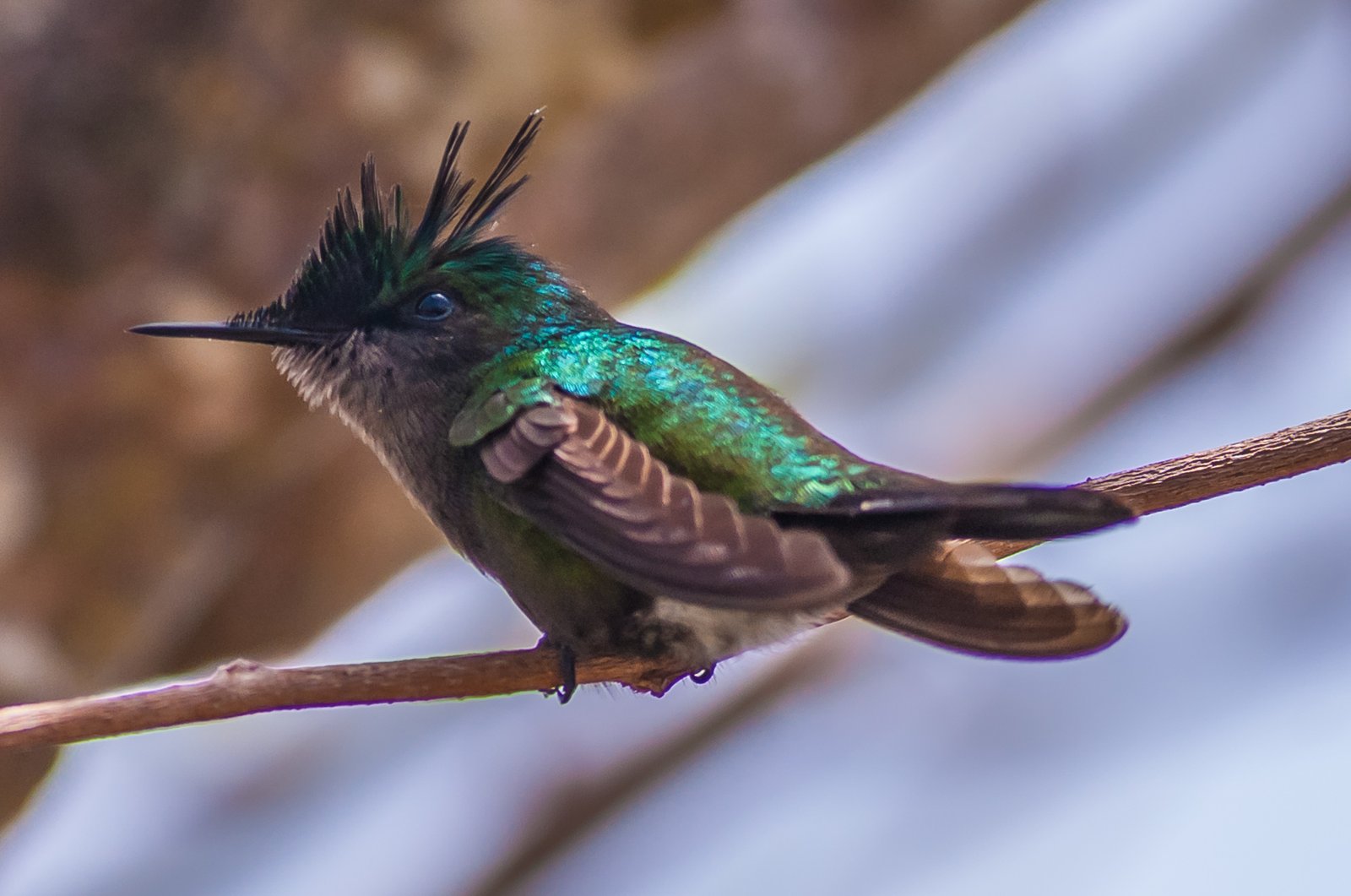
The Antillean Crested Hummingbird is one of the smallest and commonest hummingbirds of the eastern Caribbean islands, and the only species in the region whose male wears a pointed crest. It ranges from eastern Puerto Rico to Grenada and Barbados and can be found almost anywhere with flowers, from dry coastal country to town gardens. Males defend small feeding territories vigorously against other hummingbirds.
Voice
Short tsip or tzip calls, often during chases, and a longer series tslee-tslee-tslee-tslee. The wings produce a fine humming sound.
Recording: David Darrell-Lambert — CC BY-NC-SA 4.0 · converted to mono · xeno-canto
Identification
8.5–9.5 cm, with a short, straight black bill and a rounded tail. The male has a crest shading from green to a glittering blue-green or blue tip; on Barbados birds the crest is entirely green. The upperparts are dull bronze-green, the underparts sooty black to dark greyish-black and the tail black. The crest usually lies flat but is raised when the bird is excited and then catches the light. The female lacks the crest; she is bronze-green above and light grey below, with a blackish tail whose four outer feathers are broadly tipped greyish-white.
Confusion species
No other hummingbird in the region has a crest. Green-throated Carib Eulampis holosericeus and Purple-throated Carib Eulampis jugularis are much larger, with long, curved bills. In Puerto Rico, Puerto Rican Emerald Riccordia maugaeus is slightly larger with a forked tail, and the male is glittering green below. On Dominica and Martinique the female Blue-headed Hummingbird Riccordia bicolor shows a reddish lower mandible and a white spot behind the eye, both lacking in the female crested.
Habitat
Almost any ground with flowering plants: dry coastal woodland and scrub, forest edges, secondary growth, plantations, parks and gardens, up into montane forest. Commonest below 500 m but reaches the higher parts of the mountains. It feeds mostly low down, at herbs and low shrubs, and takes small insects in flight and among foliage.
Where the bird is most at home, classified by the vegetation types of the Caribbean.







Range and movements
Resident from eastern Puerto Rico, including Vieques and Culebra, through the US and British Virgin Islands and almost the entire Lesser Antilles chain to Grenada and the Grenadines, and on Barbados. Separate subspecies occupy the different island groups. Absent from Trinidad and Tobago and from the ABC islands. Recorded as a vagrant in Florida.
- Resident
- dark = core range, pale = thinly spread
How and when to look
On virtually every island of the Lesser Antilles in hotel and village gardens, often at a few metres' range. Males return again and again to the same low lookout perch beside a flowering shrub; the crest colour shows best when the sun strikes it at an angle.
Conservation status
Not threatened. The species is numerous, occupies a large number of islands and adapts well to man-made habitats. Hurricanes can temporarily reduce numbers on individual islands.
Scientific name
Orthorhyncus cristatus | (Linnaeus, 1758)
Linnaeus described the species in 1758 as Trochilus cristatus; because it was later moved to another genus, the author and year stand in brackets. The genus Orthorhyncus was introduced in 1799 by De Lacépède. Orthorhyncus is Greek, from orthos 'straight' and rhunkhos 'bill', after the short, straight bill. cristatus is Latin for 'crested', after the male's pointed crest. The specimen the first description was based on came from Barbados.