All species › Hummingbirds and swifts › Hummingbirds › White-tailed Sabrewing
White-tailed Sabrewing | Campylopterus ensipennis
Witstaartsabelvleugel | Colibrí coliblanco
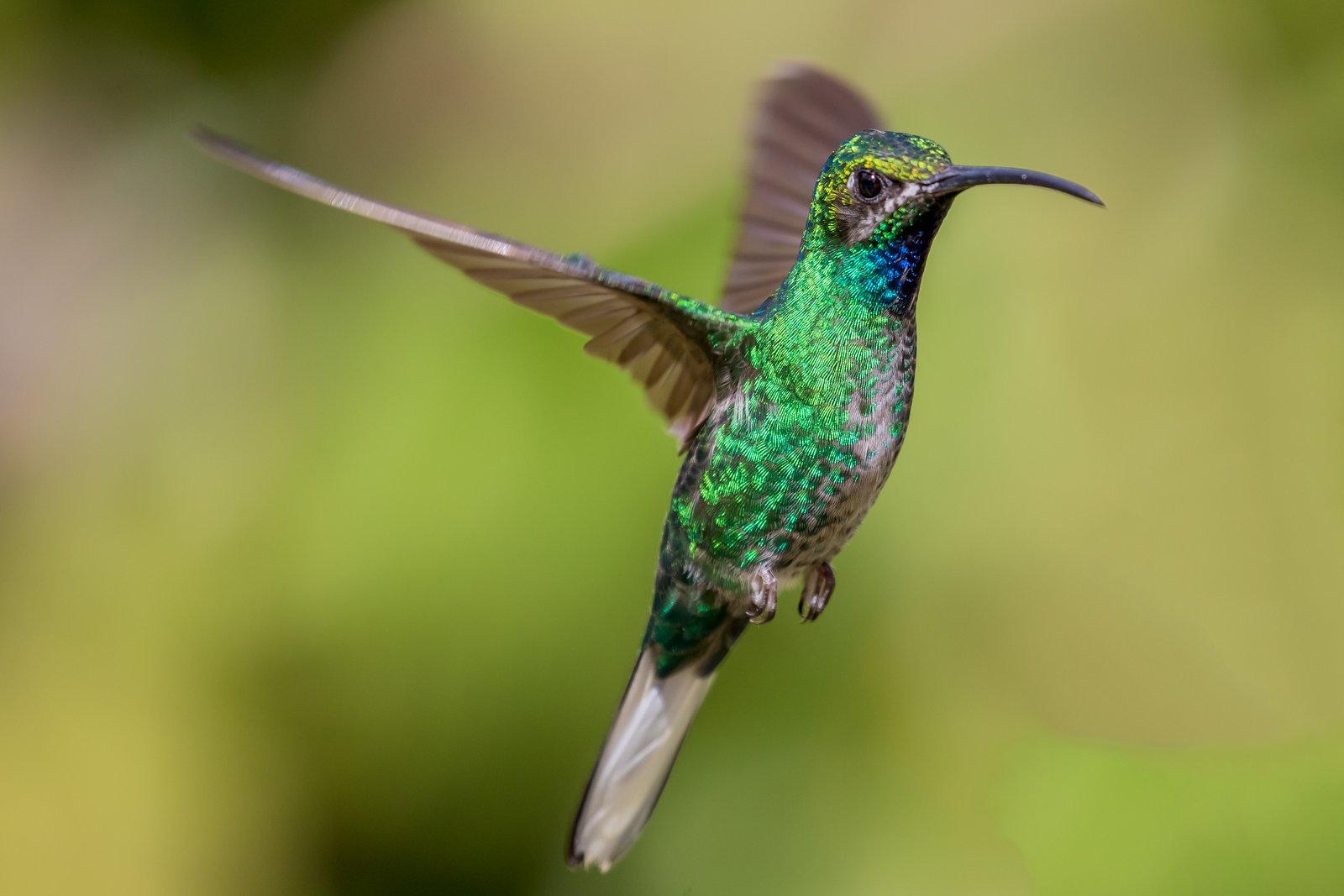
The White-tailed Sabrewing is a large hummingbird with a small range: Tobago and two mountain areas in north-eastern Venezuela. In the Caribbean it occurs only on Tobago, in the forest of the Main Ridge. The name refers to the thickened, curved shafts of the male's outer primaries.
Voice
A loud, slightly disyllabic tchink, given persistently by the male from a song perch in the understorey.
Recording: Nick Athanas — CC BY-NC-SA 3.0 · converted to mono · xeno-canto
Identification
12–13 cm, with a black, slightly curved bill. The male has glittering green upperparts, a blue to dark violet throat and green underparts. The tail is broad; the outer feathers are largely white, which shows when the tail is spread and in flight. The male's outer primary shafts are thickened. The female is green above and grey below, with a smaller blue throat patch, and also shows much white in the tail.
Confusion species
White-necked Jacobin Florisuga mellivora also has a white tail but a straight bill, and the male has a dark blue head with a white nape band and a white belly. Black-throated Mango Anthracothorax nigricollis is about the same size, with a more strongly curved bill and a purplish-red tail lacking white. Copper-rumped Hummingbird Saucerottia tobaci is much smaller, with a straight bill, a coppery rump and a dark tail.
Habitat
Humid forest, mature secondary forest and plantations, especially shaded coffee. On the mainland between 400 and 2,000 m; on Tobago in the higher parts of the Main Ridge. It feeds in the lower and middle levels of the forest, including at heliconias.
Where the bird is most at home, classified by the vegetation types of the Caribbean.




Range and movements
On Tobago confined to the Main Ridge forest in the north-east of the island. Elsewhere only in north-eastern Venezuela, on the Paria Peninsula and in the Cordillera de Caripe. Absent from Trinidad.
- Resident
- dark = core range, pale = thinly spread
How and when to look
Along the Gilpin Trace and other trails in the Main Ridge Forest Reserve on Tobago, where males call from regular perches in the understorey. A bird flying up is identified by the white tail sides.
Conservation status
Near Threatened. The world population is estimated at 50,000–100,000 mature birds and is declining through forest loss on the mainland. The Tobago population was almost wiped out by Hurricane Flora in 1963 but has since partly recovered.
Scientific name
Campylopterus ensipennis | (Swainson, 1822)
Swainson described the species in 1822 as Trochilus ensipennis; because it was later moved to another genus, the author and year stand in brackets. The genus Campylopterus was introduced in 1827 by Swainson. Campylopterus is Greek, from kampulos 'curved' and pteron 'wing', after the thickened, curved shafts of the outer primaries. ensipennis is Latin, from ensis 'sword' and penna 'feather', after the broadened, sabre-like shafts of the outer primaries. The specimen the first description was based on came from unknown.