All species › Passerines › New World warblers › Bahama Warbler
Bahama Warbler | Setophaga flavescens
Bahamazanger | Reinita de las Bahamas
The Bahama Warbler is a grey and yellow wood-warbler of the pine forests of the northern Bahamas. It was long treated as a subspecies of Yellow-throated Warbler Setophaga dominica, but differences in plumage, bill and wing measurements and song led to its recognition as a separate species. Since Hurricane Dorian (2019) it has not been found again on Grand Bahama.
Voice
The song is a series of loud, clear whistled notes with a ringing quality, differing from that of Yellow-throated Warbler in structure and pitch pattern. The call is a sharp chip.
Recording: Jesse Fagan — CC BY-NC-SA 4.0 · shortened to the first 60 s, mono · xeno-canto
Identification
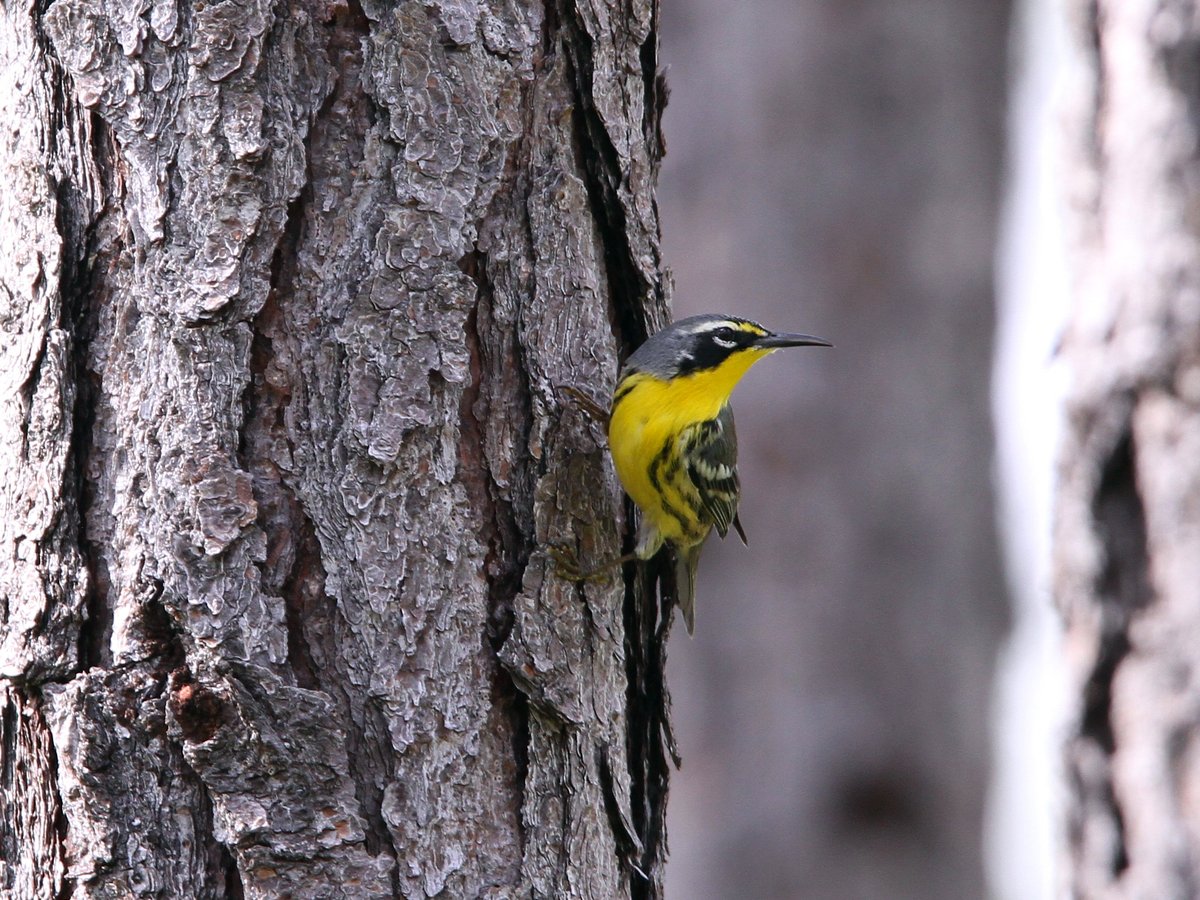
13–14 cm, with a long, thin bill and fairly long legs. Forehead and upperparts are grey. The lores and ear-coverts are black, and a white supercilium runs from the bill to behind the eye, with a white patch on the side of the neck below it. Throat and breast are yellow and the belly is largely yellow too, with black streaks along the flanks. The wing shows two white wing bars and the outer tail feathers have white spots. Females are duller, with paler yellow underparts.
Confusion species
Yellow-throated Warbler Setophaga dominica, a winter visitor to the same area, has a shorter bill, a white belly and yellow restricted to the throat and upper breast. Olive-capped Warbler Setophaga pityophila of the same pine forests is smaller, with an olive-yellow crown and no black ear patch. Pine Warbler Setophaga pinus is olive-green above, without a black-and-white head pattern.
Habitat
Forest of Caribbean pine Pinus caribaea var. bahamensis with a fairly open canopy and little woody understorey. It searches for insects and other small invertebrates, partly by probing bark and needle clusters with its long bill.
Where the bird is most at home, classified by the vegetation types of the Caribbean.

Range and movements
Only in the northern Bahamas: Great Abaco and Little Abaco, and Grand Bahama, where no birds have been found since Hurricane Dorian. The species does not occur outside these islands.
- Resident
- Summer visitor (c. Oct–Mar)
- Winter visitor (c. Apr–Sep)
- Passage (Mar–Apr, Oct–Nov)
- dark = core range, pale = thinly spread
How and when to look
The pine forest on Abaco, early in the morning when the males are singing. Olive-capped and Pine Warblers live in the same forest, and Yellow-throated Warbler joins them in winter; the long bill and yellow belly are then the features to check.
Conservation status
Endangered (EN). The world population is estimated at 500–1,200 mature birds and is declining. Hurricanes, above all Dorian in 2019, forest fires and degradation of the pine forest are the main threats.
Scientific name
Setophaga flavescens | (Todd, 1909)
Todd described the species in 1909 as Dendroica flavescens; because it was later moved to another genus, the author and year stand in brackets. The genus Setophaga was introduced in 1827 by Swainson. Setophaga is Greek, from sēs, sētos 'moth' and -phagos '-eating': 'moth-eater'. flavescens is Latin for 'yellowish', after the yellow underparts. The specimen the first description was based on came from Spencer's Point, Abaco, Bahamas.