All species › Waders, gulls and terns › Sandpipers and snipes › Baird's Sandpiper
Baird's Sandpiper | Calidris bairdii
Bairds strandloper | Correlimos de Baird
Baird's Sandpiper is a medium-sized, long-winged sandpiper that migrates from the high Arctic to southern South America. Its main route runs through the interior of North America and along the Andes, which leaves the Caribbean outside its normal flyway. Here it is a rare autumn migrant, usually found alone or among other small sandpipers.
Voice
A low, rolling krreep or prrrt, drier and coarser than the calls of the smaller sandpipers.
Recording: Alvaro Rivera Rojas — CC BY-NC-SA 4.0 · converted to mono · xeno-canto
Identification
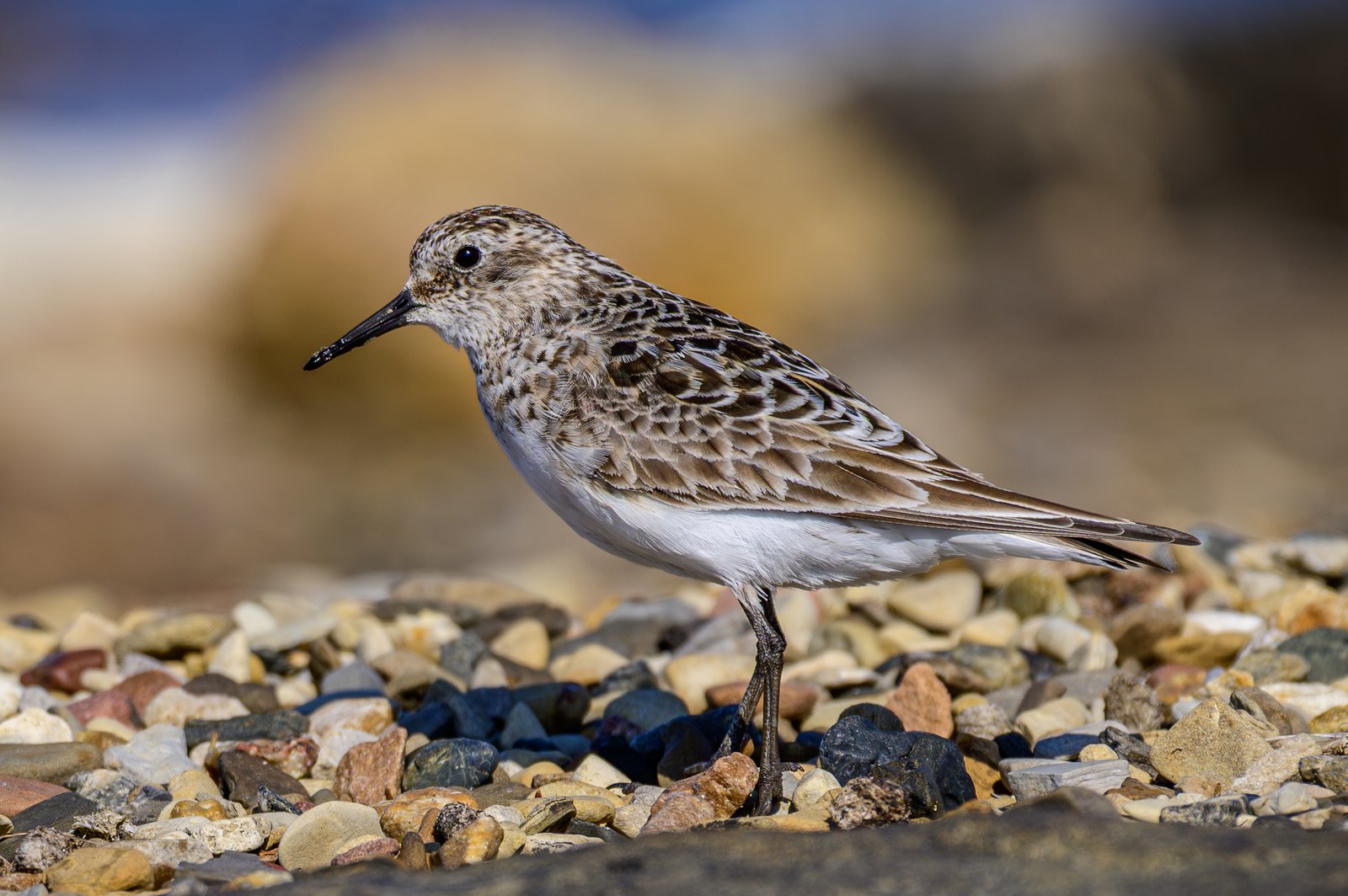
14–18 cm, slim and horizontal, with long wings that clearly extend beyond the tail at rest. The bill is black, straight and fine, the legs black. Juveniles, which make up most autumn records, are warm buff-brown with a scaly back pattern from pale feather fringes, a finely streaked buff breast band and a white belly. Adults are greyer brown with black feather centres. In flight a faint wing bar and a dark centre to rump and tail, with no white band.
Confusion species
White-rumped Sandpiper Calidris fuscicollis has equally long wings, but a white band above the tail, greyer tones, streaked flanks and often a reddish bill base. Semipalmated Sandpiper Calidris pusilla and Western Sandpiper Calidris mauri are smaller, with shorter wings and a less scaly back. Pectoral Sandpiper Calidris melanotos is larger, with yellow legs and a sharply demarcated, heavily streaked breast.
Habitat
It uses drier spots than most sandpipers: the dried-out edges of salt pans and lagoons, muddy margins with short vegetation, short grassland, airfields and drained ponds. It feeds with quick pecks at the surface and rarely wades.
Where the bird is most at home, classified by the vegetation types of the Caribbean.





Range and movements
Recorded from Aruba, Curaçao, Bonaire, San Andrés, the Cayman Islands, Puerto Rico, Hispaniola (Haiti and the Dominican Republic), Guadeloupe, Martinique, Barbados and Grenada. It is most regular on San Andrés, the Cayman Islands and Bonaire, on the western and southern edge of the region. There are few or no recent records from the Bahamas, Cuba, Jamaica and Trinidad and Tobago. Beyond the region it breeds on the tundra of north-eastern Siberia, Alaska, Arctic Canada and north-western Greenland, and winters in the Andes and southern South America.
- Summer visitor (c. Oct–Mar)
- Passage (Mar–Apr, Oct–Nov)
- dark = core range, pale = thinly spread
How and when to look
Best looked for in September on the dry edges of salt pans, for example on Bonaire, and on closely grazed ground around ponds. Any long-winged sandpiper should be checked on the rump and tail: no white band points to this species, a white band to White-rumped Sandpiper.
Conservation status
Not threatened. The world population is considered stable. In the Caribbean the species is too rare for threats to be identified.
Scientific name
Calidris bairdii | (Coues, 1861)
Coues described the species in 1861 as Actodromas (Actodromas) Bairdii; because it was later moved to another genus, the author and year stand in brackets. The genus Calidris was introduced in 1804 by Merrem. Calidris goes back to Ancient Greek kalidris or skalidris, a name Aristotle used for an unidentified grey waterside bird. bairdii honours the American naturalist Spencer Fullerton Baird (1823–1887), assistant secretary of the Smithsonian Institution. The specimen the first description was based on came from Fort Resolution, Great Slave Lake.