All species › Waders, gulls and terns › Sandpipers and snipes › Dunlin
Dunlin | Calidris alpina
Bonte strandloper | Correlimos común
The Dunlin is one of the most numerous waders in Europe, but the Caribbean lies at the southern edge of its wintering range. The birds that occur here belong to the North American subspecies hudsonia, which breeds around Hudson Bay and winters mainly along the Atlantic and Gulf coasts of the United States. It is locally fairly common in the Bahamas and Cuba and rare on most other islands. It arrives late in autumn.
Voice
A harsh, drawn-out kreee or treeep, often on take-off; flocks give a soft twittering.
Recording: Arjun Dutta — CC BY-NC-SA 4.0 · converted to mono · xeno-canto
Identification
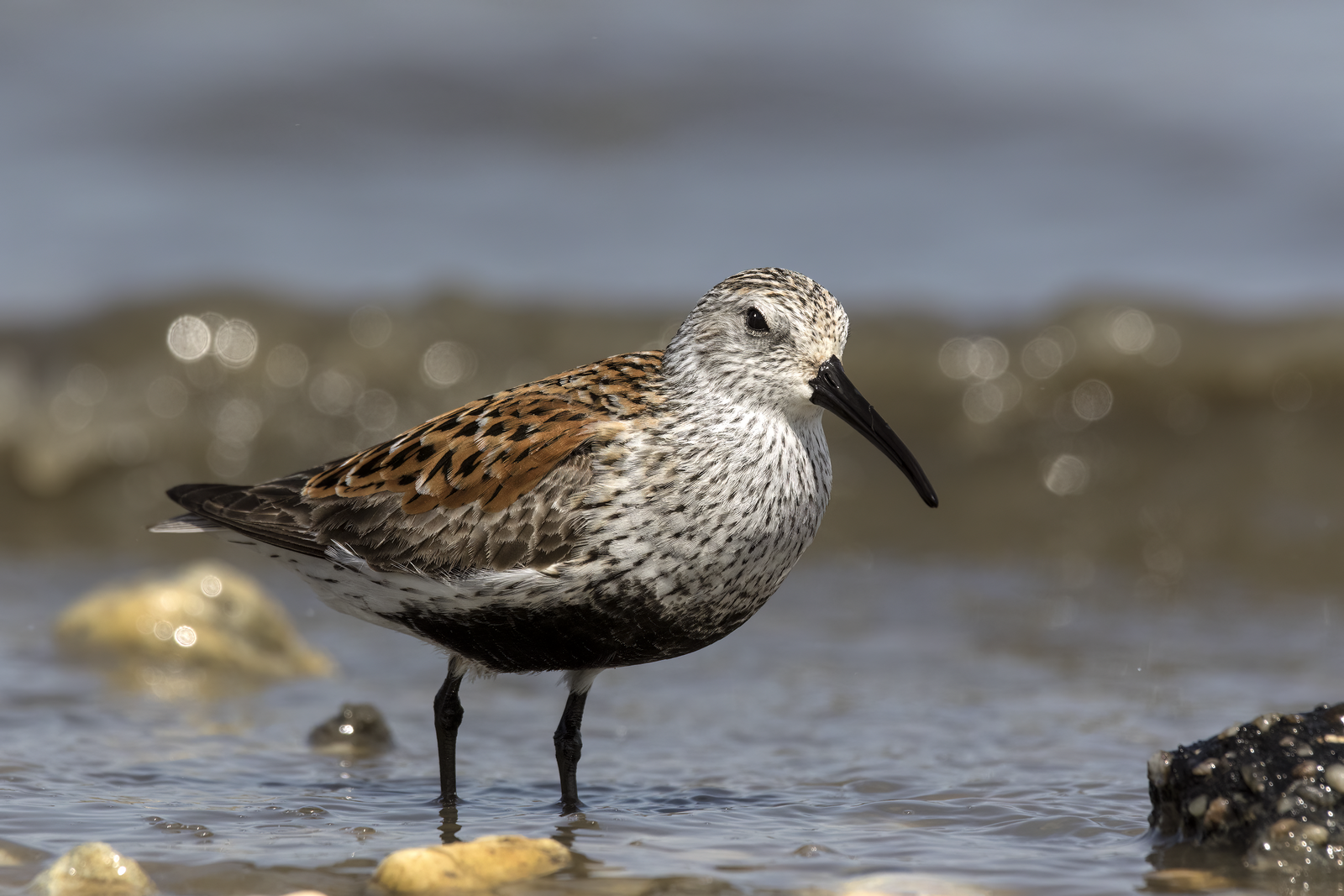
16–20 cm, compact, with a fairly short neck, black legs and a long black bill that droops clearly at the tip. In winter plumage plain brownish-grey on upperparts, head and breast, with a faint pale supercilium and a white belly; the grey breast is fairly sharply demarcated. In breeding plumage, sometimes partly present in spring, rufous on the back with a large black belly patch. In flight a white wing bar and a white rump with a dark central stripe.
Confusion species
Curlew Sandpiper Calidris ferruginea is slimmer and longer-legged, with an evenly curved bill and an entirely white rump. Western Sandpiper Calidris mauri is smaller, with a shorter bill and a paler breast. Sanderling Calidris alba is whiter, with a shorter, straight bill and a black wing bend.
Habitat
Tidal flats, mudbanks and muddy edges of salt pans and lagoons, sometimes sandy beaches. It feeds in flocks, walking and probing rapidly with the bill deep in the mud.
Where the bird is most at home, classified by the vegetation types of the Caribbean.



Range and movements
Winter visitor, most numerous in the Bahamas and Cuba and in smaller numbers in the Turks and Caicos Islands, the Cayman Islands, Jamaica and Puerto Rico. On Hispaniola, the Virgin Islands, the Lesser Antilles (including Guadeloupe, Martinique, Barbados and St Kitts) and the ABC Islands a rare or irregular visitor; hardly reported from Trinidad and Tobago and San Andrés. Beyond the region it breeds around the Arctic and winters in North America, Europe, North Africa and Asia, mainly in the northern hemisphere.
- Resident
- Winter visitor (c. Apr–Sep)
- Passage (Mar–Apr, Oct–Nov)
- dark = core range, pale = thinly spread
How and when to look
Tidal flats and salt pans in the Bahamas and on the north coast of Cuba in winter, among flocks of Semipalmated Sandpipers and Red Knots. The drooping bill tip and plain grey breast are the features to check; outside Cuba and the Bahamas every Dunlin is worth reporting.
Conservation status
Near Threatened globally, owing to declining numbers. In the region the species depends on undisturbed tidal flats and salt pans.
Scientific name
Calidris alpina | (Linnaeus, 1758)
Linnaeus described the species in 1758 as Tringa alpina; because it was later moved to another genus, the author and year stand in brackets. The genus Calidris was introduced in 1804 by Merrem. Calidris goes back to Ancient Greek kalidris or skalidris, a name Aristotle used for an unidentified grey waterside bird. alpina is Latin for 'of high mountains'; here it refers to alpine tundra in general rather than to the Alps. The specimen the first description was based on came from Lapland.