All species › Passerines › Swallows and martins › Barn Swallow
Barn Swallow | Hirundo rustica
Boerenzwaluw | Golondrina tijereta
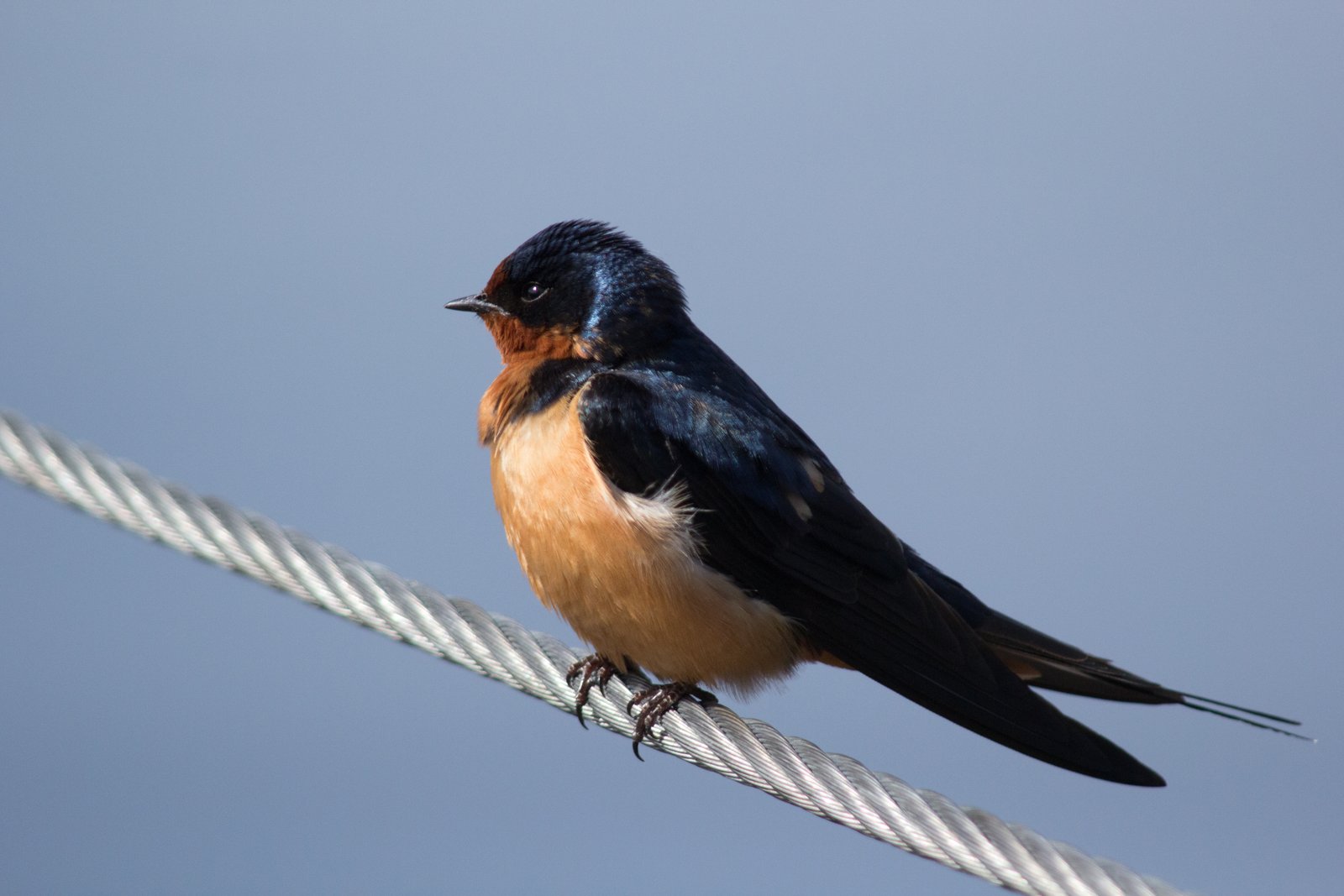
The Barn Swallow is the most widespread swallow in the world and in the Caribbean mainly a passage migrant between North and South America. On migration it can occur in numbers on almost any island; a smaller share winters in the region. American birds belong to the form Hirundo rustica erythrogaster, with rusty underparts.
Voice
A repeated, clear wit or vit-vit in flight, and a sharper siflit in alarm. The song, a rapid twittering warble ending in a rattle, is sometimes heard on migration.
Recording: Beatrix Saadi-Varchmin — CC BY-NC-SA 4.0 · shortened to the first 60 s, mono · xeno-canto
Identification
15–19 cm, including the long outer tail feathers. The upperparts are glossy steel-blue, the forehead and throat chestnut, and the underparts cream to deep rufous; a narrow, often broken blue-black band separates the throat from the breast. The tail is deeply forked, with white spots that form a row when the tail is spread. The female has shorter streamers and is usually paler below. Juveniles, numerous in autumn, have a short fork, duller upperparts and a pale buff throat.
Confusion species
American Cliff Swallow Petrochelidon pyrrhonota and Cave Swallow Petrochelidon fulva have a square tail and a pale buff to rusty rump. Tree Swallow Tachycineta bicolor and Bahama Swallow Tachycineta cyaneoviridis are pure white below; Bahama Swallow also has a deeply forked tail, but without white spots. Short-tailed juvenile Barn Swallows differ from Sand Martin Riparia riparia in their bluish upperparts and buff throat without a brown breast band.
Habitat
On migration and in winter mainly over open country: pastures, fields, sugar cane, rice fields, marshes, lagoons and beaches, often near water. It rests on wires and fences, sometimes in flocks of hundreds. It hunts flying insects low and fast. In North America it breeds in an open nest of mud and straw in barns, under bridges and in other structures.
Where the bird is most at home, classified by the vegetation types of the Caribbean.







Range and movements
A passage migrant on almost all islands, from the Bahamas and Cuba to Trinidad and Tobago, the ABC Islands and San Andrés; common in autumn, less so in spring. In winter in smaller numbers on many of the islands; a few birds stay through the summer. Breeds in North America and much of Europe, Asia and North Africa; American birds winter from Central America to Argentina.
- Resident
- Summer visitor (c. Oct–Mar)
- Winter visitor (c. Apr–Sep)
- Passage (Mar–Apr, Oct–Nov)
- dark = core range, pale = thinly spread
How and when to look
In September and October over pastures, rice fields and coastal lagoons, where flocks feed low or rest on wires. For swallows on wires, tail shape and rump colour are decisive: a dark rump and long tail streamers indicate this species.
Conservation status
Least Concern. Very numerous worldwide, although numbers are declining in parts of North America, partly due to fewer insects and changes in farming.
Scientific name
Hirundo rustica | Linnaeus, 1758
Linnaeus described the species in 1758 and placed it straight away in the genus where it still stands. He introduced the genus Hirundo in that same work. Hirundo is the ordinary Latin word for 'swallow'. rustica is Latin for 'of the countryside', after the farms and barns in which the bird nests. The specimen the first description was based on came from Sweden.