All species › Hummingbirds and swifts › Hummingbirds › Black-billed Streamertail
Black-billed Streamertail | Trochilus scitulus
Zwartsnavelwimpelstaart | Colibrí portacintas piquinegro
The Black-billed Streamertail is the eastern counterpart of the Red-billed Streamertail and is found only in the far east of Jamaica. Plumage, shape and voice are virtually the same; the difference lies in the bill colour. Whether the two are separate species or subspecies of one species is still debated. This guide treats them as two species.
Voice
A loud metallic ting or teet and a prolonged twink-twink-twink falling at the end, like that of Red-billed Streamertail. In flight the male produces a whirring sound in time with the wingbeat.
Recording: Nick Komar — CC BY-NC-SA 4.0 · converted to mono · xeno-canto
Identification
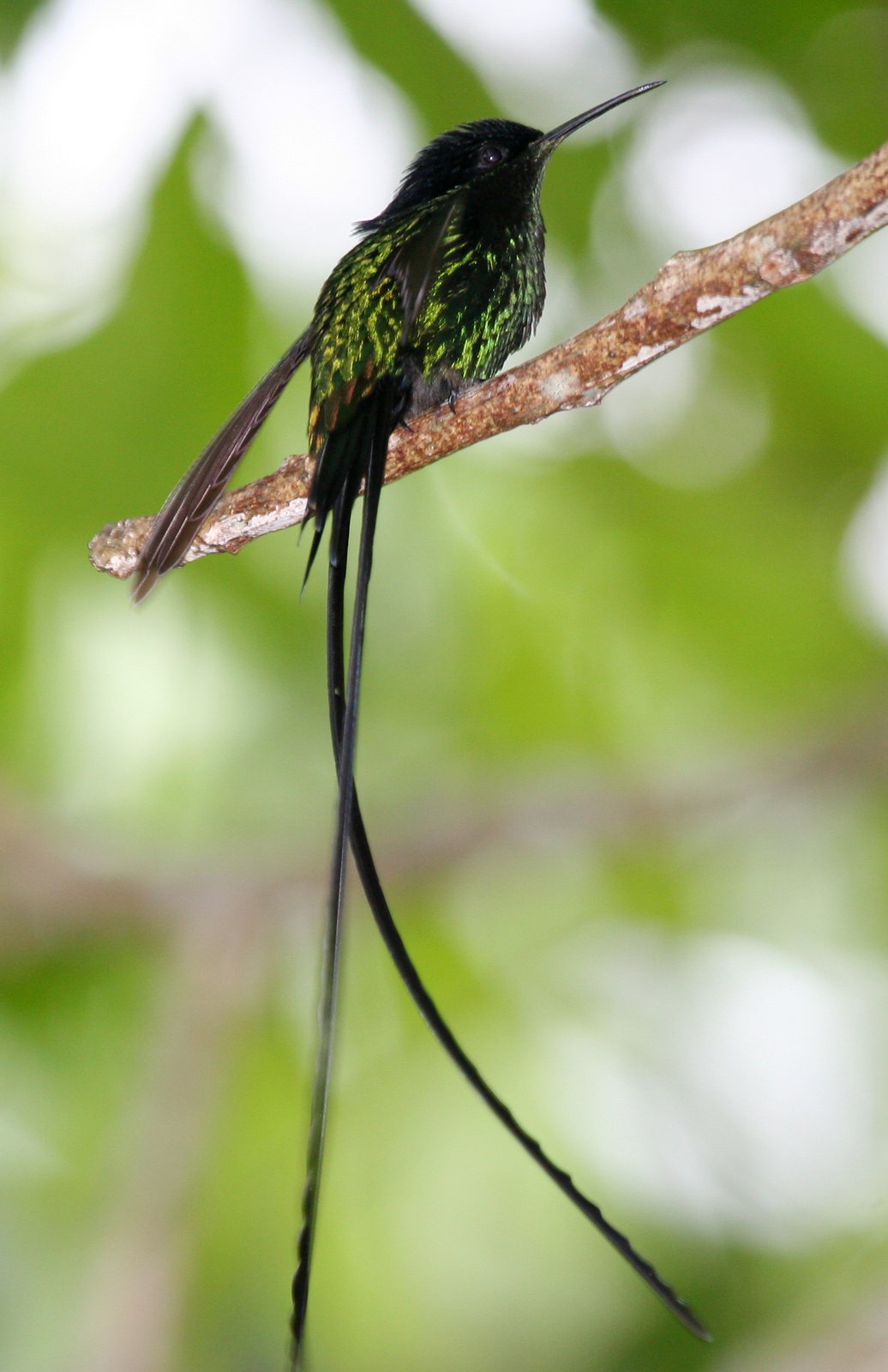
10–24 cm; the female measures about 10.5 cm, the male 22–24 cm, of which 10–13 cm is made up by two greatly elongated black tail feathers. The male has a velvety black crown and nape forming a small crest, grass-green upperparts and glittering green underparts. The bill is all black in both sexes. The female is bronze-green above and white below, with green spotting on the flanks, and has a short tail with white tips to the outer feathers.
Confusion species
Red-billed Streamertail Trochilus polytmus differs only in its coral-red, black-tipped bill; in the narrow contact zone intermediates with partly red bills occur, which cannot be identified with certainty. Jamaican Mango Anthracothorax mango is larger and dark purplish-black, with a curved bill and no streamers. Vervain Hummingbird Mellisuga minima is much smaller, around 6 cm, with dull green upperparts and pale underparts.
Habitat
Evergreen montane forest, lowland forest and secondary growth, forest edges, plantations and gardens, from sea level to about 1,500 m. It avoids mangroves. It takes nectar from a wide range of flowers and catches small insects in flight.
Where the bird is most at home, classified by the vegetation types of the Caribbean.





Range and movements
Only in the far east of Jamaica, in the parishes of Portland and Saint Thomas, including the John Crow Mountains and the eastern Blue Mountains. The boundary with Red-billed Streamertail runs roughly from the Rio Grande in the north to the Morant Bay area in the south, where a narrow zone of mixing occurs. It does not occur outside Jamaica.
- Resident
- dark = core range, pale = thinly spread
How and when to look
Along the Ecclesdown Road in the John Crow Mountains and in the Rio Grande valley near Port Antonio, at flowering shrubs along roadsides and forest edges. Near the boundary with Red-billed Streamertail the bill is worth checking in good light, as intermediates occur.
Conservation status
Not threatened. The range is small, but the species is common within it and also uses secondary forest and gardens. Deforestation in eastern Jamaica and hurricanes are potential threats.
Scientific name
Trochilus scitulus | (Brewster & Bangs, 1901)
Brewster & Bangs described the species in 1901 as Aithurus scitulus; because it was later moved to another genus, the author and year stand in brackets. The genus Trochilus was introduced in 1758 by Linnaeus. Trochilus comes from the Greek trokhilos, a small bird that according to Herodotus picked crocodiles' teeth clean; Linnaeus applied the name to the hummingbirds. scitulus is Latin for 'elegant, pretty', a diminutive of scitus 'fine'. The specimen the first description was based on came from Priestman's River, Portland, Jamaica.