All species › Waders, gulls and terns › Gulls and terns › Black Tern
Black Tern | Chlidonias niger
Zwarte stern | Fumarel común
The Black Tern breeds in freshwater marshes in North America and Eurasia but spends much of the rest of the year at sea. North American birds, of the subspecies surinamensis, migrate to the coasts of northern South America and the tropical ocean. In the Caribbean it is a passage migrant, sometimes in flocks at sea, usually in small numbers on the islands themselves.
Voice
Little heard on migration. The call is a sharp, short keek or kek; flocks give a continuous chatter.
Recording: Ricardo Hevia — CC BY-NC-SA 4.0 · converted to mono · xeno-canto
Identification
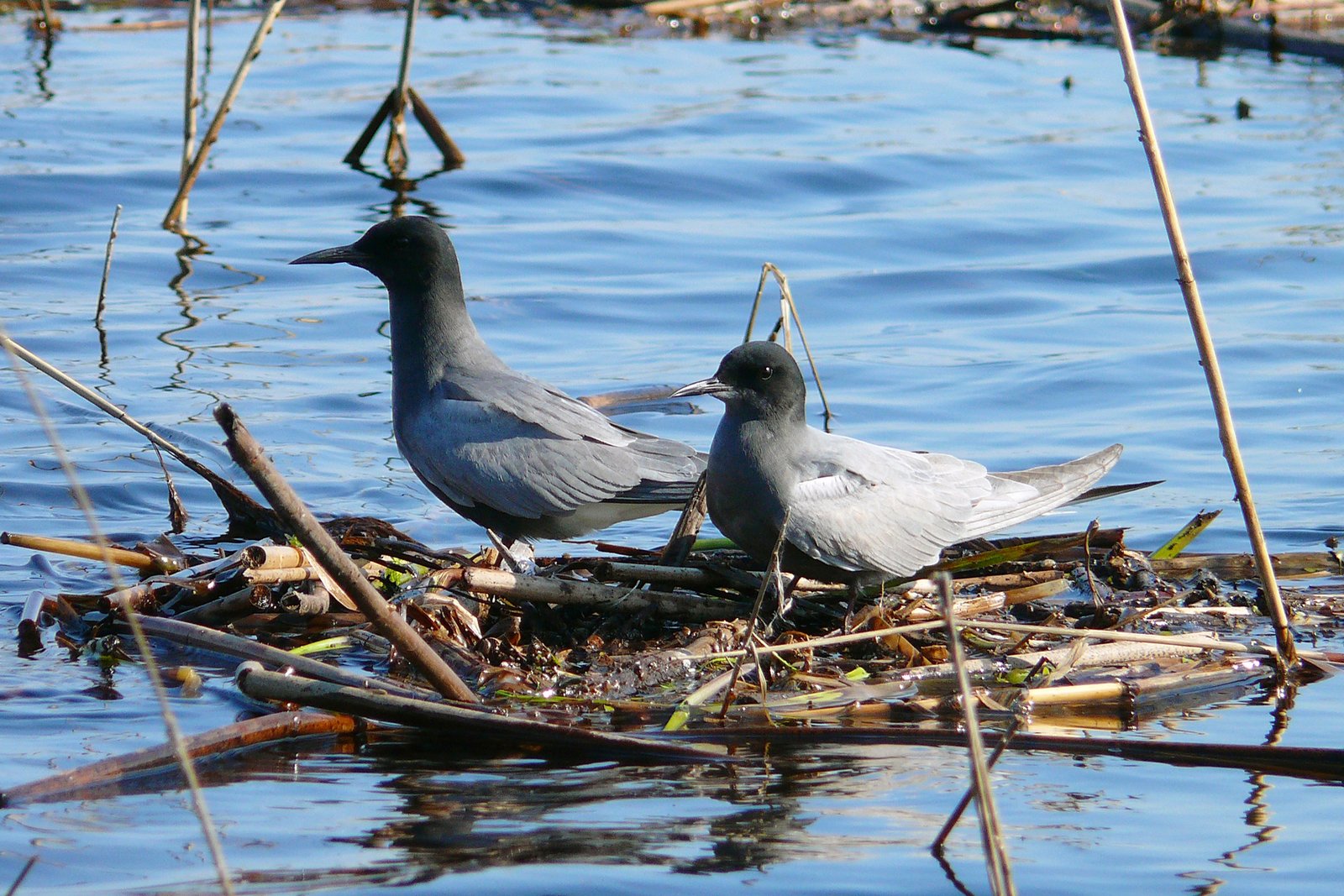
23–28 cm, small, with a short, slightly notched tail and a thin black bill. In breeding plumage the head and underparts are sooty black, with white undertail coverts, and the back, wings and tail are dark slate grey; the underwing is pale grey. In winter plumage, in which most birds appear here, the forehead and underparts are white, with a black hindcrown and ear patch forming a cap, and a characteristic dark patch on the side of the breast. Juveniles resemble winter adults but have brown-scalloped upperparts. Birds moulting into or out of breeding plumage are blotched black and white. Legs dark red.
Confusion species
White-winged Tern Chlidonias leucopterus is a rare vagrant; in breeding plumage it has white wings and black underwing coverts, and in winter and juvenile plumage a white rump, no breast patch and a less complete cap. Larger terns such as Common Tern Sterna hirundo and Least Tern Sternula antillarum plunge-dive, have a deeper tail fork and lack the dark breast patch.
Habitat
In the region mainly at sea, over inshore waters and further offshore, where flocks hunt over shoals of fish or along drift lines. Also on salt pans, lagoons, freshwater ponds and reservoirs, often after bad weather. It flies lightly and buoyantly low over the water and picks prey from the surface without truly diving.
Where the bird is most at home, classified by the vegetation types of the Caribbean.





Range and movements
Passage migrant throughout the region. Most often reported from the Cayman Islands and Puerto Rico, regularly also from Cuba, the Dominican Republic, Jamaica, the Bahamas and Guadeloupe, and from the ABC Islands, San Andrés, Barbados and Trinidad. On many islands of the Lesser Antilles sightings from land are rare; numbers at sea are larger. Outside the region it breeds in the northern United States, southern Canada and in Europe and Central Asia; American birds winter along the coasts of Central America and northern South America, mainly on the Pacific side.
- Resident
- Summer visitor (c. Oct–Mar)
- Passage (Mar–Apr, Oct–Nov)
- dark = core range, pale = thinly spread
How and when to look
Seawatches from headlands and boat trips in August and September give the best chance; after storms birds are also seen on salt pans and ponds. In winter plumage the dark breast patch is the quickest feature to notice. In the Cayman Islands the species is seen relatively often during migration.
Conservation status
Not threatened, but greatly declined in North America and Europe since the 1960s through the loss of marshes on the breeding grounds. At sea birds can be affected by oil pollution.
Scientific name
Chlidonias niger | (Linnaeus, 1758)
Linnaeus described the species in 1758 as Sterna nigra; because it was later moved to another genus, the author and year stand in brackets. The genus Chlidonias was introduced in 1822 by Rafinesque. Chlidonias is from Ancient Greek khelidonios 'swallow-like', from khelidon 'swallow'. niger is Latin for 'shining black'. The specimen the first description was based on came from near Uppsala, Sweden.