All species › Passerines › Tanagers › Blue-black Grassquit
Blue-black Grassquit | Volatinia jacarina
Jacarinagors | Semillero brincador
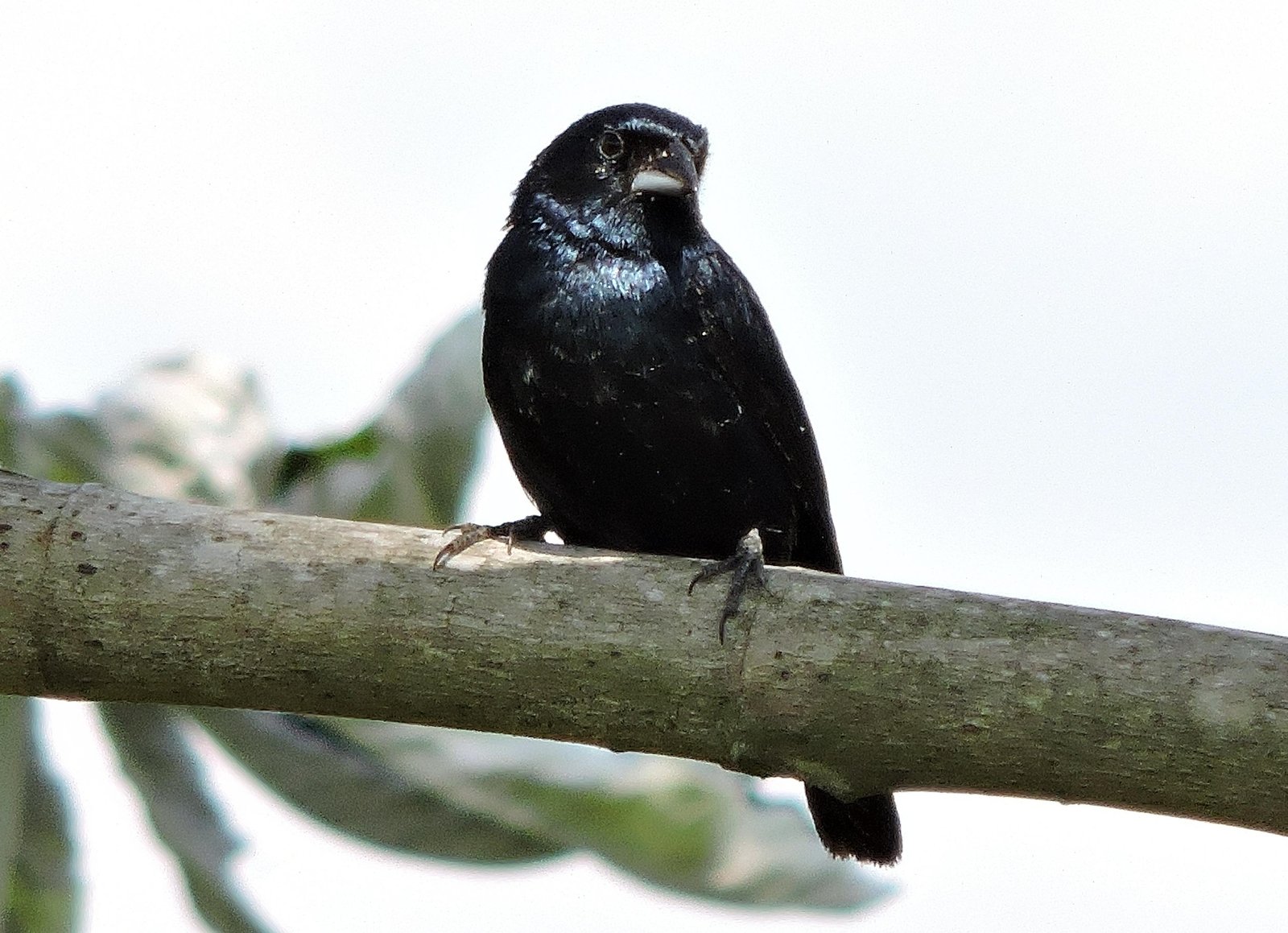
The Blue-black Grassquit is a small, seed-eating tanager of grassland and rank weeds, best known for the male's display: from a stem or wire it repeatedly jumps a short way into the air and drops back, giving a buzzy call. On Trinidad it is therefore called johnny jump-up. In the Caribbean it lives on Trinidad, Tobago and Grenada.
Voice
With every jump the male gives a buzzy, somewhat hissing dzee-oo or ee-slick, often repeated for long periods. Also a dry, soft chip.
Recording: Tristan Guillebot de Nerville — CC BY-NC-SA 4.0 · converted to mono · xeno-canto
Identification
10–11 cm, with a short, pointed, conical bill. The breeding male is entirely black with a blue gloss; wings and tail are dull black. A white patch on the underwing is usually visible only in flight or during the jump. Outside the breeding season the male is brown with black blotches. The female is warm brown above with faint dark streaks, and warm buff below with a band of dark streaks across the breast. Juveniles resemble the female but are more heavily streaked below.
Confusion species
Male Black-faced Grassquit Melanospiza bicolor has a black face and breast but an olive-grey back and no blue gloss; the female is plain olive-grey and unstreaked. Sooty Grassquit Asemospiza fuliginosa is larger and dull sooty grey. Seedeaters such as Lined Seedeater Sporophila lineola and Yellow-bellied Seedeater Sporophila nigricollis have a short, thick, rounded bill; their females are unstreaked.
Habitat
Grassy weedy areas, savanna, pastures, field edges, waste ground, roadsides and dry scrub in the lowlands. It avoids closed forest. It eats mainly grass seeds, taken on the ground or from the seed heads, and in the breeding season also insects. The nest is a small cup low in grass or a bush.
Where the bird is most at home, classified by the vegetation types of the Caribbean.





Range and movements
A common resident on Trinidad, Tobago and Grenada. There are a few records from Bonaire and Curaçao, as a rare visitor. Outside the region from northern Mexico through Central America and much of South America to northern Argentina and Chile.
- Resident
- dark = core range, pale = thinly spread
How and when to look
In the rainy season on almost any grassy waste ground and along roadsides, where displaying males perch on posts and wires and keep jumping up. Females are often noticed only when they flush from the grass.
Conservation status
Not threatened. A widespread species that benefits from deforestation, pastures and other open, man-made habitats.
Scientific name
Volatinia jacarina | (Linnaeus, 1766)
Linnaeus described the species in 1766 as Tanagra jacarina; because it was later moved to another genus, the author and year stand in brackets. The genus Volatinia was introduced in 1850 by Reichenbach. Volatinia is a diminutive of Latin volatus 'flight, flying', after the male's short leaping display flights. jacarina comes from Tupí, where it was a name for a kind of finch. The specimen the first description was based on came from northeastern Brazil.