All species › Gannets and cormorants › Gannets and boobies › Brown Booby
Brown Booby | Sula leucogaster
Bruine gent | Piquero pardo
The Brown Booby is the commonest booby in the Caribbean and the only one that regularly fishes close inshore. It perches on buoys, pilings and rocks, flies low in lines over the water and plunges at an angle into shallow water. Birds in the region belong to the Atlantic nominate form, Sula leucogaster leucogaster.
Voice
Silent at sea. At the colony the male gives a high, whistled schweee, the female a low, hoarse quacking kwak or honking honk.
Recording: JAYRSON ARAUJO DE OLIVEIRA — CC BY-NC-SA 4.0 · converted to mono · xeno-canto
Identification
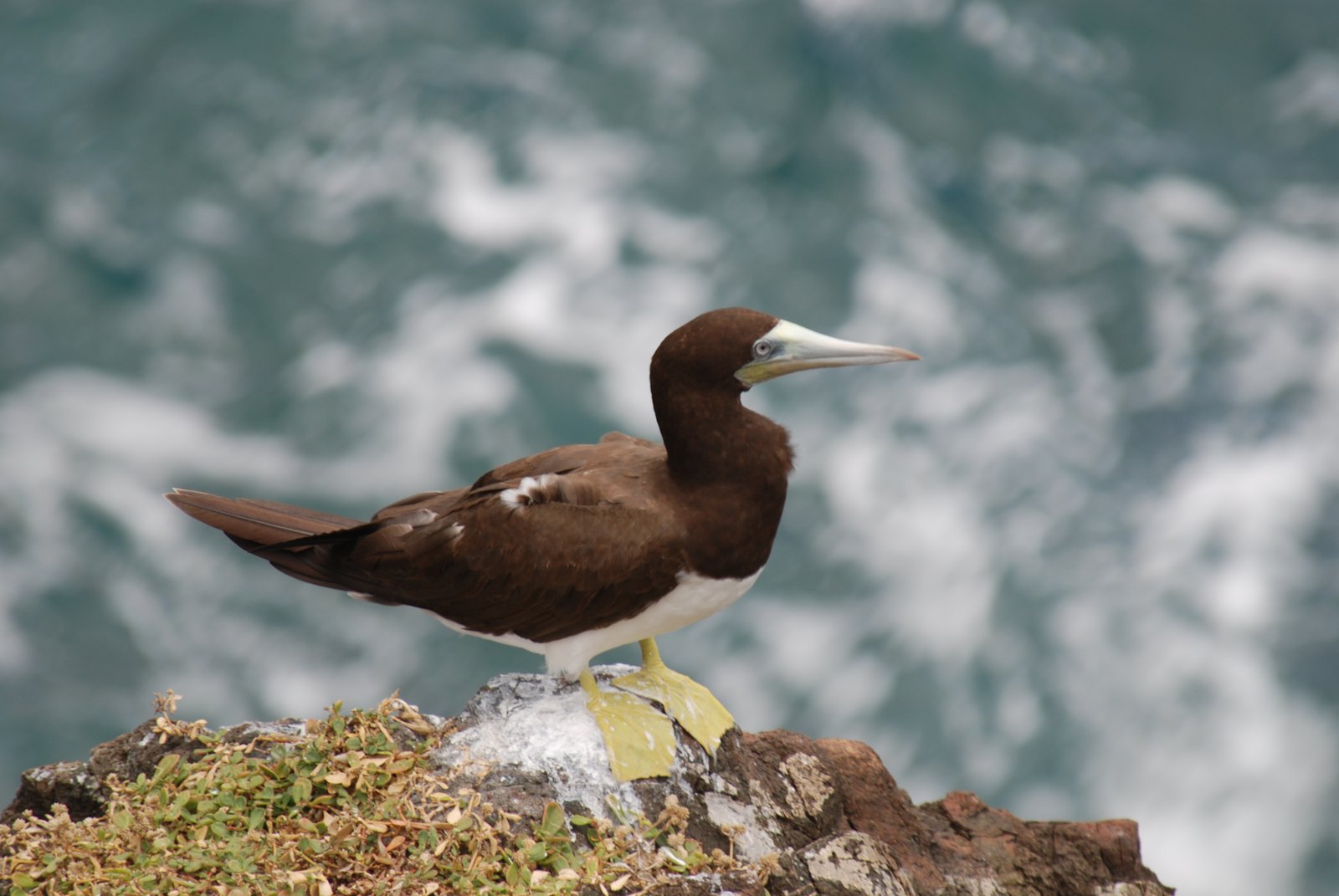
64–85 cm; females are larger than males. Head, neck, breast and upperparts are uniform dark chocolate brown, belly and undertail coverts white, with a sharp, straight border across the breast. The underwing has a white central panel with a broad dark margin. Bill and feet are yellow. The male has bluish bare skin around the eye and bill base, the female yellow. Juveniles are brown with a pale brown, mottled belly merging gradually into the breast, and a grey bill.
Confusion species
The brown morph of Red-footed Booby Sula sula has uniformly brown underparts without a sharply defined white belly, and red feet, grey-yellow in young birds. Young Masked Boobies Sula dactylatra have a white collar and white belly with a brown hood and are larger. Young Brown Pelicans Pelecanus occidentalis are much larger, with a long, flat bill. At a distance a flying young Northern Gannet Morus bassanus may also cause confusion, but it is larger and speckled white.
Habitat
Coastal waters, bays, harbours and open sea over the shelf. It often plunges at an angle from a low height and also catches flying fish above the water. It rests on buoys, boats, rocks and pilings. It breeds colonially on the ground, on rocky islets, cays and cliffs, with a nest of shell debris and plant material; of the two eggs usually only one chick is raised.
Where the bird is most at home, classified by the vegetation types of the Caribbean.




Range and movements
Year-round along the coasts of the whole region, from the Bahamas and the Turks and Caicos Islands through the Greater Antilles and the Cayman Islands to the Lesser Antilles, the ABC Islands, San Andrés and Trinidad and Tobago. Colonies are on many islets, including the cliffs of Cayman Brac, islets off Puerto Rico and the Virgin Islands, off Anguilla and in the Grenadines. Outside the region in the tropical Atlantic and the Indo-Pacific; the eastern Pacific form is sometimes treated as a separate species.
- Resident
- Summer visitor (c. Oct–Mar)
- Winter visitor (c. Apr–Sep)
- Passage (Mar–Apr, Oct–Nov)
- dark = core range, pale = thinly spread
How and when to look
In almost any harbour and on buoys offshore; inter-island ferries often give good chances to see birds hunting alongside the ship. The colony on the eastern cliffs of Cayman Brac can be seen from the path along the edge of the Bluff.
Conservation status
Not threatened. Colonies are threatened by introduced rats and cats, disturbance, the taking of eggs and chicks and entanglement in fishing gear; plastic is often found in nests.
Scientific name
Sula leucogaster | (Boddaert, 1783)
Boddaert described the species in 1783 as Pelecanus Leucogaster; because it was later moved to another genus, the author and year stand in brackets. The genus Sula was introduced in 1760 by Brisson. Sula goes back to súla, the Old Norse and Icelandic word for the gannet; the name passed to the boobies. leucogaster is Greek, from leukos 'white' and gastēr 'belly', after the white underparts. The specimen the first description was based on came from Cayenne, French Guiana.