All species › Owls › Typical owls › Burrowing Owl
Burrowing Owl | Athene cunicularia
Holenuil | Mochuelo de madriguera
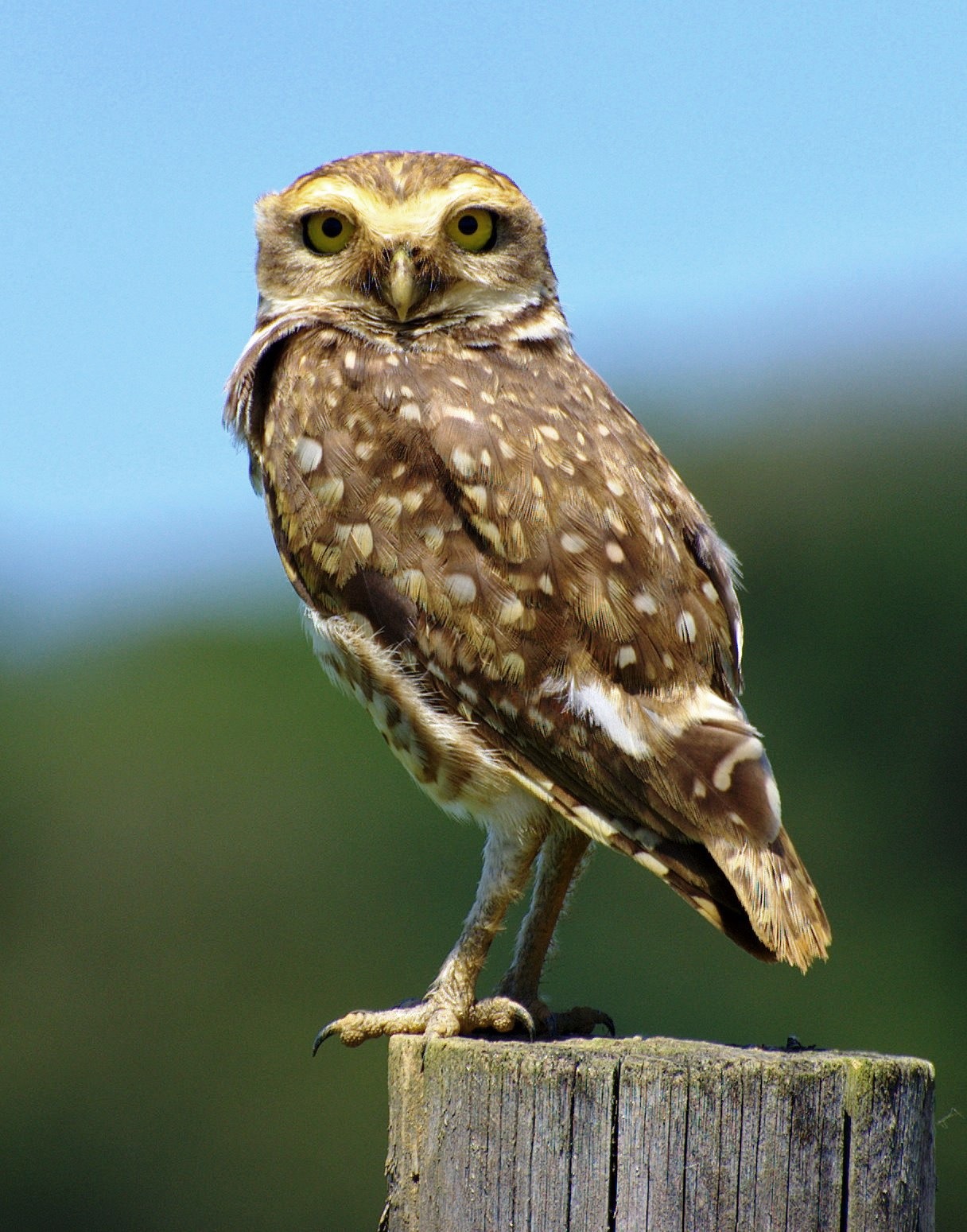
The Burrowing Owl is a small, long-legged owl of open country that nests in holes in the ground and often sits by day on a mound, post or stone. In the Caribbean, distinct subspecies live in Cuba, Hispaniola, the Bahamas and Aruba, where, as the shoco, it is a national symbol. The former populations on Antigua, St Kitts, Nevis and Guadeloupe are extinct.
Voice
A soft two-part coo-hooo, mainly at night in the breeding season. When agitated a rapid, cackling quik-quik-quik; young in the burrow give a rasping, hissing sound.
Recording: Manuel Grosselet — CC BY-NC-SA 4.0 · converted to mono · xeno-canto
Identification
19–25 cm, round and short-tailed, with a round head without ear tufts, bright yellow eyes, white eyebrows and a white throat band. The legs are long, thin and largely bare. The upperparts are brown with white spots; the underparts are pale with brown spotting and barring on the breast and flanks. Males are often paler than females through sun bleaching. Juveniles have a plain buff belly.
Confusion species
Bare-legged Owl Margarobyas lawrencii also has bare legs, but has dark eyes and a streaked breast and lives in forest. Cuban Pygmy Owl Glaucidium siju is smaller and longer-tailed, with short feathered legs. Short-eared Owl Asio flammeus is much larger, with long wings.
Habitat
Dry, open, short-grass country: savanna, pasture, thorn scrub and cactus vegetation, open coastal scrub, also road verges, golf courses and airport margins. It hunts from the ground or a low lookout, often at dusk, for insects, lizards, small rodents and sometimes birds. On the islands it often digs its own burrow or uses holes in limestone and sand.
Where the bird is most at home, classified by the vegetation types of the Caribbean.





Range and movements
Resident in Cuba and Isla de la Juventud (locally), on Hispaniola with Gonâve and Beata (mainly in the dry south-west), on a few islands of the Bahamas and on Aruba. Extinct on Antigua, St Kitts, Nevis and Guadeloupe (Marie-Galante). Outside the region from south-western Canada and Florida to Tierra del Fuego.
- Resident
- dark = core range, pale = thinly spread
How and when to look
On Aruba on open, dry ground with cacti and in the interior, for example around Arikok, where birds sit by their burrow entrance during the day. On Hispaniola in the dry south-west of the Dominican Republic. A bird that bobs up and down when approached and then flies off low is typical.
Conservation status
Not threatened as a species. Caribbean populations are small and vulnerable to the loss of open ground, building, traffic and introduced predators such as cats, dogs and mongooses; the latter probably contributed to its extinction in the Lesser Antilles.
Scientific name
Athene cunicularia | (Molina, 1782)
Molina described the species in 1782 as Strix Cunicularia; because it was later moved to another genus, the author and year stand in brackets. The genus Athene was introduced in 1822 by Boie. Athene refers to the Greek goddess Athena, whose emblem was the owl. cunicularia is Latin for 'miner, burrower' (from cuniculus 'tunnel, rabbit'), after its nesting in burrows. The specimen the first description was based on came from Chile.