All species › Passerines › New World blackbirds › Carib Grackle
Carib Grackle | Quiscalus lugubris
Caribische troepiaal | Zanate caribeño
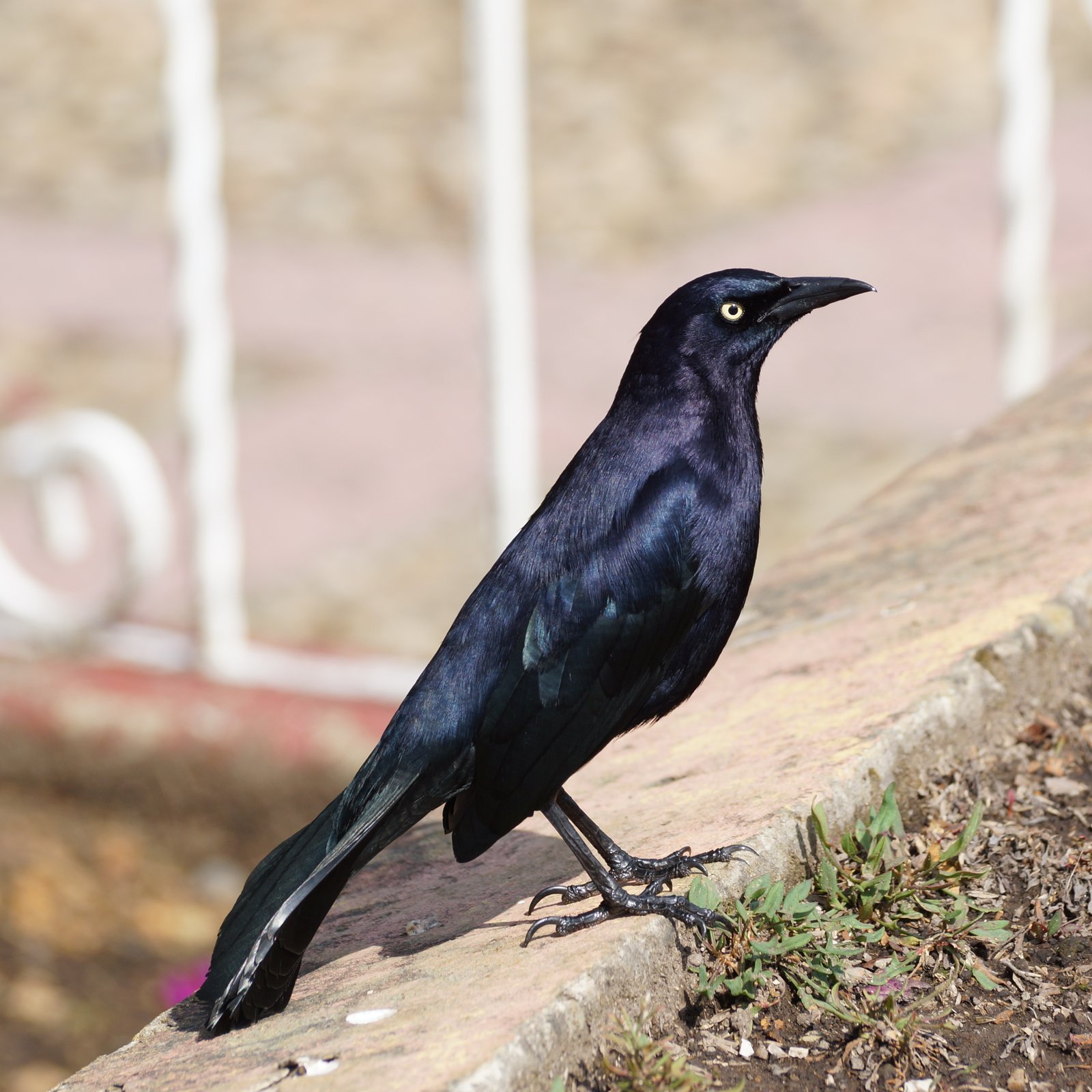
The Carib Grackle is the south-eastern counterpart of the Greater Antillean Grackle: a small, noisy grackle seen at nearly every beach bar, café and hotel in the Lesser Antilles, Trinidad and Tobago and the ABC Islands. Eight subspecies are recognised, differing in size, bill and female plumage.
Voice
A mixture of harsh and more musical ringing notes, with the characteristic bell-like tickita-tickita-tickita-ting and a rapid chi-chi-chi-chi. The song differs in dialect from island to island.
Recording: Tristan Guillebot de Nerville — CC BY-NC-SA 4.0 · converted to mono · xeno-canto
Identification
23–27 cm; the male is larger than the female. Slim, with a pointed, slightly curved bill and a keel-shaped tail, held in a V by the male. The male is glossy black with a purple, blue or greenish sheen and a bright yellow iris. On most islands the female is grey-brown, with paler underparts and a darker tail; on some islands, including Barbados, females are darker. The female also has a yellow iris. Juveniles are brown with a dark iris.
Confusion species
Shiny Cowbird Molothrus bonariensis is stockier, with a short, conical bill, a dark eye and a flat tail; the female is plain brown without a pale eye. Great-tailed Grackle Quiscalus mexicanus, established on Aruba and Curaçao, is much larger, with a far longer tail. Giant Cowbird Molothrus oryzivorus in Trinidad and Tobago is larger, with a small head and a red eye.
Habitat
Open country with trees, especially around people: villages, towns, gardens, parks, harbours, fields, pasture, plantations and coastal areas, including mangroves and coastal scrub. It eats insects, seeds, fruit, small animals and scraps and boldly takes leftovers from tables. It nests in colonies, with several deep, lined cup nests in one tree; the clutch is 2–4 eggs.
Where the bird is most at home, classified by the vegetation types of the Caribbean.





Range and movements
Resident in the Lesser Antilles from Anguilla, Sint Maarten and Saint-Barthélemy south through Antigua and Barbuda, Saint Kitts and Nevis, Montserrat, Guadeloupe, Dominica, Martinique, Saint Lucia, Saint Vincent and the Grenadines and Grenada to Barbados, and also in Trinidad, in Tobago (introduced in 1905, now common) and on Aruba, Curaçao and Bonaire. It has spread northward in recent decades. Only a single record from the Virgin Islands. Outside the region in northern South America, from Colombia to north-eastern Brazil.
- Resident
- dark = core range, pale = thinly spread
How and when to look
On almost any island in the south-east of the region at cafés, beaches and car parks. The pale eye and the male's V-shaped tail are the best features against Shiny Cowbird, which often feeds in the same company.
Conservation status
Not threatened. Common and well adapted to people; it benefits from forest clearance and building and is still spreading in the Lesser Antilles.
Scientific name
Quiscalus lugubris | Swainson, 1838
Swainson described the species in 1838 and placed it straight away in the genus where it still stands. The genus Quiscalus was introduced in 1816 by Vieillot. Quiscalus goes back to Linnaeus's species name Gracula quiscula; where he got the word is uncertain, possibly from Taíno quisqueya, a name for Hispaniola. lugubris is Latin for 'mournful', after the all-black 'mourning' plumage. The specimen the first description was based on came from Guyana.