All species › Waders, gulls and terns › Gulls and terns › Caspian Tern
Caspian Tern | Hydroprogne caspia
Reuzenstern | Pagaza piquirroja
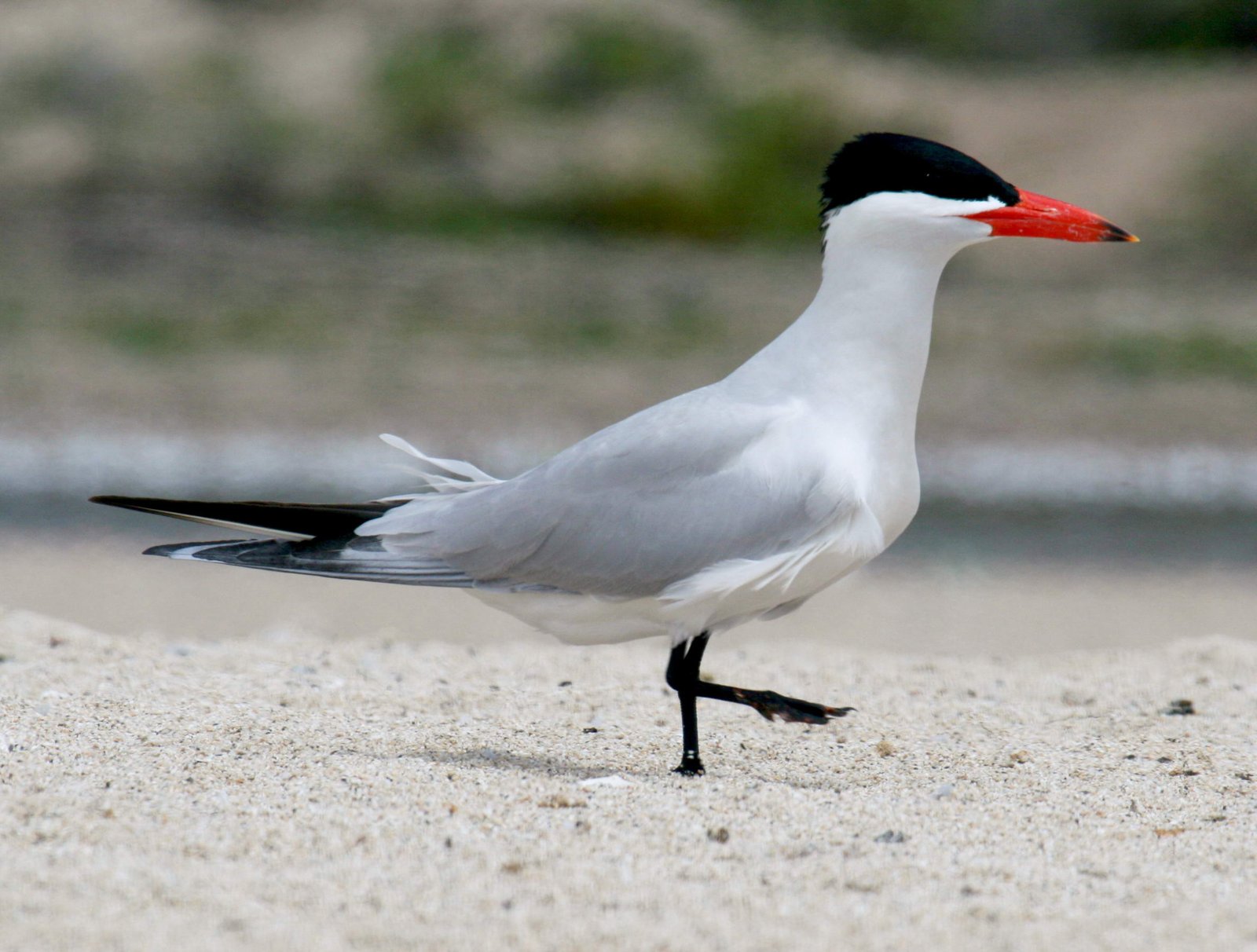
The Caspian Tern is the largest tern in the world, with a build closer to that of a gull. It breeds across five continents, in North America mainly inland and along the Gulf of Mexico. In the Caribbean it is a winter visitor and passage migrant, regular on Cuba but quickly becoming rarer further east.
Voice
A deep, raw, heron-like kraa-ah or kreeeh-ap, lower than any other tern. Juveniles following their parents give a high, whistled wheeoo.
Recording: Clément Bruneau — CC BY-NC-SA 4.0 · converted to mono · xeno-canto
Identification
48–60 cm, heavily built, with broad wings, a short, shallowly forked tail and a very thick, deep red bill with a dark smudge near the tip. In breeding plumage the cap is entirely black and without a crest; outside the breeding season, when the species is present here, the forehead is finely streaked white and the cap mottled blackish-grey, but never as white as in Royal Tern. Upperparts are pale grey, underparts white. In flight the dark grey undersides of the outer primaries form a dark patch. The legs are black. Juveniles have an orange-red bill, a brown-spotted back and a dark cap.
Confusion species
Royal Tern Thalasseus maximus is slightly smaller and slimmer, with a thinner orange bill, a short crest and, in winter, a white forehead with black confined to the hindcrown; from below the primaries are mostly pale with only a narrow dark trailing edge. Gull-billed Tern Gelochelidon nilotica is much smaller, with a short black bill. At a distance the bulky shape may suggest a gull, but gulls lack the red dagger bill and do not dive.
Habitat
Sheltered coastal waters: salt pans, lagoons, estuaries, shallow bays and mudflats, as well as large freshwater lakes and reservoirs inland. It hunts by patrolling high above the water with the bill pointed down, then plunging steeply; the diet is mainly fish. It roosts on sandbars and small beaches, often among Royal Terns and gulls.
Where the bird is most at home, classified by the vegetation types of the Caribbean.




Range and movements
On Cuba a fairly common winter visitor and passage migrant, mostly along the north coast and in the large lagoons. Regular in small numbers in the Bahamas, the Dominican Republic, the Cayman Islands and Jamaica; rare on Puerto Rico, Haiti, the Turks and Caicos Islands, San Andrés and the ABC Islands. There are only a handful of records from Trinidad and the Lesser Antilles, including Guadeloupe and Martinique. Breeds in North America, Europe, Asia, Africa and Australia; North American birds winter from the southern United States to Central America and northern South America.
- Resident
- Winter visitor (c. Apr–Sep)
- Passage (Mar–Apr, Oct–Nov)
- dark = core range, pale = thinly spread
How and when to look
The salt pans and coastal lagoons of Cuba in winter offer the best chance, for example on the Zapata Peninsula. In resting flocks of terns it stands out by its thick red bill and dark cap; in flight the dark underside of the primaries is the best feature. The low, raw call is often heard before the bird comes into view.
Conservation status
Not threatened. The world population is large and has increased in North America in recent decades, although large colonies are vulnerable to disturbance, flooding and conflicts with fisheries. Only non-breeding birds occur in the Caribbean.
Scientific name
Hydroprogne caspia | (Pallas, 1770)
Pallas described the species in 1770 as Sterna caspia; because it was later moved to another genus, the author and year stand in brackets. The genus Hydroprogne was introduced in 1829 by Kaup. Hydroprogne joins Greek hudro- 'water' to Latin progne 'swallow'. caspia is Latin and refers, like the English name, to the Caspian Sea. The specimen the first description was based on came from Caspian Sea.