All species › Hummingbirds and swifts › Swifts › Chimney Swift
Chimney Swift | Chaetura pelagica
Schoorsteengierzwaluw | Vencejo de chimenea
The Chimney Swift breeds in eastern North America and winters in the western Amazon basin. On its way there and back part of the population crosses the western Caribbean islands, where the species turns up briefly in spring and autumn. It is a small, dark swift that hunts with rapid, stiff wingbeats and short glides. In North America it breeds and roosts mainly in chimneys, formerly in hollow trees.
Voice
A dry, rapid chipping, chip-chip-chip-chip, often speeding up into a twittering series; also single chip notes. Flocks on migration call a great deal.
Recording: Stanislas Wroza — CC BY-NC-SA 4.0 · shortened to the first 60 s, mono · xeno-canto
Identification
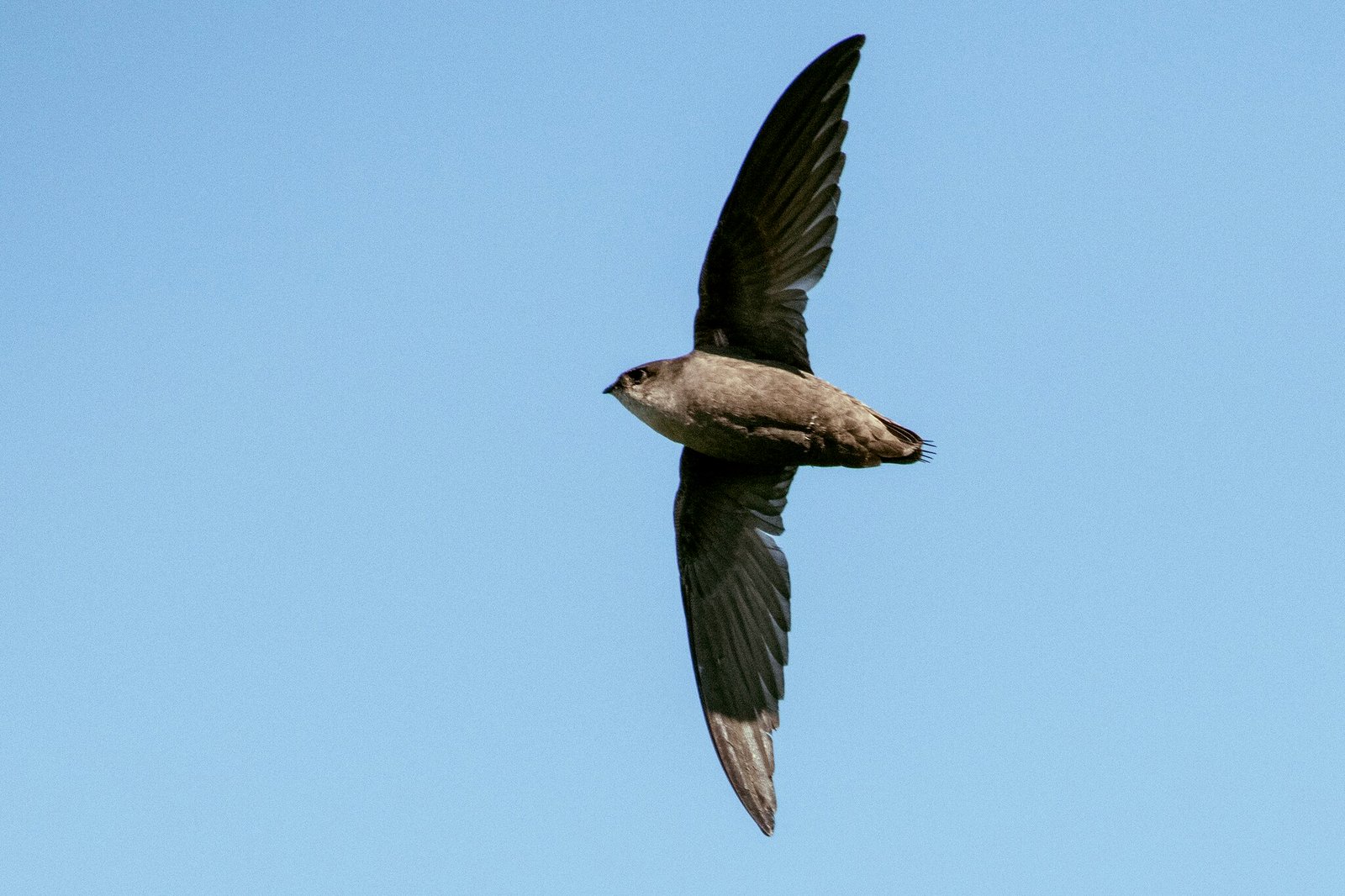
12–15 cm, with a cigar-shaped body, long, narrow, slightly curved wings and a short, rounded tail with spiny feather shafts. The plumage is uniform dark grey-brown, with a slightly paler throat and breast and a rump hardly paler than the back. The sexes are alike. In flight, fast, fluttering beats alternate with short glides; the wings sometimes appear to beat out of step.
Confusion species
Lesser Antillean Swift Chaetura martinica of the central Lesser Antilles is smaller, with a pale grey rump contrasting with the dark back. Short-tailed Swift Chaetura brachyura and Grey-rumped Swift Chaetura cinereiventris from the south also have a clearly paler rump, and Short-tailed has a very short tail. Antillean Palm Swift Tachornis phoenicobia is much smaller, with white on the rump and underparts. American Black Swift Cypseloides niger is larger and blacker, with a longer, slightly forked tail and slower flight.
Habitat
On migration in the airspace over almost any landscape: towns and villages, open farmland, coastal plains, lakes and forest edges. It hunts small flying insects on the wing, often together with swallows. It roosts communally in chimneys, hollow trees or other vertical cavities.
Where the bird is most at home, classified by the vegetation types of the Caribbean.





Range and movements
A rather scarce but regular passage migrant in the Bahamas, Cuba, the Cayman Islands and San Andrés, where the route between North and South America crosses the west of the region. Also recorded regularly on Aruba. A rare visitor to Hispaniola, Puerto Rico, the Virgin Islands, the Turks and Caicos Islands, Jamaica, some islands of the Lesser Antilles (including Barbados, Guadeloupe and Dominica), Curaçao, Bonaire and Trinidad and Tobago. Breeds in the eastern United States and south-eastern Canada; winters mainly in Peru, Ecuador, western Brazil and northern Chile.
- Summer visitor (c. Oct–Mar)
- Passage (Mar–Apr, Oct–Nov)
- dark = core range, pale = thinly spread
How and when to look
The best chance is in April and May and from late August to October, in Cuba, the Caymans and the Bahamas, especially after a front has passed. Single swifts among swallows over ponds or open ground are worth checking; the uniformly dark rump and short tail separate this species from the other swifts in the region.
Conservation status
Vulnerable on the IUCN Red List. The breeding population has declined steeply since the 1960s. Possible causes include the decline of flying insects, the loss or capping of suitable chimneys for nesting and roosting, and storms during migration. No specific threats are known in the Caribbean.
Scientific name
Chaetura pelagica | (Linnaeus, 1758)
Linnaeus described the species in 1758 as Hirundo Pelagica; because it was later moved to another genus, the author and year stand in brackets. The genus Chaetura was introduced in 1826 by Stephens. Chaetura is Greek, from khaitē 'hair, bristle' and oura 'tail', after the spiny projecting shafts of the tail feathers. pelagica is Latin for 'of the open sea' (Greek pelagikos); an odd name for a land bird, perhaps alluding to its wandering habits. The specimen the first description was based on came from South Carolina, United States.