All species › Cuckoos › Cuckoos › Common Squirrel Cuckoo
Common Squirrel Cuckoo | Piaya cayana
Eekhoornkoekoek | Cuclillo canela
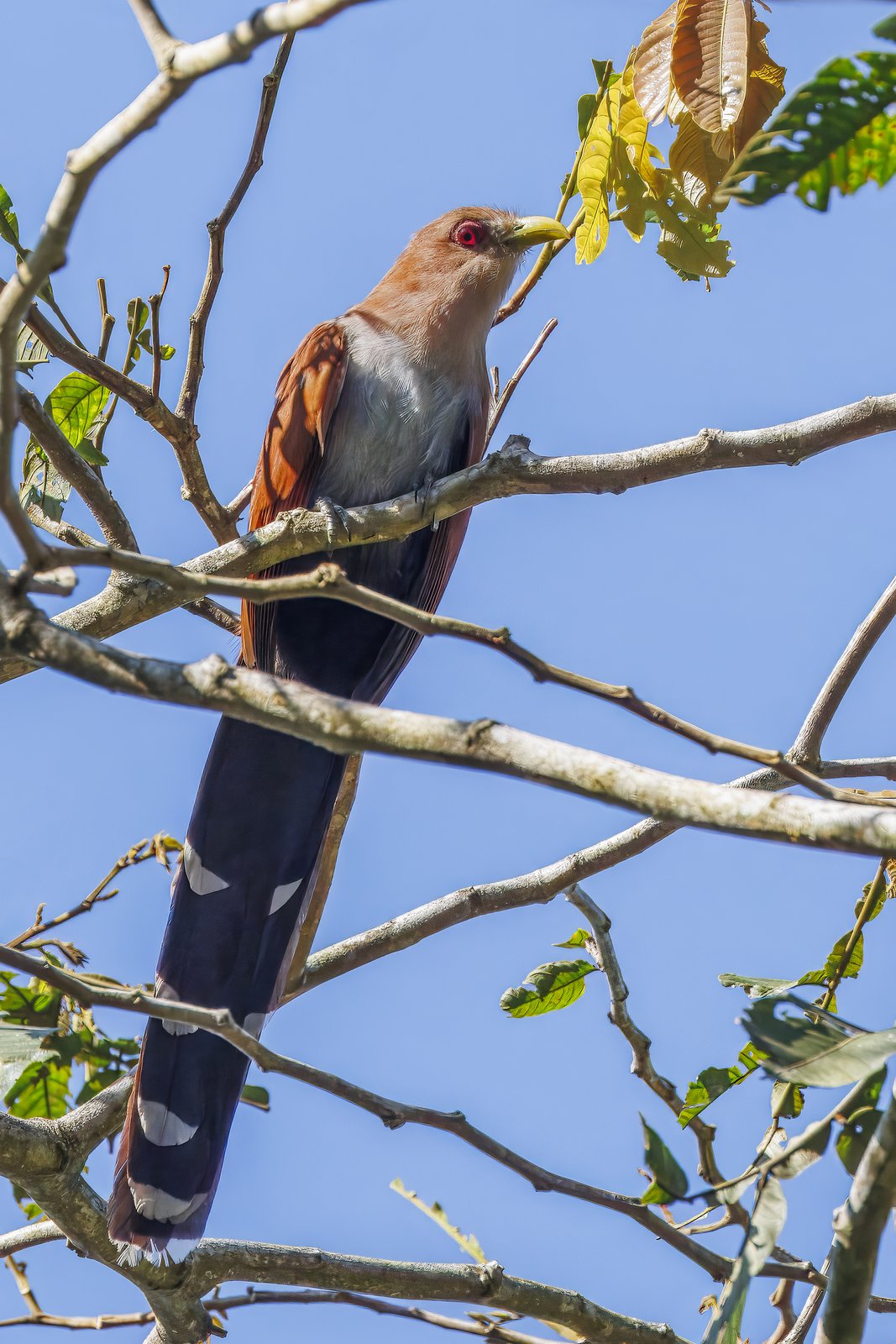
The Common Squirrel Cuckoo is a large, chestnut cuckoo with a very long, graduated tail that clambers and leaps through the branches like a squirrel. In the region it occurs only in Trinidad, where it lives in almost every forested area, from the lowlands up into the Northern Range. Despite its size and colour it is often hidden in foliage, but its loud calls and long tail give it away.
Voice
A sharp, explosive kip! and a two-part kip weeoo, the second part falling; these calls are often given as the bird moves from branch to branch. The song is a series of loud whistled notes, wheep wheep wheep wheep, which can be kept up for a long time and carries far through the forest.
Recording: Jacob Wijpkema — CC BY-NC-SA 4.0 · converted to mono · xeno-canto
Identification
40–50 cm, more than half of it tail. Head, neck and upperparts are bright chestnut, the throat paler rufous; the lower breast is grey, the belly dark grey to blackish. The long tail is graduated: the central feathers are rufous, the outer ones black with broad white tips, so that the underside shows a ladder pattern of black and white bands. The bill is stout, slightly curved and yellow to yellowish green; the eye is red. The wings are short and rounded. The sexes are alike; young birds are duller, with less contrast in the tail. The subspecies in Trinidad is Piaya cayana insulana.
Confusion species
Little Cuckoo Coccycua minuta has the same warm colour, but is much smaller, with a much shorter tail, and lives low in mangroves and wet scrub. Striped Cuckoo Tapera naevia is streaked and crested. With its chestnut upperparts, grey and blackish underparts and very long, black-and-white banded tail, the Common Squirrel Cuckoo is distinguishable from other species in Trinidad.
Habitat
Forest of all kinds, primary and secondary: moist deciduous forest, lowland and montane rainforest, gallery forest, forest edges, hedgerows, cacao and coffee plantations with shade trees and large wooded gardens. It moves through the canopy and middle storey with leaps and short runs along branches and lianas, and flies only short distances, mainly gliding with an occasional flap. It eats large insects, especially caterpillars, as well as spiders and occasionally small lizards; prey is taken off the foliage with a quick lunge. It sometimes joins mixed-species foraging flocks. The nest is a shallow platform of twigs and leaves, one to twelve metres up in a tree; both parents incubate the two or three white eggs for about eighteen days.
Where the bird is most at home, classified by the vegetation types of the Caribbean.




Range and movements
In the region only in Trinidad, in almost all forested areas of the island, from the lowlands up into the Northern Range; it is absent from Tobago. Outside the region in wooded country from northwestern Mexico through Central America into South America, to northern Argentina and Uruguay; from sea level to about 2,500 m.
- Resident
- dark = core range, pale = thinly spread
How and when to look
In the forest of the Northern Range, for example in the Arima Valley, and in forest edges and cacao plantations in the lowlands. The bird is often first noticed by the long tail hanging out of the foliage or by the explosive kip!. It moves unhurriedly and, once found, often gives good views, especially when it glides from tree to tree across an opening.
Conservation status
Not threatened. The species has a very large range and also occurs in secondary forest and in farmland with trees. In Trinidad it is a familiar bird of the forested areas.
Scientific name
Piaya cayana | (Linnaeus, 1766)
Linnaeus described the species in 1766 as Cuculus cayanus; because it was later moved to another genus, the author and year stand in brackets. The genus Piaya was introduced in 1830 by Lesson. Piaya comes from Piaye, 'devil (bird)', the Creole name in Cayenne for the Squirrel Cuckoo, regarded as a bird of ill omen. cayana refers to Cayenne in French Guiana, where the type specimen came from. The specimen the first description was based on came from Cayenne, French Guiana.