All species › Falcons › Falcons › Crested Caracara
Crested Caracara | Caracara plancus
Kuifcaracara | Caracara quebrantahuesos
The Crested Caracara is a large, long-legged falcon that behaves more like a vulture or a crow than a falcon. It spends much time walking on the ground, feeds on carrion and patrols roads for road kill, but also catches small animals. Birds in the Caribbean belong to the northern form cheriway, formerly treated as a separate species; this guide follows the broader concept. In Cuba it is called caraira, in the ABC Islands warawara.
Voice
Usually silent. At the nest and in disputes a dry, rattling krrrak-krrrak, given while throwing the head back onto the back.
Recording: Franco Vushurovich — CC BY-NC-SA 4.0 · converted to mono · xeno-canto
Identification
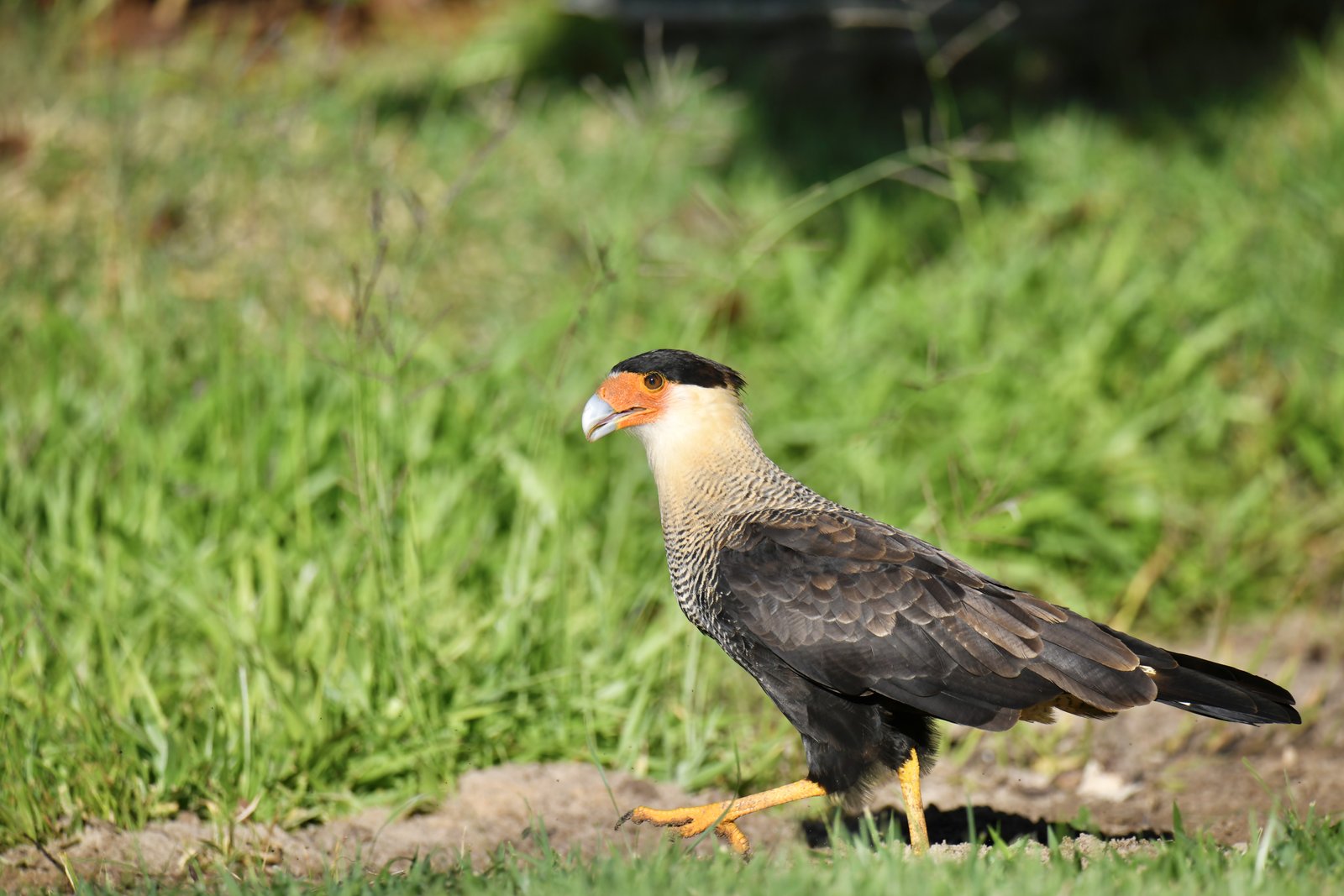
50–65 cm, with a large head, long yellow legs and broad wings. Crown and short crest are black, the bare face red to orange, the heavy bill bluish grey with a pale tip. Throat, cheeks and neck are dirty white, the breast and upper back white with fine black bars, the rest of the body blackish brown. In flight four pale areas stand out: pale patches near the wingtips plus the white neck and tail; the tail is finely barred with a broad black terminal band. Juveniles are browner, streaked rather than barred on the breast and back, with a greyish or pinkish face. The sexes are alike.
Confusion species
No other raptor in the region combines a black cap, a red face and white patches in the hand and tail. Black Vulture Coragyps atratus also has white patches near the wingtips, but is all black with a short tail and a grey bare head. Turkey Vulture Cathartes aura soars with the wings in a V and has two-toned underwings. Savanna Hawk Buteogallus meridionalis on Trinidad is rufous with a black tail band.
Habitat
Open country: savanna, palm savanna, pasture, farmland, dry scrub and cactus scrub, also roadsides, rubbish dumps and the edges of marshes. It searches on foot or from a perch for carrion, reptiles, small mammals, birds, eggs and large insects, and robs other raptors and vultures. The nest is an untidy platform of sticks in a palm, a tree or a large cactus.
Where the bird is most at home, classified by the vegetation types of the Caribbean.





Range and movements
Common resident in Cuba and the Isla de la Juventud, mainly in the open lowlands, and on Aruba, Curaçao and Bonaire. On Trinidad it has been seen increasingly often since about 2010, mainly in open country in the centre and east; rare on Tobago. Elsewhere in the region at most a vagrant. Outside the region from the southern United States through Mexico and Central America to Tierra del Fuego.
- Resident
- dark = core range, pale = thinly spread
How and when to look
In Cuba best in the savannas and pastures of the west and centre of the island, for example around Zapata, where birds sit on palms and fence posts or walk along the road. On Curaçao and Bonaire the species is common along roads and at rubbish dumps.
Conservation status
Not threatened. The species benefits from forest clearance and cattle ranching and appears to be spreading on Trinidad. Locally it is shot or poisoned, and road traffic takes a toll.
Scientific name
Caracara plancus | (Miller, 1777)
Miller described the species in 1777 as Falco Plancus; because it was later moved to another genus, the author and year stand in brackets. The genus Caracara was introduced in 1826 by Merrem. Caracara comes from an onomatopoeic Tupi-Guaraní name, via Marcgrave (1648), after the harsh call. plancus is Latin for 'flat-footed'; in Pliny the name of a kind of eagle. The specimen the first description was based on came from Tierra del Fuego.