All species › Birds of prey › Hawks, eagles and kites › Cuban Black Hawk
Cuban Black Hawk | Buteogallus gundlachii
Cubaanse zwarte buizerd | Gavilán batista
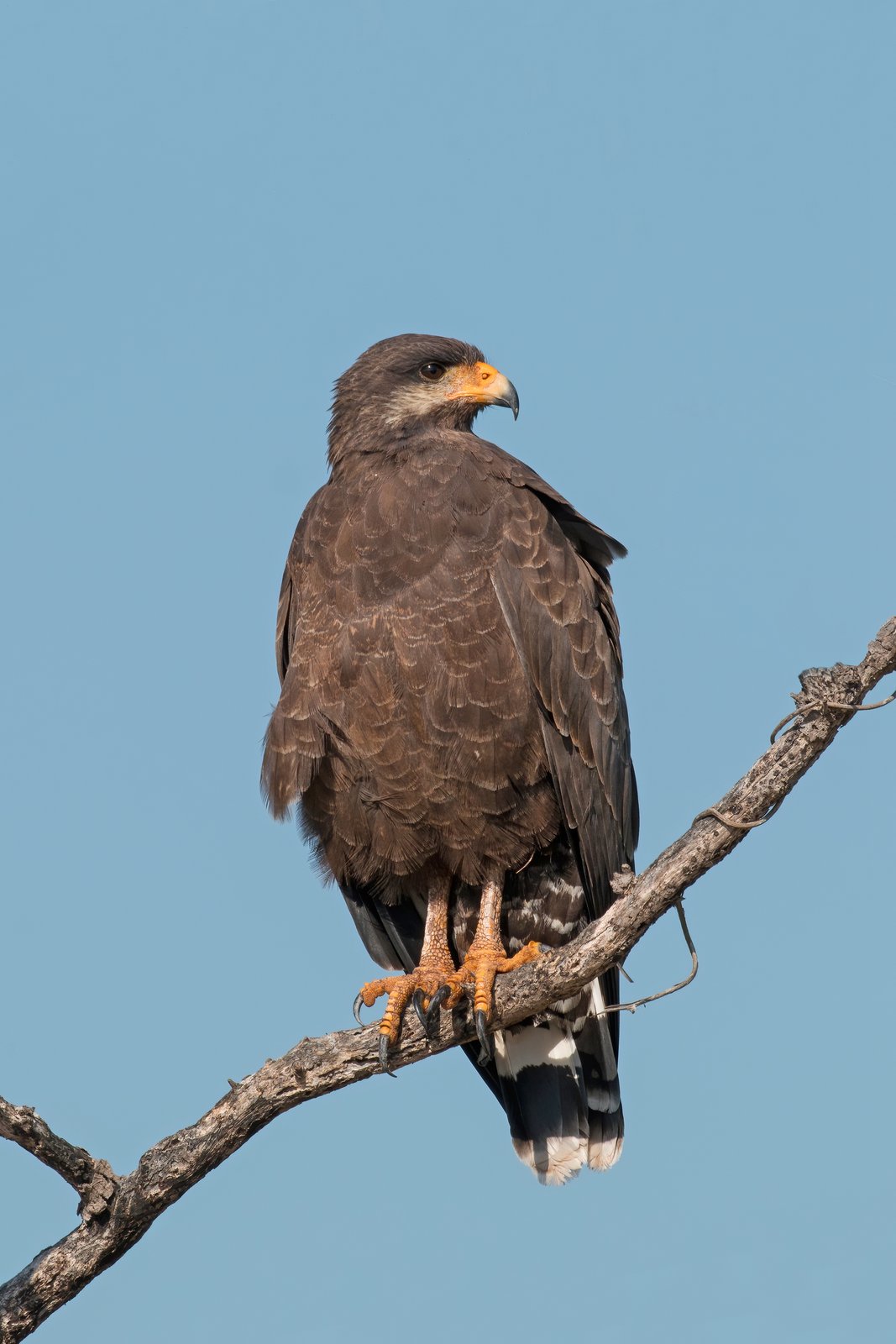
The Cuban Black Hawk is a large, dark hawk of the coasts and mangroves of Cuba. It was long treated as a subspecies of Common Black Hawk Buteogallus anthracinus, but differs in voice and plumage and is now regarded as a separate, endemic species. In Cuba it is called gavilán batista.
Voice
A loud, squeaky weet-WEET-whew or weet-WEET-whew-puh, stressed on the second note; also a harsh scream and a cackling call.
Recording: GABRIEL LEITE — CC BY-NC-SA 4.0 · converted to mono · xeno-canto
Identification
43–52 cm; the female is larger than the male. Very broad wings and a short tail. Adults are blackish brown, the underparts slightly paler and greyer with faint barring. A pale greyish patch lies between eye and bill, and there is an indistinct white moustachial stripe. The cere, lores and legs are deep yellow to yellow-orange, the bill tip black. In flight large whitish patches at the base of the primaries show from below. The tail is black with a broad white band across the middle and a narrow white tip. Juveniles are brown above and white below with heavy dark brown streaks, and have a paler eye.
Confusion species
The only black hawk in Cuba. Turkey Vulture Cathartes aura has a bare red head, long wings with a pale trailing half and soars with wings raised in a V. Black Vulture Coragyps atratus has a bare grey head, a short tail and white patches at the wingtips, but lacks the white tail band. Juveniles may resemble young Red-tailed Hawks Buteo jamaicensis, which are slimmer, longer-tailed and show a dark belly band.
Habitat
Mangroves, coastal marshes and swamp forest, forest edges and wooded coasts, including the cays; mostly below 800 m, but locally also in hill forest further inland. It hunts from a perch or on foot, mainly for crabs, and also takes lizards, rodents, stranded fish and sometimes birds. It nests in a stick nest in a tree, often in or near mangroves.
Where the bird is most at home, classified by the vegetation types of the Caribbean.







Range and movements
Only in Cuba, the Isla de la Juventud and the larger cays off the Cuban coast, such as those of the Jardines del Rey archipelago. Along the coasts of the whole island, most numerous in large mangrove areas. A few records from the Cayman Islands probably involve vagrants.
- Resident
- dark = core range, pale = thinly spread
How and when to look
The Ciénaga de Zapata and the mangroves and causeways of Cayo Coco and Cayo Guillermo, where birds often perch low on a branch or post and are fairly confiding. The call is the quickest clue. In flight the broad wings with white primary patches and the single tail band are distinctive.
Conservation status
Near Threatened. The population is small and probably declining through the drainage and degradation of mangroves and coastal marshes, including tourist development on the cays. Disturbance at nest sites and shooting also play a role locally.
Scientific name
Buteogallus gundlachii | (Cabanis, 1855)
Cabanis described the species in 1855 as Hypomorphnus Gundlachii; because it was later moved to another genus, the author and year stand in brackets. The genus Buteogallus was introduced in 1830 by Lesson. Buteogallus is Latin, from buteo 'buzzard' and gallus 'cock, fowl'; the reason for the second part is unclear. gundlachii honours the German-Cuban naturalist Juan (Johannes) Gundlach (1810–1896). The specimen the first description was based on came from Cuba.